


If you have been seeing Blaze Runner pop up in searches and app listings, the first thing to know is that it is presented as a single player 3D racing game built around desert tracks, unlockable vehicles, and level based progression. Publicly available store style descriptions are still fairly limited, which means the smartest way to understand Blaze Runner is to focus on the design choices that are already visible: fast races, obstacle-heavy routes, and a structure that seems built for mobile sessions rather than long simulation play.
- What kind of game is Blaze Runner?
- Blaze Runner gameplay style feels built for momentum
- Blaze Runner core mechanics that likely define the experience
- Why Blaze Runner stands out in a crowded racing category
- The desert setting is doing more work than people think
- Who will enjoy Blaze Runner most?
- Real world strengths and possible limitations
- Blaze Runner compared with broader arcade racing trends
- FAQ about Blaze Runner
- Final thoughts on Blaze Runner
That matters because not every racing title is trying to do the same job. Some games chase realism. Others go all in on open world freedom. Blaze Runner appears to aim for something more immediate. It leans into speed, pressure, and quick decision making, with a desert setting that naturally supports sharp turns, environmental hazards, and a strong arcade feel. The available listings mention 100 levels, multiple vehicles, customizable number plates, and smooth performance on smaller Android devices, all of which point toward a racing experience that is meant to feel accessible first and demanding second.
So what actually makes Blaze Runner stand out? The answer is not one big revolutionary feature. It is the way the game appears to combine pace, terrain reading, vehicle variation, and level design into a format that works well for players who want instant momentum. That combination gives Blaze Runner a distinct identity in a crowded mobile racing space.
What kind of game is Blaze Runner?
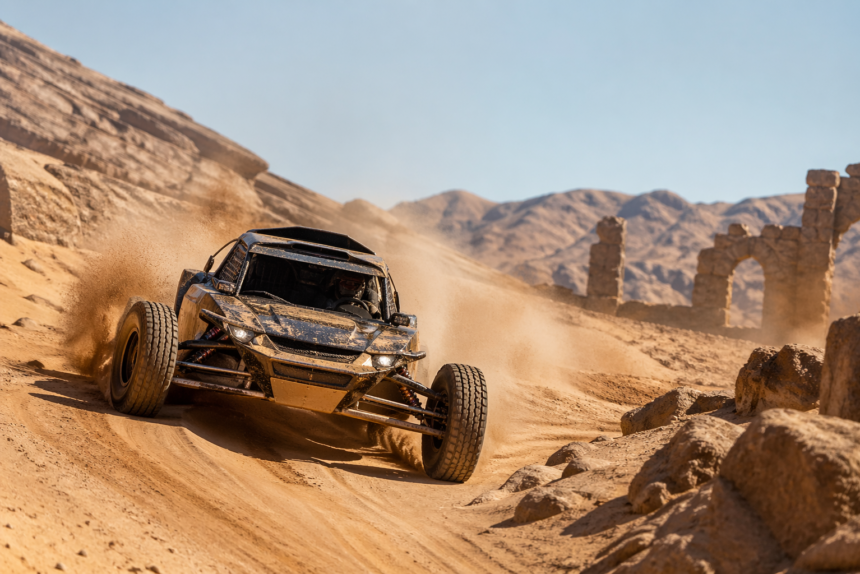
At its core, Blaze Runner is described as a high octane racing game set in a large desert environment. The published descriptions highlight dunes, rocks, ancient ruins, unlockable vehicles, and 100 levels, which suggests a structure centered on repeated mastery rather than one long campaign map.
That setup tells us a lot about its intended gameplay style.
First, Blaze Runner looks much closer to arcade racing than simulation racing. Arcade racers usually prioritize responsiveness, momentum, and readable hazards over deep realism. In games like this, you are not expected to spend half your time tuning suspension settings or studying tire wear. You are expected to react quickly, stay on line, and survive the course.
Second, the level count matters. A 100 level structure usually means the game is built around repeatable challenge loops. Each stage likely asks the player to improve route choice, refine timing, and adapt to tighter turns or denser obstacle placement. That is a different philosophy from open world racers, where progression often comes from exploration or event variety rather than compact level mastery.
Third, the desert setting is not just cosmetic. Sand, ruins, narrow paths, and rocky obstacles are the kind of environmental ingredients that can shape how a racing game feels second to second. In a city racer, the drama often comes from traffic or lane changes. In Blaze Runner, the drama seems more likely to come from terrain rhythm and obstacle awareness.
Blaze Runner gameplay style feels built for momentum
The best way to describe the gameplay style of Blaze Runner is momentum driven arcade racing.
Everything in the available descriptions points in that direction. The game promises intense obstacles, precision driving, sharp turns, and visually immersive desert routes. Those are not the keywords of a slow tactical racer. They are the language of a game that wants your attention constantly engaged.
That style usually creates a very specific player experience:
- You are almost always moving at a pace that feels slightly faster than comfortable
- The challenge comes from staying in control under pressure
- The course design matters as much as the vehicle itself
- Small mistakes can cost a lot of time
- Improvement feels noticeable because repetition builds familiarity
This is where Blaze Runner seems smartest. It appears to understand that mobile racing often works best when there is no long delay before the fun starts. You open the game, pick up where you left off, race a short stage, unlock or progress something, and keep going. That rhythm fits modern mobile habits well.
A lot of mobile games struggle because they confuse quantity with engagement. They add more menus, more currencies, or more clutter than the gameplay can support. Blaze Runner, at least from its public pitch, seems more focused on core action. That is a strong choice because racing players usually remember the feel of control first and the menu system last.
Blaze Runner core mechanics that likely define the experience
When people search for Blaze Runner, they usually want more than surface level description. They want to know how it probably plays in real hands. Based on the game’s listed features, these are the mechanics that appear to sit at the center of the experience.
1. Level based progression
The 100 level structure is one of the clearest signs of how Blaze Runner is meant to be played. Instead of one huge racing sandbox, the game seems to divide progress into contained challenges.
That kind of structure does a few useful things:
- It gives players short term goals
- It makes difficulty scaling easier
- It encourages replay when a level goes badly
- It helps the game work well in short sessions
For mobile players, this is often a huge advantage. You do not need forty uninterrupted minutes to enjoy Blaze Runner. You can jump in, clear a level or two, and step away without losing the feeling of progress.
2. Precision driving
The descriptions repeatedly hint at precision driving and sharp turns. That means control accuracy is probably more important than pure speed.
In practical terms, precision driving means the game likely rewards:
- Clean corner entry
- Fast correction after near misses
- Smart path selection
- Timing over brute force acceleration
This is a big reason Blaze Runner may appeal to players who like skill expression. A racer becomes more satisfying when you can feel yourself getting better, not just stronger because of unlocks.
3. Environmental hazards
Dunes, rocks, and ancient ruins are not just visual flavor. They suggest the track itself is part of the challenge.
Hazard driven course design changes the mood of racing. Instead of simply outrunning opponents, the player is reading terrain, anticipating danger, and adjusting constantly. In a desert racer, even the empty space can become psychological pressure because it creates speed without safety.
4. Vehicle variety
The available listings mention multiple unique vehicles suited to different terrains.
If that is implemented well, it can give Blaze Runner more depth than its simple premise suggests. Vehicle variety in arcade racing works best when every option changes handling feel, not just appearance. A heavier vehicle might feel more planted through rough sections. A lighter one might be better for quick corrections. Even small differences can make replaying stages feel less repetitive.
5. Personalization
Customizable number plates are a smaller feature, but they still matter.
Customization may not change the way a car drives, yet it does increase player attachment. Even simple personalization helps a game feel less disposable. In a crowded app market, that matters more than developers sometimes realize.
Why Blaze Runner stands out in a crowded racing category
The mobile racing space is full of titles that promise speed. Not all of them create identity. What helps Blaze Runner stand out is that its pitch is focused.
It is not trying to be everything at once. It is not selling itself as a realistic motorsport sim. It is not positioning itself as a massive open world. It is not framing itself as a story heavy console experience squeezed onto a phone. Instead, Blaze Runner appears to know exactly what lane it wants to stay in: fast, level based desert racing with approachable controls and enough challenge to keep players coming back.
That focus matters for three reasons.
The first is clarity. When a game knows what it is, players understand quickly whether it matches their taste.
The second is pacing. Focused racers tend to waste less of the player’s time. They get to the fun faster.
The third is replayability. A level based skill racer can stay enjoyable longer than expected because the satisfaction comes from doing better, not just doing more.
Another detail worth noticing is performance positioning. One listing specifically notes smooth 60 FPS gameplay optimized for small Android devices. If that holds up in practice, it would be a real strength because responsiveness is everything in racing. A stylish racer that stutters loses trust immediately. A simpler racer that feels clean and responsive often wins players over.
The desert setting is doing more work than people think
It is easy to treat the desert backdrop in Blaze Runner as just a visual theme, but it likely shapes the whole game.
Deserts create a natural sense of speed because the space looks open, the colors are bold, and the terrain can shift from wide to dangerous very quickly. They also help make hazards readable. Rocks, ruin fragments, and sharp route bends stand out clearly when the environment is not overloaded with visual noise.
That is one reason the setting feels like a smart design call. Blaze Runner seems to benefit from a world that supports both spectacle and clarity. You can have dramatic scenery without making the track unreadable.
There is also a thematic fit here. Desert racing carries a built in tone of survival, endurance, and momentum. Even before you touch the controls, the setting tells you this is not a polished city circuit. It is a place where staying in control is part of the fantasy.
From a player experience perspective, that helps Blaze Runner feel more memorable. Many mobile racers blur together because they use generic roads and interchangeable environments. A desert course with ruins and rough terrain gives the game a more recognizable identity.
Who will enjoy Blaze Runner most?
Not every racing fan wants the same thing, and Blaze Runner seems best suited to a certain type of player.
You will probably enjoy Blaze Runner most if you like quick sessions, arcade pacing, and challenge that comes from course mastery. If you enjoy the feeling of replaying a stage to shave off mistakes, this kind of design can be very rewarding.
It may also be a good fit for players who want a racing game without the complexity of deeper simulation systems. You are getting the thrill of speed and obstacle management without needing to invest in technical tuning knowledge.
The game looks less suited to players who mainly want deep multiplayer competition or a richly documented progression ecosystem. Public information around Blaze Runner is still pretty limited, and the available listings do not position it as a major live service racer with broad competitive infrastructure.
That is not necessarily a weakness. Sometimes a focused single player racing game is exactly what mobile players want.
Real world strengths and possible limitations
A fair review of Blaze Runner has to acknowledge both sides.
Likely strengths
- Clear arcade racing identity
- Strong setting with desert visual appeal
- Short session friendly level structure
- Potentially satisfying precision based control loop
- Vehicle unlocks that can support replay value
- Lightweight personalization through number plates
Possible limitations
- Publicly available information is still sparse
- Store presence appears limited compared with major racing franchises
- Review volume seems low, which makes long term player reception harder to judge
- Players seeking realism or robust multiplayer may want more than Blaze Runner currently promises
That last point is important. Search interest can rise for many reasons, but a game earns lasting attention only when its core loop stays engaging after the first impression. For Blaze Runner, that likely depends on how well the handling, level design, and vehicle differences come together in actual play.
Blaze Runner compared with broader arcade racing trends
Looking at Blaze Runner through the lens of modern mobile design, it seems aligned with a familiar trend: make the core action readable, fast, and repeatable. That is a proven formula because phone gaming often happens in fragments. People play while commuting, waiting, or taking a short break. A racing title that respects that reality has a better chance of holding attention.
The available technical and descriptive notes also suggest Blaze Runner is trying to balance style with accessibility. The file size reported by AppBrain is relatively substantial for a mobile game at about 170 MB, which hints at a more visual 3D presentation rather than an ultra minimalist racer. At the same time, the game is still framed as approachable and optimized for smaller devices.
That middle ground can work very well. Players want games that look modern, but they also want something that runs smoothly and does not bury them in friction. If Blaze Runner delivers on both fronts, that would explain why its concept is easy to click with.
FAQ about Blaze Runner
Is Blaze Runner a simulation racing game?
No public description suggests that. Everything currently visible points toward an arcade style racing experience focused on speed, level progression, and obstacle handling rather than full driving realism.
What is the setting of Blaze Runner?
Blaze Runner is presented as a desert racing game with dunes, rocks, and ancient ruins shaping the race environment.
How many levels does Blaze Runner have?
Public listings describe Blaze Runner as having 100 challenging levels.
Does Blaze Runner include different vehicles?
Yes. The game is described as offering multiple unique vehicles, apparently suited to different terrain or racing needs.
Is Blaze Runner available everywhere?
Availability appears limited and inconsistent across listings. AppBrain notes that the app is not currently available on Google Play, while TapTap still lists the game and its details.
Final thoughts on Blaze Runner
In the end, Blaze Runner looks interesting because it does not overcomplicate its identity. It seems to be aiming for what many mobile racing fans actually want: fast loading sessions, readable challenge, responsive movement, and enough variety in levels and vehicles to keep the action from going flat. The desert backdrop gives the game a clear personality, and the level based structure suggests a loop built around improvement rather than empty scale.
What makes Blaze Runner stand out most is the combination of simplicity and pressure. It appears easy to understand, but not necessarily easy to master. That is often the sweet spot for arcade racing. If the controls feel as sharp as the game’s descriptions imply, Blaze Runner could appeal to players who want quick bursts of genuine challenge rather than a bloated racing app filled with distractions.
There is still limited public information around Blaze Runner, so some caution is reasonable. But based on the available evidence, the game’s core promise is clear: race hard, read the terrain, stay precise, and keep momentum alive. In a genre shaped by speed and reaction, that is a solid foundation. If you enjoy the wider history of arcade racing, Blaze Runner fits into that fast, skill forward tradition while giving it a desert flavored identity of its own.