


Owning a lot in a strata scheme means sharing more than walls. You share risk. You share liability. You share the financial consequences of decisions made by a committee you may barely know. Most lot owners never read their strata policy until something goes wrong. By then, it is usually too late to fix the gaps. Getting the right body corporate strata insurance in place is not paperwork. It is the difference between an insured loss and a catastrophic one that the entire strata pays for out of pocket. The specifics matter enormously.
Who Is Actually Responsible for What in a Strata Scheme?
This is where most property owners get confused and stay confused. The body corporate owns and is responsible for common property. Individual lot owners are responsible for everything within their lot boundaries. The dividing line is not always obvious. Is the pipe inside the wall common property or lot property? It depends on jurisdiction, the registered strata plan, and in some cases, the specific defect causing the problem.
In Australia, strata legislation varies by state. Queensland’s Body Corporate and Community Management Act, New South Wales’s Strata Schemes Management Act, and Victoria’s Owners Corporations Act each define boundaries differently. What is common property in Queensland may be lot property in NSW. An insurance policy purchased without accounting for your specific jurisdiction can leave enormous gaps.
What Does a Standard Body Corporate Policy Actually Cover?
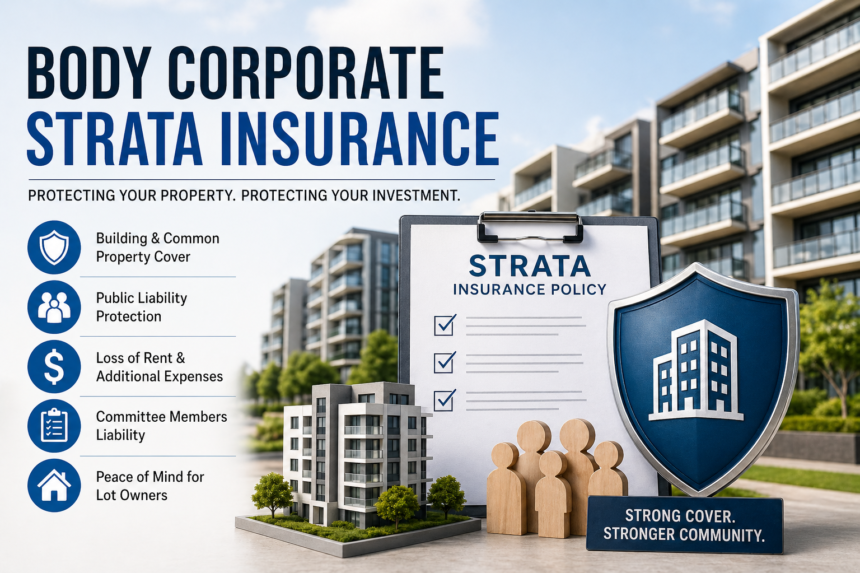
At minimum, a compliant body corporate policy covers the building itself — the structural elements, common areas, and shared services like lifts, pools, and car parks. It covers public liability for injuries that occur on common property. In most states, this coverage is legally mandatory for any scheme with a building.
The building sum insured is the figure that causes the most underinsurance problems. Many bodies corporate calculate replacement value based on market value or purchase price. These figures are completely wrong for insurance purposes. Replacement value means the cost to rebuild the entire structure from scratch to current building codes, including demolition and site clearance. The Insurance Council of Australia estimates that underinsurance affects over 80 percent of Australian strata schemes. That figure is staggering and entirely preventable.
What Risks Do Commercial Strata Schemes Face That Residential Ones Do Not?
Commercial strata — office buildings, retail centres, mixed-use developments, industrial parks — carries additional exposures. Tenant liability, machinery breakdown, loss of rent for common property, and professional indemnity for body corporate committee members all become relevant. A retail lot owner whose tenant has a fire that damages the common stairwell is in a very different legal and insurance position than a residential owner in the same situation.
Commercial strata also involves more complex ownership structures. Investors may own multiple lots. Institutional owners may have specific insurance requirements under their own lending covenants. The body corporate policy must be coordinated with individual lot policies to avoid gaps and overlaps. When both respond to the same claim, disputes about primary and excess coverage become lengthy and expensive.
Why Is Lot Owners Liability Coverage Often Overlooked?
Most lot owners assume the body corporate liability policy covers them for everything that happens in their lot. It does not. If a visitor is injured inside your lot, your personal or investment property liability policy responds first — not the body corporate policy. If you do not have adequate lot owners liability coverage, you are exposed.
In commercial strata, this exposure is amplified by the nature of business activities. A tenant’s customer slipping in a leased office space creates liability that runs through the lot owner before it reaches the body corporate. Understanding how these layers interact is not optional knowledge for a commercial property investor.
How Often Should Body Corporate Policies Be Reviewed?
At minimum, annually. Building costs change. Construction material prices spiked over 30 percent in Australia between 2021 and 2023. A policy with a sum insured calculated on 2021 replacement costs is already materially underinsured. Committees that set and forget renewal terms are taking on silent risk that only becomes visible when a claim exceeds the insured value.
Major renovations, additions to common property, changes in tenancy, and changes in the number of lots all trigger the need for an immediate policy review — not a review at the next renewal cycle. Insurance brokers who specialise in strata can identify these triggers and act on them before they become problems.
The body corporate committee is responsible for getting this right. Individual lot owners are affected by every decision the committee makes on coverage. Staying informed and pushing for proper professional advice is not just good practice. It is self-protection.