



Key Takeaways
- AI is revolutionizing business operations by automating tasks and enhancing decision-making.
- Integrating AI into core workflows is essential for achieving sustained value.
- Organizations must address challenges like legacy system modernization and workforce upskilling to leverage AI fully.
The Shift from Pilot Projects to Full-Scale AI Implementation
Artificial intelligence is no longer confined to test environments or side projects. Today, it is at the heart of digital transformation initiatives across leading companies. According to several industry reports, a growing number of enterprises are moving AI projects from the experimental phase into production environments, unlocking measurable value and streamlining complex workflows. This transition is especially apparent in operational areas encompassing everything from supply chain management to customer service and strategic planning. As AI becomes integral to achieving competitive advantage, sustained business value hinges on deep integration, not isolated efforts. Building on this momentum, platforms like C3 are helping organizations accelerate AI deployment and unlock new revenue streams by providing scalable, enterprise-grade solutions. Businesses that adopt end-to-end AI capabilities are better equipped to adapt and thrive amid digital disruption.
- Key Takeaways
- The Shift from Pilot Projects to Full-Scale AI Implementation
- AI’s Role in Transforming Enterprise Data Management
- Real-World Examples of AI-Driven Business Transformation
- Challenges in AI Adoption: Legacy Systems and Infrastructure
- Workforce Transformation and the Need for Upskilling
- Strategic Approaches to AI Integration
- The Future of AI in Business Transformation
- Conclusion
AI’s Role in Transforming Enterprise Data Management
One of the most significant drivers of business transformation is AI-enabled data management. With the rapid evolution of natural language processing and intelligent agent technologies, organizations are democratizing access to data and insights in ways unheard of just a few years ago. For example, advanced natural language queries allow executives and business users to pull up real-time reports, analyze trends, and identify emerging risks, without waiting on specialized IT teams. This immediacy enables faster, smarter decision-making, reinforcing a culture of innovation and agility throughout the enterprise. Organizations embracing these advancements discover that AI can bridge traditional knowledge gaps and reduce employee dependence on legacy systems or siloed information. In turn, this fuels the potential for new business models and operational approaches previously out of reach.
Real-World Examples of AI-Driven Business Transformation
Across industries such as healthcare, manufacturing, retail, and energy, AI solutions are creating substantial improvements in efficiency and innovation. A Microsoft report details more than 700 organizations across sectors that have adopted AI to streamline processes, automate manual tasks, and introduce new services. These case studies illustrate diverse applications of AI, from intelligent product recommendations in retail to predictive maintenance in heavy industry and enhanced fraud detection in financial services. The breadth of results makes clear that AI is a proven accelerator for business transformation. For example, leading healthcare institutions are using AI-powered diagnostic tools to simultaneously improve patient outcomes and operational efficiency. Meanwhile, global logistics companies employ AI-driven analytics to optimize delivery routes and reduce fuel consumption, reflecting the technology’s cross-sector impact.
Challenges in AI Adoption: Legacy Systems and Infrastructure
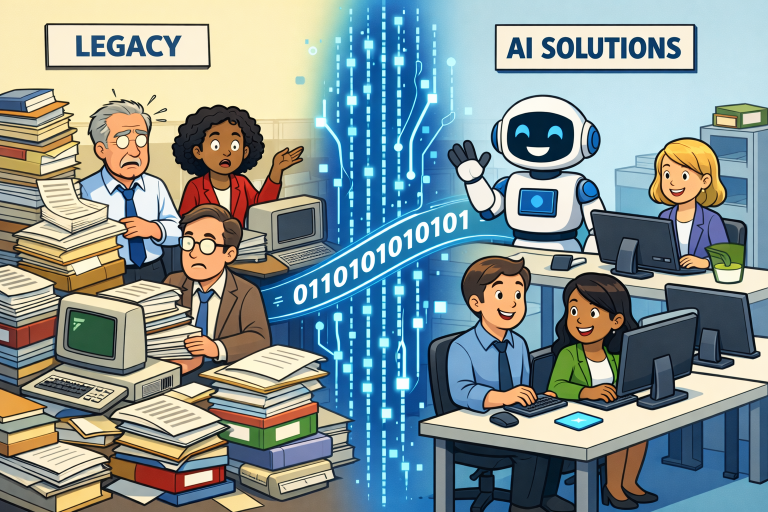
While the benefits of AI-driven transformation are substantial, overcoming infrastructure challenges remains a pressing concern. Many organizations still rely on outdated legacy systems, which can significantly hinder the adoption and scaling of AI solutions. Recent research from TechRadar found that 85% of business leaders are concerned that legacy technology will limit AI’s full potential within their organizations. Addressing these challenges requires a commitment to modernization, including both technology upgrades and change management strategies. Modernizing enterprise infrastructure involves migrating critical business processes to cloud platforms, integrating data lakes, and ensuring standardized data pipelines for seamless AI model deployment. Without these foundational investments, AI initiatives risk stagnation or limited long-term ROI.
Workforce Transformation and the Need for Upskilling
The impact of AI on the workforce cannot be overstated. As automation and intelligent systems become more prevalent, employees are required to develop new skills and adapt to rapidly changing roles. According to a recent joint study by Cisco and Omdia, more than half of the global workforce will collaborate directly with AI agents in the next two years. This shift makes workforce training and reskilling essential components of successful AI adoption strategies. Companies investing in comprehensive upskilling initiatives are best positioned to harness the integration between human creativity and computational intelligence. Forward-thinking organizations are developing in-house AI academies, forging partnerships with universities, and encouraging continuous learning to support this transition.
Strategic Approaches to AI Integration
Achieving meaningful, scalable business outcomes with AI relies on a well-planned strategy. Organizations should begin by carefully assessing existing systems and workflows, identifying where AI can deliver significant impact, and prioritizing modernization efforts where necessary. Creating a roadmap that aligns with broader business objectives ensures clarity of purpose and resource allocation. Additionally, ongoing employee education is critical for cultivating a workforce capable of adapting to emerging AI-driven roles.
- Assess and update core infrastructure to support AI deployment.
- Develop and communicate a clear AI vision linked to strategic goals.
- Invest in employee training as a foundation for innovation.
- Implement robust governance to ensure compliance with ethical standards and data privacy regulations.
The Future of AI in Business Transformation
Looking ahead, artificial intelligence will play an even more vital role in shaping global business landscapes. New advancements in machine learning, neural networks, and autonomous systems promise to unlock capabilities that extend far beyond today’s applications. Organizations that invest in foundational technology, prioritize employee enablement, and take a responsible approach to AI governance will set the benchmark for future business success.
Conclusion
AI is a transformative force in the modern enterprise, enabling automation, data-driven decision-making, and breakthrough innovation. By thoughtfully integrating AI into daily operations and mitigating the challenges posed by legacy systems and skills gaps, organizations can unlock significant value. This proactive, strategic approach will ensure long-term resilience and a sustainable competitive edge in an increasingly digital future.