


If you work with cattle, a reliable BVD Test is not just another lab check. It is one of the most practical tools for protecting herd health, fertility, calf survival, and long term farm profitability. Bovine viral diarrhea virus, often shortened to BVDV, can move quietly through a herd, and the biggest problem is that some infected animals look normal while still spreading infection. That is why modern BVD Testing focuses heavily on finding persistently infected, or PI, animals as early as possible. Diagnostic confirmation may involve virus isolation, PCR, or serology, and control programs consistently emphasize identifying and removing PI cattle.
- What Is a BVD Test?
- Why BVD Testing Matters So Much
- How the Modern BVD Test Process Usually Works
- Main Types of BVD Test Used Today
- Comparing Today’s Most Common BVD Test Options
- What Counts as “Latest Technology” in BVD Testing?
- How Labs Confirm PI Status
- Bulk Milk and Herd Level Screening
- Practical Tips for Getting Better BVD Test Results
- Common Mistakes That Weaken a BVD Test Program
- The Future of BVD Testing
- Conclusion
A good BVD Test today is far more advanced than older “wait and see” approaches. Veterinarians and diagnostic labs now combine ear notch antigen tests, individual PCR, pooled PCR, bulk milk screening, and in some cases sequencing to trace how the virus is moving. The result is faster BVD Diagnosis, smarter BVD Screening, and more confidence when herd owners make culling, isolation, and vaccination decisions.
What Is a BVD Test?
A BVD Test is any validated method used to detect the virus itself, viral genetic material, or the animal’s immune response to the virus. In plain terms, some tests look for the virus, while others look for antibodies that suggest exposure. The most useful BVD Testing programs do not rely on only one result in isolation. They match the test to the animal’s age, health status, and the real question being asked, such as “Is this calf PI?” or “Has this herd recently been exposed?”
That distinction matters. A calf with a transient infection may test positive for a short time and then clear the virus. A PI calf, by contrast, sheds virus continuously and acts as a long term source of infection for the herd. Because of that, the main goal of many BVD Test protocols is to separate transient infection from persistent infection as accurately and quickly as possible. WOAH and field programs both note that retesting after at least three weeks is part of confirming true PI status when the first result is positive.
Why BVD Testing Matters So Much
BVD is not just a diarrhea problem. It can affect reproduction, immunity, growth, and overall herd performance. Infection during pregnancy is especially important because fetal infection during a critical window can produce a PI calf that keeps shedding virus after birth. That is why a BVD Test often has value even when cattle do not look seriously ill.
This is also why BVD Screening is often built into calf management rather than waiting for a disease outbreak. A herd may look stable on the surface while one PI calf quietly increases the risk of pneumonia, scours, reproductive loss, and vaccine underperformance in the background. Good BVD Diagnosis is really about uncovering hidden risk before it becomes an expensive herd level problem.
How the Modern BVD Test Process Usually Works
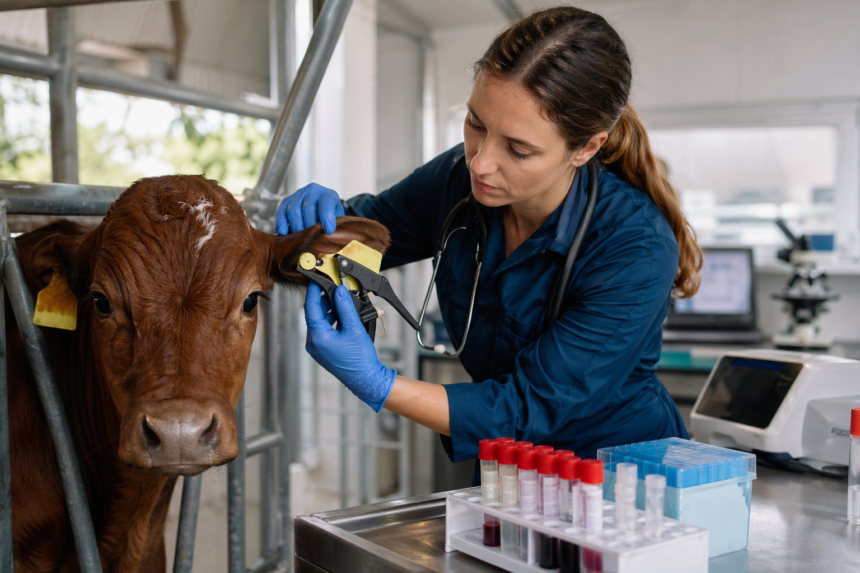
In real farm conditions, a BVD Test strategy often starts with the most efficient sample type. For newborn calves and young stock, ear notch testing is popular because it is practical, stable for transport, and highly useful for PI detection. Official guidance and diagnostic references state that ear notch skin samples work well for in vivo diagnosis of persistent infection, and antigen capture ELISA on ear notch tissue has shown reliable performance.
If the goal is finding PI animals in otherwise healthy groups, many labs now use pooled PCR on blood based samples. Cornell’s diagnostic guidance notes that pooled BVD PCR can be performed on up to 10 blood samples for PI detection in apparently healthy animals, with the lab doing the pooling and a turnaround of about 3 to 5 days. If a pool is positive, individual follow up testing is performed to identify the infected animal.
This layered approach is one reason the modern BVD Test is so effective. First, the herd is screened efficiently. Then positive pools or suspicious animals move to individual testing. That saves time and cost without losing the ability to pinpoint the source animal.
Main Types of BVD Test Used Today
Ear Notch Antigen ELISA
The ear notch antigen ELISA is one of the best known forms of BVD Testing. It detects viral antigen in tissue, and it is widely used to identify PI calves. Extension guidance notes that the ear notch ELISA is a quick test and is especially useful for PI detection, while WOAH states that skin biopsies such as ear notch samples are useful for in vivo diagnosis of persistent infection.
One practical advantage is that this BVD Test can fit easily into calf processing. Producers or veterinarians can collect the sample early, send it to the lab, and use the result to decide whether the calf should stay in the herd. In large control programs, ear notch testing has been important because it combines convenience with strong herd level surveillance value.
PCR and RT PCR
PCR based BVD Diagnosis detects viral genetic material. It is widely used for individual testing, pooled testing, and some screening applications like bulk tank milk or outbreak investigation. Diagnostic references from Cornell and extension sources note that PCR is used to identify infected cattle, especially when the aim is detecting active infection rather than only previous exposure.
PCR is especially attractive because of speed and sensitivity. Cornell lists an individual PCR turnaround of about 2 business days for some submissions, while pooled testing can be reported in about 3 to 5 days depending on the sample and testing pathway. That kind of timing makes the BVD Test much more actionable for herd owners who need to isolate animals quickly.
Serology
Serology looks for antibodies, not the virus itself. That means it can help answer herd level exposure questions, measure immunity patterns, or support investigation of reproductive disease, but it is not always the best standalone BVD Test for identifying PI calves. WOAH notes that serology is used to identify herd immunity levels, help detect PI presence at herd level, and support reproductive investigations.
Virus Isolation
Virus isolation is still part of BVD Diagnosis, but it is slower than many modern methods. Cornell lists virus isolation with a turnaround of roughly 10 to 14 days, which makes it less convenient for fast screening decisions. It remains useful in some diagnostic contexts, especially when labs want to characterize the virus more fully.
Comparing Today’s Most Common BVD Test Options
| BVD Test method | What it detects | Best use | Main strength | Main limitation |
|---|---|---|---|---|
| Ear notch antigen ELISA | Viral antigen | PI calf screening | Practical, field friendly, widely used | Positive animals may still need retesting to confirm PI status |
| Individual PCR | Viral RNA | Suspect animals, acute infection, PI confirmation | Sensitive and fast | Usually costs more than pooled screening |
| Pooled PCR | Viral RNA in grouped samples | Herd level PI screening in healthy groups | Efficient and cost conscious | Positive pools need follow up individual testing |
| Serology | Antibodies | Herd exposure and immunity assessment | Helpful for herd level investigation | Does not directly prove current virus shedding |
| Virus isolation | Live virus | Selected diagnostic investigations | Useful confirmatory tool | Slower turnaround |
This table reflects how a practical BVD Test plan is built in the real world. There is no single perfect test for every situation. The smartest programs match the test to the management question, the age of the animal, and whether the farm is doing targeted diagnosis or whole herd BVD Screening.
What Counts as “Latest Technology” in BVD Testing?
When people hear “latest technology,” they often think only of expensive machines. In reality, the biggest improvements in the BVD Treatments & BVD Test world have come from combining smart sampling with faster molecular methods.
One major step forward is pooled PCR. Instead of testing every healthy animal individually, labs can screen multiple samples together, then reflex positive pools to individual animals. Cornell specifically notes pooling up to 10 blood samples for PI detection in apparently healthy cattle, which is a strong example of how technology reduces cost without abandoning precision.
Another important development is integrated ear tissue sampling technology. In Belgium’s eradication program, newborn calves were tested using ear notch samples collected during official identification, and researchers showed that the same sampling system could support both antigen ELISA testing and later genetic analysis when the right buffer was used. That is a good example of a modern BVD Test becoming part of a wider data and traceability system rather than staying a stand alone lab event.
Sequencing is also becoming more useful in advanced investigations. A BMC Veterinary Research report on rapid nanopore whole genome sequencing showed that full genome sequencing can reveal whether cases are truly linked or genetically distinct, improving molecular epidemiology during outbreaks. For routine farms, sequencing is not yet the first line BVD Test, but for tracing transmission, studying viral diversity, and understanding outbreak connections, it represents a real technological leap.
How Labs Confirm PI Status
One of the most misunderstood parts of BVD Testing is the difference between a first positive result and a confirmed PI animal. A single positive result can reflect either persistent infection or transient infection. That is why official programs and research protocols often call for a second sample after at least three weeks. If the animal remains positive, persistent infection becomes much more likely.
This matters because management decisions are serious. A confirmed PI animal is not just sick itself. It is a reservoir that can keep exposing pen mates, breeding stock, and pregnant animals. In practice, many eradication and control systems are built around finding these animals early and removing them from the herd.
Bulk Milk and Herd Level Screening
For dairy operations, a BVD Test may also begin with bulk tank milk. Cornell notes that a positive bulk tank can reflect acutely infected cattle, one or more PI cattle, or both. The lab processes somatic cells rather than relying only on fluid milk, because viral detection can differ depending on the sample fraction.
Bulk milk is useful because it gives a quick herd level signal, but it is not the end of the story. It tells you to look deeper, not exactly which animal is responsible. That is where individual BVD Screening and follow up BVD Diagnosis become necessary.
Practical Tips for Getting Better BVD Test Results
A BVD Test is only as good as the sample and the plan behind it. Producers usually get better outcomes when they:
- test calves early, especially in herds with unknown status
- use ear notch testing for PI focused screening
- use pooled PCR only in appropriate, apparently healthy groups
- label samples clearly and avoid mixing age groups if the lab advises against it
- retest positives on the schedule recommended by the veterinarian or lab
- quarantine incoming cattle and screen them before herd entry
These steps align with diagnostic lab guidance and extension recommendations that emphasize proper sample handling, quarantine, vaccination, and follow up testing as part of real control, not just paperwork.
Common Mistakes That Weaken a BVD Test Program
A frequent mistake is assuming one negative result solves everything forever. Herd status can change when new animals are purchased, fence line contact occurs, or pregnant animals were already exposed before testing. Another mistake is using the wrong BVD Test for the wrong question, such as relying on antibody results when the actual goal is to identify a virus shedding PI calf.
Some farms also skip confirmatory testing after a positive result. That can create confusion, especially when the issue is distinguishing transient infection from persistent infection. Modern BVD Diagnosis works best when testing is connected to a clear herd protocol, not when results are interpreted one by one without context.
The Future of BVD Testing
The future BVD Test will likely become faster, more integrated, and more informative. We are already seeing better pooling strategies, smarter sampling devices, and sequencing methods that can do more than simply say “positive” or “negative.” They can also help explain where the virus came from and whether two cases are actually linked.
For producers, though, the biggest win is still simple: find PI animals early, keep biosecurity tight, and treat BVD Testing as a routine herd health tool rather than an emergency response. The technology is improving, but the goal stays the same. A timely BVD Test protects calves, supports reproduction, and reduces the chance that one hidden carrier will damage the performance of the whole herd.
In the broader conversation around bovine viral diarrhea, the science keeps moving toward earlier detection and better traceability. That is exactly why a modern BVD Test is no longer just a lab result. It is part of a smarter herd management system built on fast diagnostics, better sampling, and stronger decision making.
Conclusion
A modern BVD Test works best when technology and herd management work together. Ear notch ELISA remains a practical frontline option for PI detection, PCR improves speed and sensitivity, pooled PCR makes herd screening more efficient, and sequencing is opening the door to deeper outbreak tracing. When these tools are used correctly, BVD Testing, BVD Diagnosis, and BVD Screening become far more accurate and far more useful in day to day cattle health management.