


If you have been searching for Palate Expander Before and After results, you are probably wondering what really changes once treatment begins. Most people want honest answers. Will your smile look better? Will your face shape change? How long does it take to notice a difference? And is the transformation dramatic or more subtle than the photos online make it seem?
- What Is a Palate Expander?
- Why Orthodontists Recommend Expansion Early
- Palate Expander Before and After: What Changes First?
- How Your Smile Improves After a Palate Expander
- Does a Palate Expander Change Face Shape?
- A Realistic Before and After Timeline
- What Before and After Results Look Like in Kids vs Adults
- Common Side Effects During the Process
- Questions Patients Usually Ask Before Starting
- What Makes Before and After Results Better
- What Online Photos Often Leave Out
- Final Thoughts on Palate Expander Before and After Results
The truth is that Palate Expander Before and After results can be impressive, but they are not magic overnight changes. A palate expander works by widening the upper jaw over time, creating more room for teeth and improving how the upper and lower arches fit together. In many cases, this leads to a broader smile, better bite alignment, and even noticeable facial balance, especially in growing children. According to the American Association of Orthodontists and Cleveland Clinic, palatal expanders are commonly used to correct narrow upper jaws, crowding, and crossbites.
For patients and parents, the appeal of Palate Expander Before and After treatment is simple. It is not only about straighter teeth. It is also about giving the mouth enough space to function the way it should. That can improve chewing, make future orthodontic work easier, and in some cases reduce the severity of more complex treatment later on.
What Is a Palate Expander?
A palate expander is an orthodontic appliance designed to gradually widen the upper jaw. It usually sits on the roof of the mouth and applies gentle pressure over time. This pressure encourages the two halves of the upper jaw to separate slightly at the midline, which is how expansion happens.
Orthodontists usually recommend this treatment when a patient has:
- A narrow upper jaw
- Crossbite
- Dental crowding
- Impacted or blocked-out teeth
- A smile that appears too narrow
- Bite problems that could worsen with growth
The NHS notes that orthodontic treatment is used to improve the position, function, and appearance of teeth. A palate expander fits into that goal because it addresses jaw width, not just tooth position.
When people look up Palate Expander Before and After, they are often focused on visible changes. But function matters just as much as appearance. When the upper jaw is too narrow, the teeth may not fit together properly, and that can affect chewing, speech, and long term dental health.
Why Orthodontists Recommend Expansion Early
One reason Palate Expander Before and After searches are so common among parents is that expanders are most effective in younger patients. In children and early teens, the upper jaw is still developing, so the bones respond more easily to expansion. That makes treatment more predictable.
The American Association of Orthodontists recommends early orthodontic evaluations because some jaw and bite issues are easier to correct while a child is still growing. Expansion during the growth years can help create space, correct crossbites, and reduce the need for more invasive treatment later.
That does not mean adults are out of options. Adults can still receive expansion treatment, but it is often more complex. In some cases, adult expansion may require a different appliance or even surgical assistance, as seen in NHS patient information on surgically assisted palatal expansion.
Palate Expander Before and After: What Changes First?
When people imagine Palate Expander Before and After transformations, they often picture dramatic smile photos. In reality, the first changes are usually structural, not cosmetic.
Here is what often changes first:
1. More space between the front teeth
This is one of the most common early signs. As the upper jaw widens, a gap can appear between the upper front teeth. It may look surprising at first, but orthodontists often consider it a sign that the appliance is working.
2. A wider upper arch
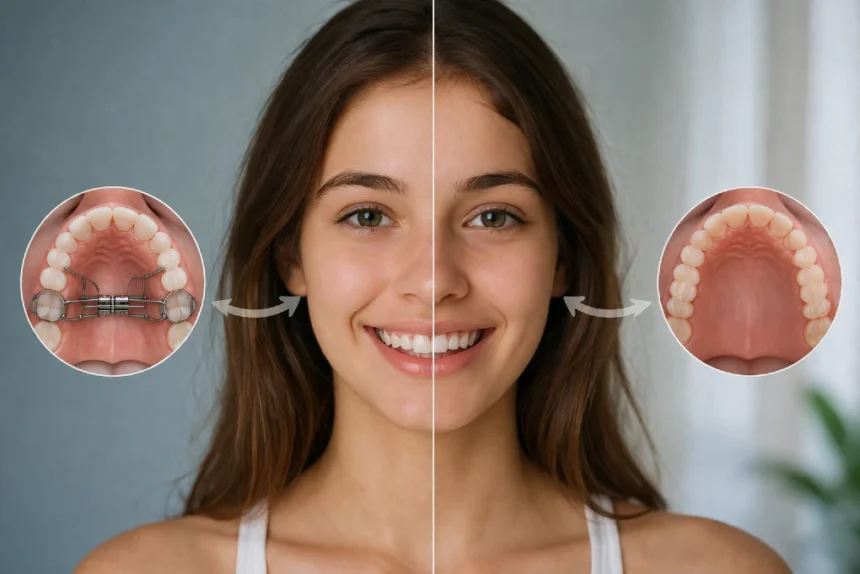
The shape of the upper dental arch gradually broadens. This gives crowded teeth more room and helps the bite fit together better.
3. Improved bite contact
Patients with a crossbite may start to notice that their upper teeth sit in a more normal position relative to the lower teeth.
4. Better room for future alignment
Some teeth that looked trapped or crowded before treatment may begin to move into a more favorable position.
This is why Palate Expander Before and After photos can look so different. The appliance is not just shifting a few teeth. It is changing the foundation those teeth sit on.
How Your Smile Improves After a Palate Expander
The smile changes people notice after expansion are often the most rewarding part of the process. A narrow upper jaw can make a smile look tight or constricted. When the upper arch widens, the smile often appears fuller and more balanced.
Common smile improvements include:
- Less crowding in the upper teeth
- Better symmetry
- A wider smile arc
- Reduced crossbite
- Better support for future braces or aligners
- More visible upper teeth when smiling
In many Palate Expander Before and After cases, the smile does not become perfect from the expander alone. Expansion is often just one stage of treatment. Braces or aligners usually follow to fine tune the tooth positions. But the difference is that those later stages become easier because the teeth now have enough room to move properly.
A simple way to think about it is this. Braces align teeth, but expanders create space. Without enough space, alignment is more difficult and sometimes less stable.
Does a Palate Expander Change Face Shape?
This is one of the biggest reasons people search for Palate Expander Before and After images. They want to know if expansion changes the face.
The short answer is yes, it can, but the degree of change varies.
In growing patients, widening the upper jaw may improve facial balance by supporting the midface more effectively. Some people notice that the smile looks broader, the cheeks appear slightly fuller, or the face looks more proportionate. These changes are usually subtle rather than extreme.
Possible facial changes can include:
- A broader looking smile
- Better midface balance
- Less pinched appearance around the upper jaw
- Improved harmony between teeth, lips, and cheeks
What it usually does not do is completely reshape the face in a dramatic cosmetic sense. Online Palate Expander Before and After photos can sometimes be misleading because lighting, angles, posture, and age can make changes look larger than they really are.
Still, when the upper jaw has been too narrow for years, even a modest increase in width can make the whole lower face and smile look healthier.
A Realistic Before and After Timeline
One of the most helpful ways to understand Palate Expander Before and After treatment is to look at the timeline.
| Treatment Stage | What You May Notice |
|---|---|
| First few days | Pressure, tightness, speech changes, extra saliva |
| Week 1 to 2 | Appliance feels more normal, possible front tooth gap |
| Weeks 3 to 8 | Upper arch widening, bite changes becoming more visible |
| 2 to 6 months | Noticeable structural improvement, better space for crowded teeth |
| After active expansion | Appliance may stay in place for retention while bone stabilizes |
| Later orthodontic phase | Braces or aligners refine tooth alignment and bite |
According to Cleveland Clinic, treatment time can range from weeks to several months, and sometimes up to a year depending on age and complexity.
That matters because Palate Expander Before and After results do not happen all at once. There is usually an active phase, followed by a retention phase, and then additional orthodontic work if needed.
What Before and After Results Look Like in Kids vs Adults
Not every Palate Expander Before and After case looks the same because age plays a big role.
Children and early teens
This group usually sees the most efficient expansion. Their growing jaws respond better, and the changes can be achieved with less resistance. Before and after improvements often include corrected crossbite, more room for permanent teeth, and better smile width.
Older teens and adults
Expansion can still happen, but treatment may require a more specialized plan. Adults may need mini implant assisted devices or surgical support in some cases. The results can still be meaningful, but the process is often slower and more complex.
So if you compare Palate Expander Before and After photos from a child and an adult, the path behind those results may be very different.
Common Side Effects During the Process
It is important to talk honestly about the awkward stage of Palate Expander Before and After treatment. The appliance can feel strange at first.
Common short term side effects include:
- Pressure in the roof of the mouth
- Mild soreness
- Temporary speech changes
- Extra saliva
- Difficulty eating certain foods
- A gap opening between the front teeth
Most of these effects improve as the patient adapts. Orthodontists typically recommend soft foods during the early days and careful brushing around the appliance.
The discomfort is real, but it is usually temporary. What makes most families stick with the process is seeing the structural improvements begin to appear within a relatively short time.
Questions Patients Usually Ask Before Starting
Will I look different right away?
Usually not in a dramatic way. Early changes are often internal or dental before they become visually obvious.
Is the gap between front teeth normal?
Yes. In many Palate Expander Before and After cases, that gap is a sign the upper jaw is widening as planned.
Can a palate expander improve breathing?
Some research has looked at how maxillary expansion affects airway dimensions, especially in younger patients, but outcomes vary and treatment should not be viewed as a guaranteed breathing cure. Orthodontic decisions should always be based on a full clinical evaluation. Research summaries can be found through PubMed.
Will I still need braces?
Very often, yes. A palate expander creates space and improves jaw width, but braces or aligners are usually needed to finish the smile.
Are the results permanent?
They can be stable when the appliance is used correctly and followed by proper retention and orthodontic planning.
What Makes Before and After Results Better
If you want the best Palate Expander Before and After outcome, a few things make a real difference:
- Starting treatment at the right age
- Following the orthodontist’s turning instructions exactly
- Keeping the appliance clean
- Attending follow up appointments
- Wearing retainers or moving to the next orthodontic phase as directed
A good result is not just about the appliance itself. It is about consistency. The patients who usually get the strongest transformation are the ones who follow the plan closely from start to finish.
What Online Photos Often Leave Out
Many Palate Expander Before and After images online are useful, but they can also oversimplify the process. They rarely show:
- The awkward speech phase
- The food restrictions
- The temporary front tooth gap
- The retention stage after expansion
- The fact that many patients still need braces afterward
That does not mean the results are fake. It just means the full journey is more detailed than a two photo comparison can capture.
A realistic expectation is better than an exaggerated one. The goal is not perfection in a week. The goal is healthier jaw development, improved bite function, and a smile that has room to look its best.
Final Thoughts on Palate Expander Before and After Results
The most important thing to understand about Palate Expander Before and After treatment is that the changes are both visible and functional. Yes, many patients end up with a wider smile, improved dental alignment, and better facial balance. But the real win is that the upper jaw gains the space it needs to support healthier growth and more stable orthodontic results.
For some people, the before and after difference is easy to spot in photos. For others, the biggest change is how the teeth fit together and how much easier future orthodontic treatment becomes. Either way, the transformation is rarely about one cosmetic detail. It is about improving the whole foundation of the smile.
If you are considering treatment, the best next step is a consultation with a qualified orthodontist who can evaluate age, jaw development, bite issues, and treatment goals. In the last stages of growth and facial development, understanding the role of the hard palate can also help patients make sense of why expansion works the way it does.
A well planned Palate Expander Before and After journey can lead to a smile that looks broader, functions better, and feels more balanced over time. That is why this treatment remains such an important tool in modern orthodontics.