



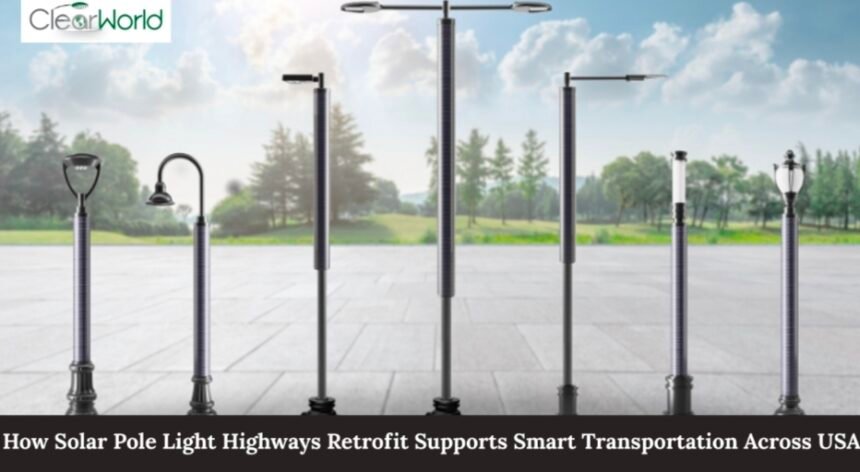
Across the United States, highway lighting systems built decades ago continue to serve roads they were never designed for. Energy bills climb, maintenance schedules stretch thin, and dark stretches of highway create safety risks that transportation departments can no longer afford to ignore. Solar Pole Light Highways Retrofit technology steps into this gap with a solution that makes genuine sense mounting solar panels, LED fixtures, and intelligent controls directly onto poles that already stand. No new foundations, no torn-up roads, no waiting on utility approvals. What remains is a highway network that powers itself.

How Retrofit Technology Strengthens Highway Infrastructure From the Ground Up
Highway lighting carries more responsibility than most people driving past it ever stop to consider. Every mile of unlit or under-lit corridor is a mile where reaction times shorten, accidents rise, and emergency response slows. Transportation agencies managing hundreds of miles of roadway understand this pressure intimately and they understand that the old approach of patching grid-dependent systems simply does not hold anymore.
Solar Pole Light Highways Retrofit technology changes the underlying logic of how highway lighting works. Rather than replacing poles from the ground up, retrofit systems attach solar panels, battery storage, and energy-efficient LED fixtures onto poles that already exist. Functioning poles get upgraded. Non-functioning poles get restored. Either way, the foundation stays intact, the installation timeline shortens, and transportation departments avoid the road closures and utility coordination that full replacement programs consistently create. The upgrades happen faster, cost less, and cause far less disruption to the communities using those roads every day.
What makes this approach genuinely valuable for smart transportation planning is how naturally each retrofitted pole connects to broader infrastructure systems.
Smart Connectivity
Each retrofit solar pole carries a wireless communication module that links it to a centralized management platform. Highway authorities track lighting performance, energy consumption, and fault conditions across the entire network without sending inspection crews to each individual location.
IoT Integration
Retrofitted poles function as live data nodes within a wider IoT network. Embedded sensors transmit real-time information on battery status, light output, and environmental conditions along the corridor, giving infrastructure managers the visibility they need to act before small issues become significant ones.
Adaptive Dimming
Dimming controls respond to traffic volume, ambient light, and time of night. Poles run at full output during busy hours and reduce consumption during quieter periods maintaining safe illumination while managing energy use across the network intelligently.
Remote Monitoring
Wireless fault detection identifies underperformance before drivers or maintenance crews ever notice a gap in highway lighting. Teams respond to confirmed issues rather than running routine inspections across miles of corridor, which makes the entire system considerably easier and cheaper to maintain.
Sensor Compatibility
Retrofit poles accommodate traffic counters, environmental monitors, and emergency communication systems within the same structure. Each pole stops being just a light source and starts contributing actively to highway management, safety coordination, and data collection along the route.
Solar Pole Light Highways Retrofit and Its Role in Smart City Development
Transportation planners building smart city frameworks have come to understand something important: highway lighting cannot stay passive. Roads need to communicate. They need to adapt to conditions in real time and feed data into city-wide systems that manage everything from traffic flow to emergency response. Retrofit technology positions highway lighting at the center of that work, not as an afterthought, but as active infrastructure.
When transportation agencies deploy retrofit solar systems across highway corridors, they build networks of self-powered, connected poles that work together rather than simply standing beside each other. Advanced lithium-ion batteries store solar energy through the day and power LED fixtures through the night, entirely independent of the utility grid. When the grid fails, during storms, peak demand events, or unexpected outages, retrofitted poles keep running without interruption. For highway safety management, that kind of reliability is not a bonus feature. It is a baseline requirement.
- Each pole generates and stores its own power, removing utility dependency from highway lighting operations entirely.
- Interconnected poles share real-time data with traffic management centers, supporting smarter signal timing and faster congestion response.
- Off-grid solar assets reduce load on municipal power infrastructure and keep functioning when the broader grid comes under pressure.
- Solar-powered highway lighting produces no operational emissions, contributing directly to carbon mandates and sustainability commitments cities have made.
- Retrofit systems maintain full illumination during power outages and natural disasters, giving first responders consistently lit corridors when reliable visibility matters most.
The Practical Case for Solar Pole Light Highways Retrofit Across State
Capital Savings
When transportation authorities weigh infrastructure upgrades, the budget conversation usually comes first. Retrofit solutions perform well here. Municipalities consistently report capital savings of up to 65% compared to full pole replacement programs, because existing foundations stay in place and underground wiring work disappears from the project scope entirely.
Operational Efficiency
The savings do not stop at installation. Sealed electronics, long-life LED fixtures, and advanced battery storage reduce service visits across the network substantially. Remote monitoring directs maintenance crews to confirmed underperforming units rather than dispatching them across entire corridors on routine schedules. Over years of operation, those reductions in labor, energy, and maintenance coordination reshape how agencies plan and budget for public lighting.
Durable Performance
Retrofit systems fit poles of any dimension, diameter, or surface finish, which removes a significant practical barrier to large-scale deployment across varied highway networks. Storm-rated construction withstands winds up to 150 mph, keeping highway corridors illuminated through severe weather that routinely knocks out grid-dependent systems. LED output holds consistent from the first night of operation through years of daily cycling, no degradation, no dimming, the same quality of light season after season.
Conclusion
Solar Pole Light Highways Retrofit delivers something highways across the country have needed for a long time: reliable, intelligent, self-sustaining lighting that works within existing infrastructure rather than demanding its replacement. Transportation authorities that deploy these systems gain energy independence, real-time network visibility, and long-term cost efficiency in a single upgrade cycle. For any agency serious about building highway infrastructure that performs today and supports the smart transportation networks of tomorrow, the retrofit path forward is the one worth taking.