



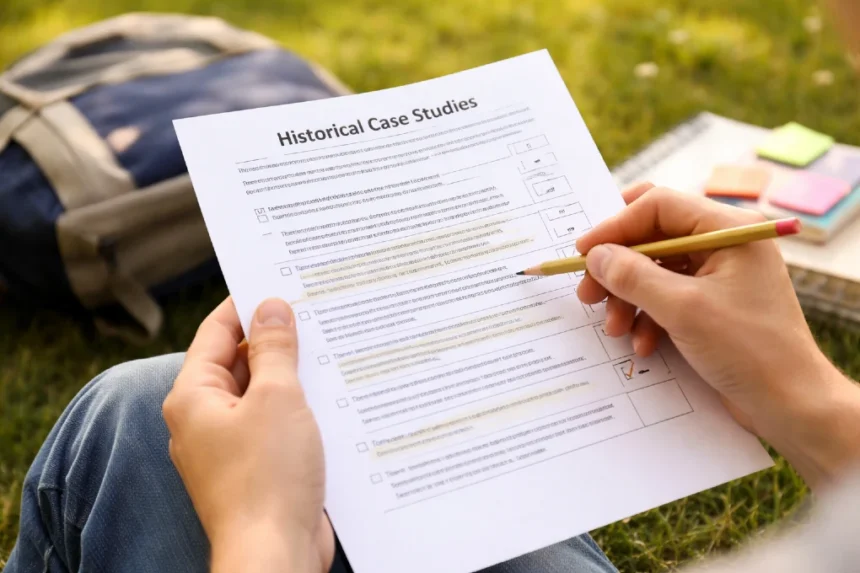
If you are searching for Student Handout 1.2 Guiding Questions for Historical Case Studies Answers, you are probably not looking for fluff. You want clear help, plain language, and answers that actually make sense when you sit down with your worksheet, textbook, or class notes. That is exactly what this article is built for.
- What Is Student Handout 1.2 Really Asking You to Do?
- Why Historical Case Studies Matter
- A Simple Way to Answer Historical Case Study Questions
- Student Handout 1.2 Guiding Questions for Historical Case Studies Answers: What Teachers Usually Expect
- A Model Framework You Can Use for Almost Any Answer
- Common Mistakes Students Make
- How to Make Your Answers Easier to Understand
- Real-World Example of a Strong Historical Case Study Response
- What to Do If You Do Not Have the Exact Answer Sheet
- Helpful Historical Thinking Skills Behind the Handout
- FAQ Style Answers Students Commonly Need
- Final Thoughts
A lot of students get stuck on historical case studies because the questions do not always ask for simple facts. Instead, they ask you to interpret evidence, explain causes, compare viewpoints, and connect events to larger historical themes. That is why Student Handout 1.2 Guiding Questions for Historical Case Studies Answers can feel confusing at first, even if you already read the case study itself.
The good news is that once you understand what these guiding questions are really asking, the answers become much easier to build. In most classrooms, historical case study handouts are meant to train students to think like historians. The Library of Congress, for example, highlights how working with primary sources helps students assess credibility, read complex texts, and conduct research more effectively.
In this article, you will find a practical, easy-to-follow explanation of how to approach the handout, how to structure your responses, and what teachers usually expect when they assign this kind of history work.
What Is Student Handout 1.2 Really Asking You to Do?
At its core, this type of worksheet is not just about finding a date or naming a person. It is about analyzing a historical situation.
When teachers assign Student Handout 1.2 Guiding Questions for Historical Case Studies Answers, they usually want students to do a few key things:
- identify the main historical issue
- understand the people, groups, or institutions involved
- explain causes and effects
- evaluate evidence
- recognize bias or perspective
- connect one event to a broader historical pattern
That means a good answer is rarely one short sentence. Even when the question looks simple, your teacher is often checking whether you can think critically rather than copy lines from the text.
Why Historical Case Studies Matter
Historical case studies are useful because they move history beyond memorization. Instead of only asking what happened, they ask why it happened, who shaped it, and what evidence supports one interpretation over another.
This is also why many history classrooms use primary-source based learning. The Library of Congress describes primary sources as the raw materials of history, created during the time under study, while secondary sources interpret or analyze those events later.
That difference matters when answering a handout. If your case study includes a speech, newspaper excerpt, letter, law, photograph, or political cartoon, you are expected to read it carefully and ask questions like these:
- Who created this source?
- When was it created?
- Why was it created?
- What point of view does it reflect?
- What does it reveal about the historical moment?
Those questions are usually hiding inside the worksheet, even if they are phrased differently.
A Simple Way to Answer Historical Case Study Questions
If you feel lost, use this three-part method every time.
1. Start with the historical context
Before answering anything, figure out the setting of the case study.
Ask yourself:
- What time period is this about?
- What major event or issue is being discussed?
- Who are the main people or groups involved?
- What was happening in society at that time?
Without context, even a correct fact can sound weak. With context, your answer becomes more credible and more complete.
2. Find the evidence in the case study
Most good responses use details from the source material. That might be a quote, a statistic from the handout, a law, a speech, or a short description of an event.
Do not just write your opinion. Point to evidence.
For example, instead of writing:
“People were upset.”
Write something like:
“The source suggests public frustration was growing because it describes protests, criticism of government policy, and rising social tensions.”
That is the kind of move that makes your answer sound stronger.
3. Explain why the evidence matters
This is the step many students skip. They include a fact, but they do not explain its significance.
A history teacher usually wants more than this:
“The law was passed in 1890.”
A better answer would be:
“The law was passed in 1890, which shows that the government was beginning to respond formally to the issue. This helps explain how the case study fits into a larger pattern of political reform during the period.”
That extra sentence is often what separates an average answer from a strong one.
Student Handout 1.2 Guiding Questions for Historical Case Studies Answers: What Teachers Usually Expect
Even though handouts vary from school to school, the expectations are often similar. When students look for Student Handout 1.2 Guiding Questions for Historical Case Studies Answers, they are usually dealing with one of these question types.
Questions about the main issue
These ask what problem, conflict, or debate is at the center of the case study.
A strong response should:
- identify the issue clearly
- mention the historical setting
- explain why the issue mattered at the time
Questions about causes
These ask why the event or conflict happened.
A strong response should:
- list more than one cause when possible
- separate short-term and long-term causes
- support the answer with evidence from the source
Questions about effects
These ask what changed because of the event.
A strong response should:
- include immediate effects
- mention longer-term impact if relevant
- connect the effect to politics, society, economy, or culture
Questions about perspective or bias
These ask how a source reflects a point of view.
A strong response should:
- identify who created the source
- explain the creator’s likely interest or position
- show how that perspective shapes the message
Questions about significance
These ask why the event matters in history.
A strong response should:
- connect the case study to a broader theme
- explain why historians still study it
- show what it reveals about change over time
A Model Framework You Can Use for Almost Any Answer
Here is a clean structure that works well for most responses on this kind of handout.
| Part of Answer | What to Include |
|---|---|
| Opening sentence | Direct answer to the question |
| Evidence sentence | A detail from the case study or source |
| Explanation sentence | Why that evidence matters |
| Broader link | Connection to larger historical context |
Using this pattern keeps your work clear and prevents you from writing vague answers.
For example:
“The main conflict in the case study is the struggle over political rights. The source shows this through public protests and official resistance to reform. This matters because it reveals how social pressure was shaping political debate. It also reflects a wider historical pattern of reform movements during the period.”
That kind of paragraph is simple, readable, and strong enough for many classroom assignments.
Common Mistakes Students Make
A lot of answers go wrong in predictable ways. If you avoid these, your work will already improve.
Writing too little
Many students answer historical questions with one sentence when the question really needs three or four. If the worksheet asks you to explain, compare, analyze, or evaluate, give more than a one-line response.
Copying directly from the source
Teachers can tell when you just lifted a line from the passage. Use the source, but rewrite ideas in your own words and explain them.
Ignoring point of view
If the source is a speech, article, or political cartoon, perspective matters. A source is never completely neutral. Who created it and why can change the meaning.
Missing the bigger picture
A case study is usually one part of a larger historical story. Strong answers show that you understand both the specific event and its wider significance.
How to Make Your Answers Easier to Understand
One reason students search for Student Handout 1.2 Guiding Questions for Historical Case Studies Answers is that textbook language can feel dense. The easiest fix is to translate formal history language into plain English before you start writing.
Here is a quick example:
- “Assess the historical significance” becomes “Explain why this event mattered”
- “Analyze the source’s perspective” becomes “Show the point of view and how it shapes the message”
- “Evaluate the evidence” becomes “Decide how strong or useful the evidence is”
That mental translation helps a lot.
You can also improve clarity by following these habits:
- use direct topic sentences
- keep paragraphs short
- stick to one idea per paragraph
- include specific evidence
- avoid filler words
- define any difficult term before using it
Real-World Example of a Strong Historical Case Study Response
Imagine your case study is about a protest movement.
A weak answer might say:
“The protest happened because people were angry.”
A stronger answer would say:
“The protest movement developed because many people believed the existing system was unfair and unresponsive. The case study points to rising dissatisfaction, organized resistance, and demands for change. This suggests the protest was not a sudden reaction but part of a broader struggle over rights and representation.”
Notice what changed. The second answer is not fancy. It is just clearer, more specific, and better connected to historical reasoning.
What to Do If You Do Not Have the Exact Answer Sheet
Sometimes students search for Student Handout 1.2 Guiding Questions for Historical Case Studies Answers when they really want an answer key. If you do not have the official key, you can still build reliable answers.
Use this checklist:
- read the case study twice
- underline names, dates, and key events
- identify the central issue
- find at least two pieces of evidence
- ask what changed and why
- note any clear bias or perspective
- connect the event to a larger theme in history
This method will usually get you close to what a teacher wants, even without the original answer sheet.
Helpful Historical Thinking Skills Behind the Handout
Many worksheets like this are based on core historical thinking skills. Educational materials from the Library of Congress and work associated with Stanford history education resources both emphasize analyzing sources, considering context, and building interpretations from evidence.
These are the most useful skills to practice:
Sourcing
Who created the source, and why?
Contextualization
What was happening at that time?
Corroboration
Do other sources support the same idea?
Close reading
What specific words or details matter?
Interpretation
What does the evidence suggest about the event?
If you build your answers around those habits, your handout responses will sound much more confident.
FAQ Style Answers Students Commonly Need
How long should a response be?
It depends on the question, but most answers should be at least three to five sentences if the task asks for analysis. A one-sentence answer is usually too thin.
Should I quote directly from the case study?
You can, but only when needed. In most cases, it is better to paraphrase the evidence and then explain it.
What if I do not understand the source?
Break it into small parts. Identify who wrote it, when it was written, and what the main message seems to be. Then connect it to the event being studied.
Can I use outside knowledge?
Yes, if your teacher allows it. In fact, adding relevant background knowledge can strengthen an answer, as long as it supports the case study rather than replacing it.
Final Thoughts
Finding Student Handout 1.2 Guiding Questions for Historical Case Studies Answers is really about more than finding a quick shortcut. It is about learning how to answer history questions in a way that is clear, evidence-based, and easy to follow.
Once you understand the pattern behind the handout, the task becomes much less stressful. Start with context, pull evidence from the case study, explain why that evidence matters, and connect your answer to the bigger historical picture. That approach works across many history assignments, not just one worksheet.
If you keep practicing those steps, your answers will stop sounding guessed and start sounding informed. And that is exactly what history teachers want to see. For broader background on the development of schooling and how historical learning has evolved over time, you can also read about history education, which gives useful context for why case-study analysis remains such an important classroom method.