


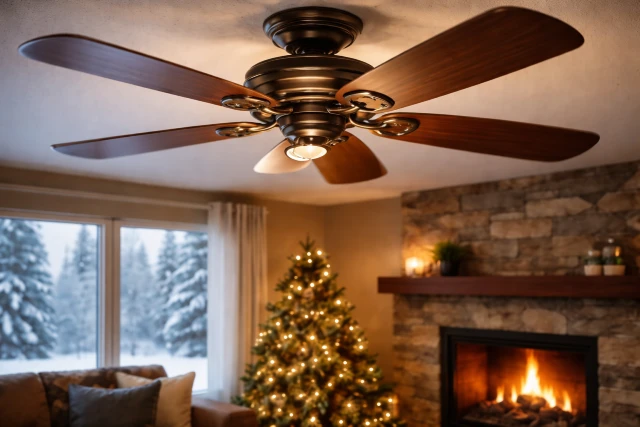
If you have a ceiling fan, you already own one of the easiest comfort upgrades in your home. The trick is using it correctly when temperatures drop. Ceiling Fan Direction for Winter is not about getting a cold breeze in December. It’s about gently moving the warm air that’s already in your room back down where you actually live.
- Why Ceiling Fan Direction for Winter actually matters
- Ceiling Fan Direction for Winter: which way is correct?
- Where the “simple switch” is and how to flip it safely
- How Ceiling Fan Direction for Winter can lower heating costs
- Best speed setting for Ceiling Fan Direction for Winter
- Room-by-room guide for Ceiling Fan Direction for Winter
- Quick setup checklist
- Common mistakes that ruin Ceiling Fan Direction for Winter
- Does Ceiling Fan Direction for Winter work with heat pumps and furnaces?
- Mini case scenario: what it looks like in real life
- A simple table you can use every season
- FAQs about Ceiling Fan Direction for Winter
- The “quiet upgrade” that makes your home feel warmer
- Conclusion
Here’s the short version you can trust: in winter, most standard ceiling fans should run clockwise at low speed. ENERGY STAR explains that this creates a gentle updraft that helps push the warm air near your ceiling back into the occupied space. The U.S. Department of Energy says the same thing: reverse the direction to clockwise and set it to low speed to circulate warm air down to living spaces.
Now let’s turn that simple switch into real, noticeable savings and comfort.
Why Ceiling Fan Direction for Winter actually matters
Warm air rises. That’s not a saying, it’s basic physics. When your heater runs, the warmest air tends to collect near the ceiling first. Meanwhile, your feet are on the floor wondering why the room still feels chilly.
Ceiling Fan Direction for Winter works because it helps break up that “hot ceiling, cold couch” problem without blasting you with wind. Done right, the fan creates a slow, steady circulation pattern so the temperature feels more even across the room.
And once the room feels more even, you’re less tempted to keep cranking the thermostat higher. That’s where the money comes in.
The comfort problem most people don’t notice until winter
A lot of homes have “layered” temperatures in winter:
- Toasty near ceiling lights
- Cool at head height
- Cold near the floor
- Drafty corners that never seem to warm up
Using Ceiling Fan Direction for Winter helps mix those layers so your heating system doesn’t have to work as hard to make you comfortable.
Ceiling Fan Direction for Winter: which way is correct?
For most fans in winter:
- Direction: Clockwise
- Speed: Low (or the lowest setting that still moves air)
ENERGY STAR specifically recommends reversing the motor and operating the fan at low speed in the clockwise direction during winter. The Department of Energy echoes this guidance for winter use.
Quick test: how to tell if your fan is set correctly
Stand under the fan (not directly touching it, obviously) and feel for airflow.
- If you feel a strong breeze pushing down on you, that’s usually the summer setting.
- For Ceiling Fan Direction for Winter, you should feel little to no direct breeze. It’s more of a subtle circulation than a “wind chill” effect.
If you can’t tell by feel, use a simple visual check:
- Look up at the blades and observe their motion.
- Many fans have a small arrow label on the motor housing showing clockwise and counterclockwise.
Where the “simple switch” is and how to flip it safely
Most ceiling fans have a small direction switch on the motor housing (the part above the blades). Some newer models use a remote or wall control, but the idea is the same.
Safe method:
- Turn the fan off.
- Wait for the blades to stop completely.
- Flip the direction switch (or change direction on the remote).
- Turn the fan on at the lowest speed.
HVAC pros commonly advise switching only when the fan is fully stopped for safety and to avoid stressing the motor.
Once you flip it, you’ve done the hardest part of Ceiling Fan Direction for Winter.
How Ceiling Fan Direction for Winter can lower heating costs
A ceiling fan doesn’t “create” heat, and it doesn’t replace your heater. What it does is help you get more value from heat you’ve already paid for.
The money-saving path usually looks like this:
- Warm air rises and gets trapped near the ceiling
- Your thermostat senses cooler air at its location (often on a wall, away from the ceiling)
- The heating system runs longer to make the room feel comfortable
- You pay more
With Ceiling Fan Direction for Winter, you gently push that warm ceiling air back down, helping the thermostat and your body “agree” that the room is warm enough.
Pair it with a small thermostat adjustment for bigger results
The Department of Energy notes you can save as much as 10% a year on heating and cooling by turning your thermostat back 7 to 10°F for 8 hours a day.
Here’s the practical winter connection:
- When Ceiling Fan Direction for Winter evens out room temperatures, many people can drop the thermostat slightly without feeling colder.
- Even a small adjustment can add up across a season, especially if your system runs many hours per day.
No hype, no gimmicks. Just smarter heat distribution and a slightly lower thermostat.
Best speed setting for Ceiling Fan Direction for Winter
Low speed wins in winter.
Why?
- High speed creates wind chill on your skin, which can make you feel colder even if the room’s air temperature is higher.
- Low speed keeps circulation gentle, focusing on mixing air rather than blasting it.
If your fan has multiple levels, start at the lowest setting and increase only if you still have obvious cold spots.
Room-by-room guide for Ceiling Fan Direction for Winter
Different rooms behave differently. Use Ceiling Fan Direction for Winter as your default, then fine-tune based on the space.
Living room
This is where people notice the biggest difference because it’s usually a larger, more open space.
Tips:
- Run the fan clockwise on low while the room is occupied.
- If you have tall ceilings, keep it on longer to reduce heat pooling.
Bedroom
Bedrooms are tricky because you don’t want airflow waking you up or drying you out.
Try this:
- Set Ceiling Fan Direction for Winter to clockwise.
- Use the lowest speed and a timer if your fan has one.
- If you wake up feeling chilly, reduce fan speed rather than raising the thermostat first.
Kitchen and dining area
Cooking already adds heat, but that heat often rises and sits up high.
Use Ceiling Fan Direction for Winter to:
- Keep warmth from getting trapped above cabinets
- Reduce the “cold table, warm ceiling” feel
Hallways and stairwells
These areas are where warm air loves to collect and get wasted.
If you have a fan in a stairwell, Ceiling Fan Direction for Winter can help keep upstairs from hogging all the heat. For multi-story homes, this can be a comfort game-changer.
Quick setup checklist
Use this checklist at the start of the cold season, then forget about it:
- Fan direction: clockwise
- Fan speed: low
- Blades: clean (dust reduces efficiency and can wobble)
- Heater vents: not blocked by furniture
- Fan use: only in occupied rooms
ENERGY STAR reminds homeowners to turn fans off when rooms are unoccupied because fans cool people, not rooms. That advice matters in winter too.
Common mistakes that ruin Ceiling Fan Direction for Winter
Mistake 1: Running it too fast
This is the biggest one. If you feel a strong breeze, you’ve gone too far. Ceiling Fan Direction for Winter should be subtle.
Mistake 2: Leaving it on all day in empty rooms
If nobody is in the room, you’re paying for a motor to spin for no benefit. Fans use far less power than heating systems, but “less” isn’t “free.”
Mistake 3: Assuming every fan behaves the same
Some fans are mounted higher, some are larger, and some have different blade pitches. Ceiling Fan Direction for Winter is a rule of thumb, but you still adjust speed based on comfort.
Mistake 4: Forgetting tall ceilings
If your home has vaulted ceilings, you’re likely losing more heat to stratification. Ceiling fans can help you reclaim that comfort when set correctly.
Does Ceiling Fan Direction for Winter work with heat pumps and furnaces?
Yes. In fact, it can be especially helpful with heat pumps because many heat pump systems deliver steady, moderate warmth rather than the “blast” you get from some furnaces.
With Ceiling Fan Direction for Winter, you keep that steady warmth circulating, which can reduce temperature swings and cold pockets.
Mini case scenario: what it looks like in real life
Imagine a typical winter evening:
- Thermostat set at 71°F
- The couch area feels cool
- You bump it to 73°F to feel comfortable
- The heater cycles more often
Now try the winter fan setup:
- Keep thermostat at 71°F
- Flip Ceiling Fan Direction for Winter to clockwise
- Run it on low for 20 to 30 minutes
In many homes, the room feels more even and the “cold couch zone” softens. You’re not creating extra heat. You’re getting the warm air off the ceiling and back into the room.
Even if that means you avoid raising the thermostat by just 1 to 2 degrees, you’re saving energy across weeks of heating.
A simple table you can use every season
| Season | Fan direction | Speed | What you should feel |
|---|---|---|---|
| Winter | Clockwise | Low | Little to no breeze, more even warmth |
| Summer | Counterclockwise | Medium to high | Direct cooling breeze |
ENERGY STAR provides the core seasonal guidance for direction and the reason it works. The Department of Energy also supports reversing direction for seasonal comfort.
FAQs about Ceiling Fan Direction for Winter
Should I feel air blowing down in winter?
Usually, no. With Ceiling Fan Direction for Winter, the goal is gentle circulation. If you feel a strong downdraft, reduce speed or confirm the direction is set to clockwise.
What if my fan doesn’t have a reverse switch?
Some older fans are not reversible, and a few models need a remote or wall control to change direction. If you can’t reverse it, you can still use low speed for circulation, but it may not be as effective for winter comfort.
Do I keep the fan on all night?
If it helps you stay comfortable at a lower thermostat setting, it can be worth it. But keep it on low and only if you like how it feels. Ceiling Fan Direction for Winter should improve comfort, not distract you.
Will this really reduce my heating bill?
It can, especially when it helps you avoid raising the thermostat. The Department of Energy’s thermostat setback guidance shows how small changes can produce meaningful annual savings. Pairing that mindset with Ceiling Fan Direction for Winter is one of the simplest “do it once, benefit all season” moves.
The “quiet upgrade” that makes your home feel warmer
A lot of winter comfort advice involves buying things. New insulation. New windows. A new thermostat. Those upgrades can be great, but they’re not “flip a switch and feel better today” solutions.
Ceiling Fan Direction for Winter is. It’s one of the rare home efficiency moves that is:
- Fast
- Free
- Easy to test immediately
If your rooms feel uneven, or you’re tired of paying to heat the ceiling, this is the first knob to turn.
Conclusion
Ceiling Fan Direction for Winter is a small adjustment with a surprisingly real payoff. Set your fan to run clockwise at low speed, keep it on when the room is occupied, and let it gently bring warm ceiling air back down where it belongs. ENERGY STAR and the U.S. Department of Energy both recommend this winter setup for improving comfort and helping circulate warm air.
When the room feels more evenly warm, you’re less likely to crank the thermostat higher. Combine Ceiling Fan Direction for Winter with sensible thermostat setbacks, and you’ve got a practical path to lower heating costs without sacrificing comfort.
In homes where ceiling heat buildup is common, this is a simple fix for thermal stratification.