



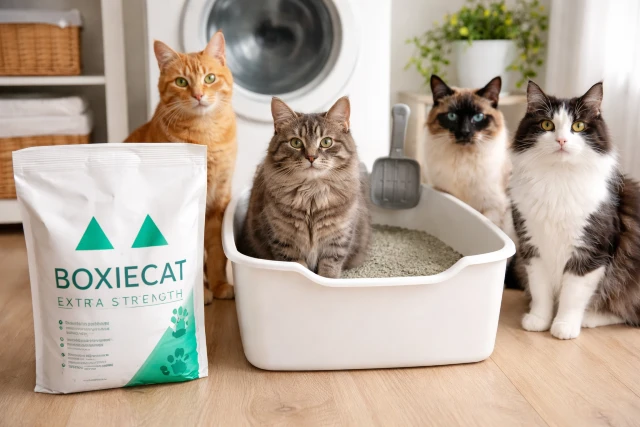
Living with more than one cat is pure entertainment. It is also a full time commitment to keeping your home smelling normal, your floors clean, and your cats comfortable enough to actually use the litter boxes you buy for them.
- Why multi cat homes are harder on litter than you think
- What Boxie Cat Litter is, in plain English
- Boxie Cat Litter in a multi cat home: what it feels like day to day
- Pros of Boxie Cat Litter for multiple cats
- Cons and honest tradeoffs
- The setup that makes Boxie Cat Litter work better with multiple cats
- Quick comparison table: what to expect in multi cat use
- Real world scenarios and what to do
- Tips to get the best results with Boxie Cat Litter in multi cat homes
- FAQ: Boxie Cat Litter for multiple cats
- Conclusion
If you are looking at Boxie Cat Litter for a multi cat home, you are probably hoping for three things: tighter clumps, less odor, and fewer “litter footprints” across the house. That is a fair wish list. Multi cat litter needs are different because traffic is heavier, waste builds faster, and cats can get picky when a box feels crowded or “used.”
This guide breaks down what to expect with Boxie Cat Litter in a multiple cat household, including real pros, real downsides, and practical tips that make the biggest difference.
Why multi cat homes are harder on litter than you think
With one cat, you can sometimes get away with an “okay” setup. With two, three, or four cats, the margin disappears.
Here is what changes:
- More volume, faster. More urine means faster ammonia build up and quicker saturation.
- More box politics. Cats may block each other, guard a favorite box, or avoid a box that smells “wrong.”
- More tracking. Heavy use breaks litter down, creating more fine particles that travel.
- Higher hygiene stakes. Shared boxes can mean shared mess, so cleanliness matters.
Veterinary and feline behavior guidelines often recommend one litter box per cat plus one extra, ideally in different easy to access locations. This is not just internet folklore. The American Animal Hospital Association guidance includes this rule of thumb and emphasizes multiple locations in multi cat households.
So before we even talk brands, remember this: even the best litter will struggle if the box count, placement, or cleaning routine is off.
What Boxie Cat Litter is, in plain English
Boxie Cat Litter (especially the probiotic clumping clay options) is designed to clump firmly and control odor by targeting the bacteria and waste that create smells. Boxie’s product information describes a probiotic approach that aims to reduce ammonia odors and claims long odor control, often marketed around “40 day” performance under certain conditions.
You will also see it positioned as an unscented, low dust, premium clumping litter in many retail listings.
In multi cat terms, that translates into three potential advantages:
- Fast, hard clumps that do not crumble when you scoop.
- Better odor control when multiple cats are using the same boxes daily.
- Less mess over time if clumps stay intact and waste is removed cleanly.
Now, does it always deliver? It can, but the “what to expect” part depends on how you run your home setup.
Boxie Cat Litter in a multi cat home: what it feels like day to day
When multiple cats share litter boxes, your daily experience tends to come down to four things:
1) Clumping behavior and scoopability
Multi cat clumps get big. If litter forms soft clumps that break apart, you end up stirring waste back into the box. That creates a smell cycle you cannot win.
Many people like premium clumping litters because firmer clumps make removal easier, and Boxie is frequently described as strong clumping in product summaries and reviews.
What you should expect:
- Firm clumps if the litter depth is right and boxes are not overfilled with waste.
- Better results with consistent scooping, because leaving clumps too long makes any litter struggle.
2) Odor control when the house is busy
Multi cat odor is mostly about urine, and urine smell is driven heavily by ammonia. Ammonia is a pungent gas and an irritant at higher concentrations.
Boxie’s probiotic messaging is specifically built around reducing ammonia odors.
What you should expect:
- Noticeably better odor control when you scoop at least once a day, ideally twice in multi cat homes.
- Less “perfume cover up” smell if you prefer unscented litter.
3) Tracking and “litter everywhere”
Tracking is a mix of litter grain, cat fur, paw fluff, and box placement. With multiple cats, you also get more zoomies, which does not help.
What you should expect:
- Some tracking still happens, because no clumping litter is magic.
- Less mess if you pair it with a large tracking mat and keep the litter level consistent.
4) How your cats accept it
This is the wildcard. Cats care about texture, smell, and the feeling of the litter under their paws.
What you should expect:
- Many cats accept fine grain clumping clay quickly.
- Sensitive paw cats may prefer softer textures, which some testers mention as a plus for certain Boxie options.
Pros of Boxie Cat Litter for multiple cats
Here are the most realistic upsides if you have two or more cats.
Strong clumping that saves time
In multi cat homes, you do not want to fight with the scoop. When clumps hold together, you remove more waste with fewer passes, and the box stays cleaner between full changes. That is the whole game.
Odor control that is not just fragrance
If you hate scented litters, probiotic style odor control can feel like a relief. Boxie markets its probiotics as targeting the source of odor rather than masking it, and it highlights ammonia odor control.
Works well when you scale your routine
The best part is that Boxie Cat Litter can “scale” with a strong routine. If you add the extra box, scoop more often, and keep depth correct, it usually performs better than budget litters that collapse under multi cat load.
Widely tested in mainstream reviews
Boxie’s probiotic clumping litter has been included in large scale testing style reviews by pet publications that evaluate odor, clumping, tracking, and dust.
Cons and honest tradeoffs
Premium litter is not automatically perfect. Here is what can frustrate multi cat owners.
Price adds up fast
Multiple cats means you buy litter more often. Even if you extend changes by scooping well, a premium bag can feel expensive when you are refilling two to four boxes.
A practical way to think about cost is “cost per day,” not “cost per bag.” A litter that clumps better can reduce how much you throw away, but it is still a higher upfront spend.
It can still track, especially with high traffic cats
If you have long hair cats or cats that sprint out of the box, you will still see litter on the floor. Your mat and your vacuum schedule will still matter.
Not every cat loves the same texture
Even the best litter can fail if one cat refuses it. In multi cat homes, that can lead to accidents that look like “behavior problems,” when it is really a litter preference issue.
Odor control is not a substitute for enough boxes
If you try to run two cats with one box, you will still lose. The AAHA guidance is clear about providing enough boxes and multiple locations in multi cat households.
The setup that makes Boxie Cat Litter work better with multiple cats
If you want the best results, focus less on “which litter” and more on “how the system runs.” Here is a setup that tends to work extremely well.
Litter box count and placement
Start with the basic rule:
- Number of cats + 1 boxes (minimum)
Then placement:
- Spread boxes across different areas, not all lined up in one “bathroom corner.”
- Avoid noisy appliances and tight dead ends where a cat can feel trapped.
This matters because cat conflict is often silent. One cat simply stops using a box if it feels unsafe.
Litter depth sweet spot
For clumping clay, a good starting point is:
- 2.5 to 3.5 inches of litter
Too shallow and urine hits the bottom, causing sticky clumps. Too deep and you waste product, and some cats dig excessively.
Scooping rhythm for multi cat homes
If you have:
- 2 cats: scoop at least once daily, ideally twice
- 3+ cats: twice daily is the “easy life” setting
This is not about being perfect. It is about keeping the box inviting enough that nobody holds it in or chooses your rug.
The “top up” method that keeps odor down
Instead of dumping and refilling constantly, do this:
- Scoop waste daily.
- Stir the top layer lightly every couple days.
- Add a small top up amount to maintain depth.
- Full change only when odor persists after scooping or litter starts breaking down.
With strong clumping products, this method usually feels cleaner and wastes less litter.
Quick comparison table: what to expect in multi cat use
| Feature | What multi cat owners care about | What you can expect with Boxie Cat Litter |
|---|---|---|
| Clumping | Clumps that stay intact under heavy use | Typically strong clumps when depth and scooping are consistent |
| Odor control | Less ammonia smell between scoops | Probiotic messaging targets ammonia odors, best with frequent scooping |
| Dust | Less mess and less irritation | Often described as low dust in product listings and reviews |
| Tracking | Cleaner floors | Still possible, improved by mats and box design |
| Cost | Higher monthly spend | Premium price, but may waste less if clumping is efficient |
Real world scenarios and what to do
Scenario 1: Two cats, one is a neat freak
You scoop daily, but one cat still poops right outside the box once a week.
This is usually a “cleanliness threshold” issue or a placement issue. Try:
- Add the extra box in a second location
- Scoop morning and evening for one week
- Keep one box uncovered if both are covered
Scenario 2: Three cats, smell returns on day two
You change the litter, it is great, then odor comes back quickly.
Try:
- Increase scooping frequency
- Make sure you are removing urine clumps completely
- Check litter depth so urine is not pooling at the bottom
- Clean the box itself with mild soap and water during a full change
Remember, ammonia is an irritant and “that sharp smell” is not something you want building up indoors.
Scenario 3: One cat tracks litter like a profession
Your floors look like a beach.
Try:
- Add a larger mat with a textured surface
- Use a high sided box or top entry box if your cat tolerates it
- Place the box so cats have to step onto the mat, not jump over it
- Keep litter level below the rim so they do not kick it out as easily
Tips to get the best results with Boxie Cat Litter in multi cat homes
Here are the tips that consistently make a difference, especially if you are trying Boxie Cat Litter for the first time.
Transition slowly if your cats are picky
If your cats are used to another texture, do a gradual change:
- Days 1 to 3: 25% new, 75% old
- Days 4 to 6: 50% new, 50% old
- Days 7 to 10: 75% new, 25% old
- Then switch fully
In multi cat homes, even one cat refusing can derail everything.
Keep at least one “quiet box”
Give your shy or anxious cat a box in a calm spot where other cats do not ambush them. This prevents accidents and reduces stress.
Do not overuse deodorizing powders
It is tempting, but mixing add ons can change texture and smell. Many cats dislike strong additives. If odor is bad, it usually means more scooping, more boxes, or a full change.
Watch for health signals
If your box routine is good and odor suddenly gets stronger, or clumps change size dramatically, consider:
- A cat may be urinating more
- There may be diarrhea or constipation
- A cat could be avoiding the box
If you see straining, frequent trips, or peeing outside the box, it is vet time.
FAQ: Boxie Cat Litter for multiple cats
How many litter boxes do I need for multiple cats?
A widely cited rule of thumb is one box per cat plus one extra, ideally in different locations, especially in multi cat households.
How often should I scoop with two or three cats?
For multi cat homes, once a day is the minimum, and twice a day is where most people notice a big improvement in odor and box acceptance.
Does probiotic litter really help with odor?
Probiotic products are marketed to reduce odors by targeting bacteria and waste related smells, including ammonia odors. Boxie describes this mechanism as part of its product design.
Is it okay for cats to share litter boxes?
Yes, many cats share litter boxes, but the key is providing enough boxes and the right placement so no cat feels blocked. More boxes also reduces conflict and helps prevent accidents.
What is the biggest mistake people make with multi cat litter?
Underestimating box count and scoop frequency. Even high performing litter cannot compensate for an overloaded box.
Conclusion
If you have multiple cats, Boxie Cat Litter can be a strong choice when you want firm clumps, low fragrance odor control, and a cleaner daily scoop. The main thing to expect is that it performs best in a system that is built for multi cat life: enough boxes, smart placement, and a consistent routine.
If you want the “wow” version of the experience, focus on the basics first. Add that extra box, scoop more often than you think you need, and keep depth consistent. When you do, Boxie Cat Litter is much more likely to feel like the upgrade you hoped for, not just another bag that promised a miracle.
In the last stretch of any multi cat setup, remember that sharp litter box odor is often tied to ammonia gas buildup, and small routine upgrades can make your whole home feel different.