


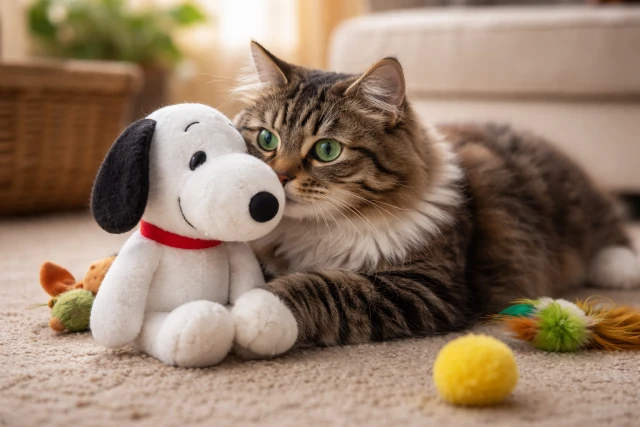
You bring home a Snoopy Stuffed Animal, set it on the floor, and your cat does that classic slow blink like, “Interesting… but also, what is your plan here?” If you have ever watched a cat fall in love with a crumpled receipt while ignoring a brand-new toy, you already know the truth: cats do not “play” the way we expect. They play the way they prefer, and their preferences can be weirdly specific.
- Why cats “ignore” toys that look amazing to humans
- The Snoopy Stuffed Animal test: what cats notice first
- Safety first: when a Snoopy Stuffed Animal should NOT become a cat toy
- Will your cat play with it or ignore it? A quick decision table
- How to introduce a Snoopy Stuffed Animal so your cat actually cares
- Make it more appealing: safe upgrades that encourage play
- Real-world scenarios: what different cats tend to do
- Common reasons cats ignore a Snoopy Stuffed Animal (and what to do)
- How long should you try before you decide “my cat doesn’t care”?
- A quick checklist: is your Snoopy Stuffed Animal suitable for cat play?
- FAQs people actually ask about Snoopy plush toys and cats
- The bigger picture: play is not optional, it is maintenance
- Conclusion: so… will your cat play with a Snoopy Stuffed Animal or ignore it?
So will your cat actually play with a Snoopy Stuffed Animal, or will it become room décor that silently judges you from a shelf?
The honest answer is: it depends on how closely that plush can mimic what cats naturally want from play, how safe it is for feline teeth and claws, and how you introduce it. Cats are wired for hunting-style play, and enrichment matters more than most people realize. Veterinary behavior guidance around feline environmental needs emphasizes that meeting a cat’s needs helps reduce stress and stress-related problems.
Let’s break it down in a practical way, without hype, so you can figure out whether your cat will cuddle, kick, chase, ignore, or attempt to “murder” Snoopy at 3 a.m.
Why cats “ignore” toys that look amazing to humans
Humans shop with our eyes. Cats shop with their instincts.
Most cats choose toys based on how well they trigger elements of predatory play: stalking, chasing, pouncing, grabbing, and sometimes bunny-kicking. Play that follows a hunting-style rhythm is more satisfying for many cats than random waving or tossing.
That is why a simple shoelace can win over a fancy toy. It moves like prey. It darts, pauses, and “escapes.” A plush character, even a cute one like a Snoopy Stuffed Animal, often sits still. And to a cat, a motionless object is not prey. It is furniture.
That said, “plush” is not automatically a fail. Plush toys can work brilliantly for:
- bunny-kicking (especially if the toy is long enough)
- comfort-carrying (some cats like to drag a toy around)
- scent-based play (catnip or silvervine)
- gentle wrestle play for shy or senior cats
The key is matching the toy to your cat’s play style, not the other way around.
The Snoopy Stuffed Animal test: what cats notice first
When a cat meets a Snoopy Stuffed Animal, it is basically running a quick sensory checklist.
1) Movement: can it behave like “prey”?
Cats are movement addicts. If Snoopy just sits there, your cat may sniff once and walk away. But if you animate it, the toy can become interesting.
Try this: instead of pushing it toward your cat (which can feel threatening), drag the Snoopy Stuffed Animal away slowly, like it is trying to escape behind a chair. Pause. Peek it out again. That start-stop pattern often triggers stalking.
This approach lines up with prey-sequence style play, where you mimic the rhythm a cat expects during “the hunt.”
2) Texture: is it satisfying to bite and grab?
Many plush toys are soft, but “soft” is not always “fun.” Cats often like a bit of resistance. If the fabric is too silky, some cats cannot get traction with claws. If it is too fuzzy, it may collect saliva and become gross fast.
If the Snoopy Stuffed Animal has a durable outer fabric and firm stuffing, it may work better for wrestling and kicking than a super-floppy plush.
3) Size and shape: can your cat carry it or kick it?
Size is a big deal.
- Small cats and kittens often prefer toys they can carry in the mouth.
- Adult cats may like mid-size plush they can hug and bunny-kick.
- Large cats often need longer toys to fully engage their back legs.
If your Snoopy Stuffed Animal is larger than your cat’s head and too bulky to grip, it may be ignored unless you use it as a moving target (dragging it, flipping it, hiding it).
4) Scent: does it smell like “store” or “home”?
Cats are scent-driven. A toy that smells strongly of packaging, perfume, or a new factory scent can get the cold shoulder.
Quick win: rub the Snoopy Stuffed Animal with a clean blanket your cat sleeps on, or leave it near your cat’s resting spot for a day so it picks up “home scent.” This can reduce the “stranger object” vibe.
Safety first: when a Snoopy Stuffed Animal should NOT become a cat toy
This part matters more than cuteness. Many character plush toys are made for humans, not pets. Cats chew, rake with claws, and pull at seams. If a plush is not built for that, it can become risky.
General pet-toy safety guidance stresses avoiding toys with small parts that can detach and become choking hazards, and emphasizes supervision.
Check these before you offer the Snoopy Stuffed Animal
Do a quick inspection like you are quality control.
High-risk features:
- plastic eyes, noses, or buttons that could pop off
- glued-on decorations
- ribbons, strings, bows, or thin collars
- loose stitching around ears, tail, or limbs
- cheap “crinkly” film inside (cats can tear plush and ingest the film)
Lower-risk features:
- embroidered eyes and mouth
- tightly stitched seams
- minimal external accessories
- sturdy fabric that does not shred easily
If your Snoopy Stuffed Animal has hard plastic eyes, treat it as a supervised-only item or a display piece. Cats can be surprisingly fast at chewing off a small part, especially once they decide it is “prey.”
A simple safety rule that saves headaches
If you can tug on a part and it shifts, twists, or feels like it could detach, assume your cat will eventually remove it.
Will your cat play with it or ignore it? A quick decision table
Here is a practical way to predict outcomes.
| What your cat usually enjoys | What a Snoopy Stuffed Animal can do well | Likely result |
|---|---|---|
| chasing fast movement (wand toys) | only if you animate it | moderate interest with your help |
| bunny-kicking and wrestling | good if medium to large and firm | high interest for some cats |
| solo batting (small balls, mice) | usually too big unless small plush | low to medium |
| comfort-cuddling or carrying toys | plush can work surprisingly well | medium to high for gentle cats |
| catnip obsession | works if you add catnip scent | boosts interest a lot |
If your cat is a hardcore “chase hunter,” your Snoopy Stuffed Animal becomes fun mainly when you make it behave like prey. If your cat is a “wrestle and kick” type, you might see an instant bond.
How to introduce a Snoopy Stuffed Animal so your cat actually cares
Cats often reject toys because the introduction feels wrong. Here is a low-pressure, cat-friendly method.
Step 1: let it exist nearby without attention
Place the Snoopy Stuffed Animal on the floor in a calm area, away from the litter box and away from noisy traffic. Do not shove it toward your cat. Let curiosity build.
Step 2: build positive association
When your cat approaches and sniffs, quietly reward with a treat or gentle praise. You are teaching, “New object equals good things.”
Step 3: “prey-ify” the plush for 60 seconds
Take the Snoopy Stuffed Animal and:
- drag it slowly behind a chair
- pause it like it is hiding
- make small, quick movements away from your cat
Avoid moving it directly into your cat’s face. Most cats prefer “prey that flees” rather than “object that attacks.”
Play guidance that focuses on prey-sequence patterns is a helpful way to structure sessions that feel natural to cats.
Step 4: end the game while your cat still wants more
This is the secret sauce. Stop before your cat gets bored. Cats remember the fun and come back for the next round.
Make it more appealing: safe upgrades that encourage play
If your Snoopy Stuffed Animal is safe (no detachable plastic parts), you can make it more interesting without turning it into a craft project.
Add scent (carefully)
- Rub a little catnip on the toy (if your cat responds to catnip)
- Use a pinch of silvervine powder if catnip does nothing for your cat
- Store the plush in a sealed bag with catnip for a few hours, then remove excess
Scent can transform a boring plush into a “must investigate” item.
Make it interactive without adding danger
Instead of tying string (which can be risky if swallowed), you can:
- place the Snoopy Stuffed Animal partially under a blanket and wiggle the lump
- hide it behind a sofa edge and let Snoopy “peek” out
- roll it down a hallway gently like a slow-moving target
Use it as a reward object
Some cats love a routine: play, “catch,” then treat. That routine can strengthen your cat’s interest in the Snoopy Stuffed Animal as a predictable game.
Real-world scenarios: what different cats tend to do
Scenario A: the energetic young hunter
This cat loves wand toys, sprints, and dramatic pounces. They will likely ignore a stationary Snoopy Stuffed Animal. But if you move it like prey, they may chase and attack it, then lose interest once it stops moving.
Best strategy: short, intense sessions where Snoopy “escapes.”
Scenario B: the bunny-kicker
This cat grabs toys, rolls onto the side, and kicks like a tiny kangaroo. A mid-size Snoopy Stuffed Animal can be perfect for this, especially if it is firm enough to grip.
Best strategy: toss Snoopy near your cat and let them choose wrestling.
Scenario C: the shy or anxious cat
This cat startles easily and does not enjoy loud toys. A soft Snoopy Stuffed Animal can become a comfort object if introduced slowly, because it is quiet and non-threatening. Reducing stress through environmental needs and enrichment is a core theme in feline guidelines.
Best strategy: scent-transfer and slow exposure.
Scenario D: the senior cat
Older cats may prefer slower play and softer targets. They might bat the Snoopy Stuffed Animal gently or use it as a pillow rather than “play.”
Best strategy: gentle movement, short play, lots of breaks.
Common reasons cats ignore a Snoopy Stuffed Animal (and what to do)
Your cat has the wrong “toy type”
Cats have preferences like people do. Some want feathers. Some want mice. Some want puzzle feeders. Plush can be a hit or miss.
Fix: offer Snoopy as one option, not the only option.
The toy is too new, too scented, or too “foreign”
Fix: let it pick up home scent for 24 to 48 hours.
Your cat is stressed or under-stimulated
Cats need appropriate outlets. Veterinary organizations emphasize meeting environmental needs to reduce stress-related issues.
Fix: improve the overall enrichment mix (vertical space, hiding spots, consistent play routine), then retry the Snoopy Stuffed Animal.
Your cat might not feel well
Sudden loss of play interest can be a health signal. If your cat used to play and now ignores everything, consider a vet check.
How long should you try before you decide “my cat doesn’t care”?
Give it a fair trial: 5 to 7 days with short sessions. Some cats decide immediately. Others need repeated, calm exposure.
A useful benchmark:
- If your cat sniffs, paws, or watches the Snoopy Stuffed Animal, you have potential.
- If your cat avoids the room, hisses, or seems stressed, remove it and restart later with a slower introduction.
A quick checklist: is your Snoopy Stuffed Animal suitable for cat play?
Before you turn a Snoopy Stuffed Animal into a cat toy, check:
- Eyes and nose are embroidered, not plastic
- No ribbons, strings, or detachable accessories
- Seams feel tight and reinforced
- Fabric does not shed easily when scratched
- You can supervise the first few sessions
- Your cat’s play style matches plush (wrestle, kick, carry, cuddle)
Pet-toy safety guidance commonly highlights supervision and avoiding small detachable pieces that can become hazards.
FAQs people actually ask about Snoopy plush toys and cats
Can kittens play with a Snoopy Stuffed Animal?
Kittens are intense chewers and climbers. A Snoopy Stuffed Animal is safest for kittens if it has no small detachable parts and you supervise. If your plush has plastic eyes or glued parts, it is better as décor, not a kitten toy.
Is it okay if my cat bites and chews the Snoopy Stuffed Animal?
Gentle biting is normal play. The concern is shredding and swallowing pieces. If your cat is ripping fabric, pulling stuffing, or tearing off parts, remove the Snoopy Stuffed Animal immediately and switch to a pet-rated plush designed for chewing and tearing.
My cat loves it for two minutes, then ignores it. Is that normal?
Very normal. Cats often play in short bursts. Try rotating toys so the Snoopy Stuffed Animal disappears for a day or two, then “returns.” Novelty is a huge motivator.
Should I leave the Snoopy Stuffed Animal out all the time?
If your cat is gentle and the plush is safe, you can. But for cats that shred plush, it is smarter to treat the Snoopy Stuffed Animal like a supervised play prop that comes out during play sessions and goes away afterward.
The bigger picture: play is not optional, it is maintenance
Even if your cat ends up ignoring the Snoopy Stuffed Animal, the experiment is still useful because it reveals your cat’s preferences. And those preferences matter.
Environmental enrichment and meeting a cat’s needs are strongly emphasized in feline guidelines, with the goal of reducing stress and improving overall wellbeing.
Play is also discussed in animal welfare research as a tool that can support welfare and help reduce problem behaviors.
This is not about turning your home into a toy store. It is about giving your cat predictable outlets that match how cats are built to behave.
Conclusion: so… will your cat play with a Snoopy Stuffed Animal or ignore it?
A Snoopy Stuffed Animal can absolutely be a fun cat toy, but it is not guaranteed. Cats are more likely to engage if the plush is safe, the size fits their body and play style, and you introduce it in a way that triggers natural hunting-play patterns. If your cat loves wrestling and bunny-kicking, the Snoopy Stuffed Animal might become a favorite. If your cat is a dedicated chaser, Snoopy becomes interesting mainly when you animate it like prey.
One last reminder: prioritize safety. Avoid plush with small detachable parts and supervise early play, especially if your cat is a heavy chewer.
And if Snoopy ends up as a shelf buddy instead of a play buddy, that is also a very cat-like outcome. It still adds charm, and it still connects you to the world of the Peanuts comic in a cozy, familiar way.