

For years, traditional POS systems have done exactly what businesses needed — processing transactions, recording sales, and keeping service ticking along. But today’s business world moves faster than ever. Customers expect convenience, speed, and flexibility, while owners need real-time insights to make decisions on the go.
- Traditional vs. Cloud POS: What’s the Difference?
- 1. Run Your Business from Anywhere
- 2. Quick Setup, No Complex Installs
- 3. Real-Time Data That Drives Decisions
- 4. Automatic Updates, Lower Maintenance
- 5. Seamless Integrations with Modern Tools
- 6. Built for Australia’s Cashless Lifestyle
- 7. Easy to Scale as You Grow
- 8. Reliable Even When It’s Busy
- 9. Continuous Support and Improvement
- Common Concerns About Switching
- When to Make the Move
- Final Thoughts
That’s why more Australian cafés, restaurants, and retail stores are saying goodbye to old, server-based POS setups and moving to the cloud. If you’re still running a traditional system, here’s why now might be the perfect time to step up.
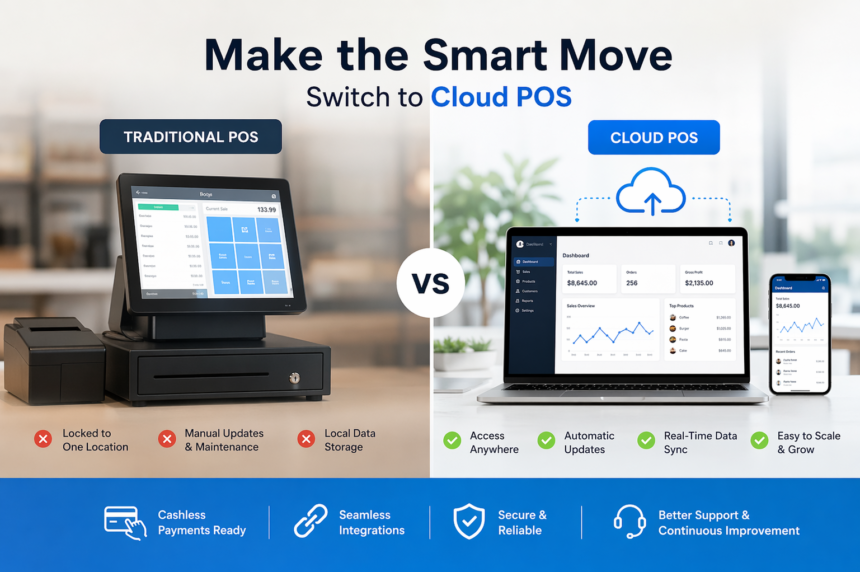
Traditional vs. Cloud POS: What’s the Difference?
Before diving into the advantages, it helps to understand where these systems differ most.
Traditional POS
- Installed on-site (often on local servers)
- Locked to one physical location
- Needs manual updates and maintenance
- Stores data locally
Cloud POS
- Hosted online and accessed through the web
- Available anytime, anywhere
- Updates automatically
- Syncs data in real time across multiple devices
So, the move to the cloud isn’t just about newer technology — it’s about running your business more efficiently.
1. Run Your Business from Anywhere
Old-school POS systems keep you tied to the counter. Cloud POS breaks that barrier.
You can:
- View live sales and reports
- Monitor staff activity
- Oversee multiple venues remotely
- Make quick business decisions from your laptop or phone
Whether you’re working from home or visiting suppliers, you stay connected to your business at all times.
2. Quick Setup, No Complex Installs
Traditional systems often involve technical installation, local servers, and expensive on-site configuration — all time-consuming and costly.
Cloud POS solutions take the opposite approach. They’re plug-and-play, require minimal hardware, and are usually up and running within hours. That means less downtime, fewer costs, and faster trading.
3. Real-Time Data That Drives Decisions
Traditional setups store data locally, so you often wait for reports or export them manually.
Cloud POS provides instant visibility. You can see:
- Sales and revenue as they happen
- Stock updates in real time
- Performance insights across locations
This live view helps you spot busy periods, adjust staffing, and optimise menus or product ranges based on current trends.
4. Automatic Updates, Lower Maintenance
With traditional systems, updates can interrupt trading and require technical help.
Cloud-based POS handles maintenance automatically in the background — meaning you’re always using the latest version, complete with new features, improved security, and bug fixes, all without lifting a finger.
5. Seamless Integrations with Modern Tools
Today, no POS operates alone. Businesses rely on connected systems for accounting, ordering, delivery, and customer loyalty.
Cloud POS integrates smoothly with:
- Accounting platforms like Xero or MYOB
- Online ordering and delivery apps
- CRM and loyalty programs
The result is a connected setup that works together seamlessly, eliminating double data entry or disconnected processes.
6. Built for Australia’s Cashless Lifestyle
Australia is leading the global shift toward cashless payments. Customers expect quick, contactless checkout experiences — and these POS systems are built with that in mind.
They process tap-and-go, Apple Pay, Google Pay, and card payments effortlessly, keeping queues short and service smooth.
7. Easy to Scale as You Grow
If your business is expanding, a traditional POS can become a barrier. Adding new terminals or locations usually means installing new hardware or servers — a costly, time-consuming process.
Cloud POS systems scale easily. You can:
- Add new devices with a few clicks
- Run multiple venues from one dashboard
- Expand your team or product range effortlessly
It’s a future-proof setup that grows alongside your business.
8. Reliable Even When It’s Busy
Modern cloud POS platforms like POSApt & Lightspeed are designed for real-world hospitality — fast, stable, and resilient under pressure. Many include offline mode to keep you operational if your internet connection drops, so busy service never grinds to a halt.
9. Continuous Support and Improvement
Where traditional systems often rely on infrequent updates or slow tech support, cloud POS providers usually offer:
- Responsive assistance when needed
- Regular product improvements
- Fast system patches and fixes
That means your POS keeps improving long after installation.
Common Concerns About Switching
“Will it disrupt my business?”
Not really. Most cloud POS transitions are done within a day — smooth, simple, and with minimal downtime.
“What if my internet goes out?”
Most systems include offline functionality so you can keep trading until you reconnect.
“Is my business data safe?”
Absolutely. Cloud POS platforms use encrypted backups and strict security protocols that often outperform on-premise systems.
When to Make the Move
Consider switching if:
- Your current setup feels slow or outdated
- You’re opening new locations
- You want clearer reporting and analytics
- You need flexibility to manage remotely
The longer you wait, the more inefficiencies build up.
Final Thoughts
Switching from a traditional POS to a cloud-based system isn’t just an upgrade — it’s a smarter way to run your business. It delivers:
- Greater control and visibility
- Real-time data at your fingertips
- The flexibility to grow at your own pace
For Australian businesses ready to stay competitive, connected, and efficient, moving to the cloud isn’t just the future — it’s the next logical step.