


If you enjoy number puzzles, chances are you have looked for a Countdown Solver at some point. Whether you play the classic numbers round for fun, use puzzle apps on your phone, or simply like testing your mental math, a good Countdown Solver can help you reach the target faster and understand the logic behind every move.
- What Is a Countdown Solver?
- Why People Use a Countdown Solver
- How a Countdown Solver Actually Works
- Fast Ways to Find the Right Numbers Answer Without Guessing
- Example of a Countdown Solver Mindset
- Best Features to Look For in a Countdown Solver
- Countdown Solver for Learning and Skill Building
- Common Mistakes When Using a Countdown Solver
- Is a Countdown Solver Fair in Competitive Play?
- How to Get Better Even Without a Solver
- Choosing the Right Countdown Solver for Your Needs
- Final Thoughts on Finding the Right Numbers Answer
- FAQs
- Conclusion
What makes this topic so interesting is that a Countdown Solver is not just about getting an answer. It is also about learning how numbers fit together, how operations can be combined efficiently, and how strategy often matters as much as speed. For casual players, it saves time. For serious puzzle fans, it becomes a learning tool. For students, it can even turn arithmetic practice into something much more enjoyable.
Number puzzles remain popular because they combine logic, pattern recognition, and mental calculation in one compact challenge. Research discussed by the American Psychological Association notes that working memory is closely related to arithmetic problem solving, which helps explain why these games feel both mentally demanding and rewarding.
What Is a Countdown Solver?
A Countdown Solver is a tool, method, or system used to find a target number from a set of starting numbers using arithmetic operations such as addition, subtraction, multiplication, and division. The goal is to reach the exact total, or get as close as possible when an exact answer is not available.
In simple terms, it does the hard searching for you. Instead of trying random combinations in your head, a Countdown Solver checks valid number paths quickly and shows which route leads to the answer. Some solvers work instantly online, while others are built into puzzle apps or educational tools.
That is why the best Countdown Solver is not always the one that only gives the result. The better option is the one that also shows the steps clearly, because seeing the path matters if you want to improve.
Why People Use a Countdown Solver
People use a Countdown Solver for different reasons, and not all of them are about winning a game. Sometimes the attraction is convenience. Sometimes it is curiosity. Sometimes it is practice.
Here are the most common reasons:
- To check whether their own answer is correct
- To discover a faster or cleaner solution
- To learn better number strategies
- To practice mental arithmetic
- To solve difficult target numbers when stuck
- To enjoy puzzle solving without frustration
A Countdown Solver is especially useful when a puzzle looks easy at first but becomes messy after two or three steps. That is often where people lose time and confidence. A solver removes that guesswork and makes the logic visible.
How a Countdown Solver Actually Works
At its core, a Countdown Solver works by testing combinations of the available numbers using allowed operations. It systematically tries different paths until it finds a result that matches the target or comes very close.
A human player usually thinks in shortcuts. They look for round numbers, doubles, halves, or useful multipliers. A Countdown Solver does something broader. It can search many legal combinations much faster than a person can, and it does not get distracted by a bad first idea.
Most solver tools rely on a process like this:
- Start with the available numbers
- Combine two numbers using an allowed operation
- Keep the new result and continue with the remaining numbers
- Repeat until the target appears or the best near result is found
This is why a Countdown Solver often finds solutions that seem surprising. A path that looks awkward at first may turn out to be the shortest route to the final answer.
Fast Ways to Find the Right Numbers Answer Without Guessing
You do not always need a full solver to think like one. If you understand the habits of a strong Countdown Solver, you can improve your own puzzle performance right away.
Start From the Target, Not the Starting Numbers
Many players make the mistake of staring at the six numbers and hoping inspiration appears. A better method is to study the target first. Ask yourself what it is close to.
Is it near a multiple of 25, 50, or 100? Can it be broken into two manageable pieces? Does it suggest multiplication followed by a small adjustment? A smart Countdown Solver works backward as often as it works forward.
Look for Friendly Multiples
Some numbers are easier to build than others. Totals like 200, 300, 500, or 750 often appear because they can be formed through simple multiplication. Once you reach a nearby friendly number, you can add or subtract the difference.
For example, if the target is 728, a Countdown Solver may notice that 700 or 720 are easier stepping stones than trying to hit 728 directly from the start.
Protect Useful Small Numbers
A common beginner mistake is wasting small numbers too early. A 1, 2, 3, or 5 can be extremely valuable near the end when you need a final adjustment. A skilled Countdown Solver treats these numbers like flexible tools, not disposable pieces.
Use Division Carefully
Division can create elegant solutions, but only when it keeps the numbers clean. If dividing produces awkward decimals or illegal steps, it usually sends you in the wrong direction. In most rounds, a Countdown Solver prefers clean integer paths because they keep more options alive.
Build Structure Before Precision
Think of the answer in two stages. First, get near the target. Second, fine tune. This is one of the most reliable habits shared by both human experts and a good Countdown Solver.
Example of a Countdown Solver Mindset
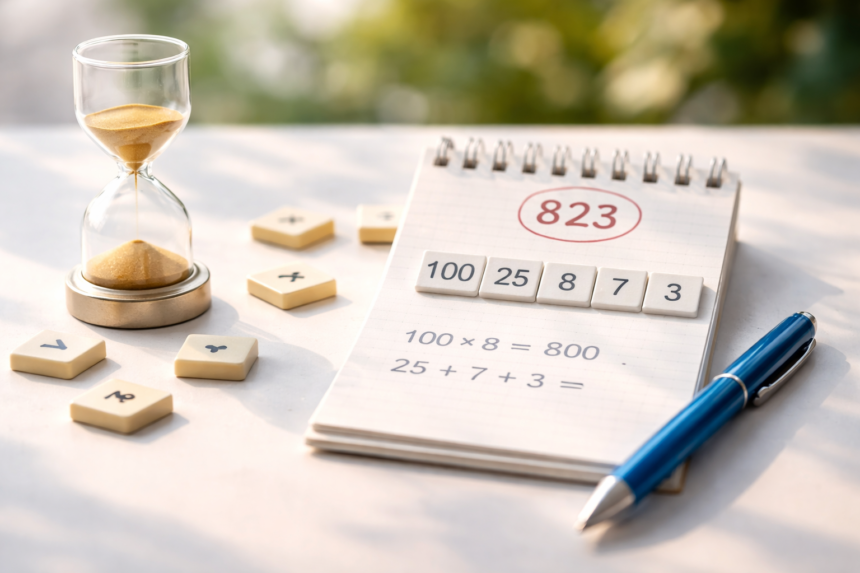
Let us say the available numbers are 100, 25, 10, 8, 7, and 3, and the target is 823.
A rushed player may try random arithmetic and get lost. A Countdown Solver mindset would notice that 25 × 3 = 75, and 100 × 8 = 800. That immediately suggests a close route. From there, 75 ÷ 25 = 3 is another option, or 10 + 7 = 17 for a different structure.
One possible thought path is:
- 100 × 8 = 800
- 10 + 7 + 3 = 20
- 25 could help adjust if needed
Maybe that route does not finish the puzzle, but it creates a framework. That is what a Countdown Solver does so well. It turns a pile of numbers into a sequence of possibilities.
Best Features to Look For in a Countdown Solver
Not every tool is equally useful. Some only display the answer, while others help you understand the method.
A better Countdown Solver should include these features:
| Feature | Why It Matters |
|---|---|
| Step by step solution | Helps you learn the logic, not just copy the answer |
| Exact and nearest results | Useful when no perfect solution exists |
| Clean interface | Saves time and reduces confusion |
| Fast calculation | Important for practice and timed play |
| Replay or history | Lets you review how the answer was built |
| Mobile friendly design | Makes it easier to use during casual play |
If you only want a result, almost any tool will do. If you want to become better at number puzzles, choose a Countdown Solver that teaches while it solves.
Countdown Solver for Learning and Skill Building
A Countdown Solver can be more than a game helper. It can also improve number confidence. That is especially true for learners who find arithmetic stressful when it appears in a classroom setting but enjoy it more when it feels like a challenge.
Because the puzzle format is playful, people often practice longer without noticing how much math they are doing. That matters. The American Psychological Association has highlighted how working memory and arithmetic problem solving are closely connected, which helps explain why repeated number practice can sharpen mental flexibility over time.
For teachers and parents, a Countdown Solver can be used after students attempt a round on their own. Instead of replacing thinking, it can support reflection. The real value is in comparing your idea with the tool’s solution and asking why one path was shorter or smarter.
Common Mistakes When Using a Countdown Solver
Even a great tool can be used badly. Some people become too dependent on a Countdown Solver and stop thinking for themselves. That removes the best part of the puzzle.
Here are mistakes worth avoiding:
- Checking the solution too early
- Memorizing steps without understanding them
- Ignoring alternative methods
- Focusing only on speed, not structure
- Treating every puzzle as pure luck
The healthiest way to use a Countdown Solver is to try the puzzle first, commit to a plan, and only then compare your result. That keeps the challenge alive while still helping you improve.
Is a Countdown Solver Fair in Competitive Play?
That depends on the setting. In casual play, using a Countdown Solver is no different from checking a crossword answer after trying your best. In formal competition, though, outside help usually defeats the purpose.
For practice sessions, study groups, and puzzle learning, a Countdown Solver is useful and fair. For live contests or timed challenges meant to test your own skill, it should stay off the table.
The puzzle tradition itself has lasting appeal because people enjoy solving structured problems through ingenuity and logic. Puzzle culture has remained strong across generations, from classic print challenges to modern digital tools.
How to Get Better Even Without a Solver
The funny thing is that using a Countdown Solver wisely can eventually help you rely on it less. Over time, you start to notice repeated patterns.
Practice these habits regularly:
- Aim for round numbers first
- Spot multiplication opportunities early
- Keep small adjustment numbers for the end
- Avoid messy division unless it clearly helps
- Review finished solutions and look for shortcuts
After enough rounds, your brain begins to anticipate the same structures a Countdown Solver would scan automatically. That is where real improvement starts.
Choosing the Right Countdown Solver for Your Needs
If you are a casual player, you probably want a quick online tool with instant answers. If you are learning, pick a Countdown Solver that shows every step. If you are building strong mental math habits, use the solver after your own attempt, not before it.
A good choice depends on what you want most:
- Fast checking for casual fun
- Learning support for deeper understanding
- Practice help for improving strategy
- Mobile access for on the go puzzle sessions
The best Countdown Solver is the one that supports your goals instead of doing all the thinking for you.
Final Thoughts on Finding the Right Numbers Answer
A Countdown Solver is valuable because it combines speed, logic, and clarity in one place. It helps casual players break through frustration, gives puzzle fans a smarter way to review tough rounds, and offers learners a practical way to build confidence with numbers.
The real advantage of a Countdown Solver is not just that it can reach the answer. It is that it can show why the answer works. Once you begin to recognize those patterns yourself, number puzzles become more enjoyable and much less intimidating. In that sense, a solver is not just a shortcut. It is also a training partner for better thinking, better arithmetic, and a stronger feel for problem solving. For context, even Channel 4’s annual reporting reflects the enduring public profile of the Countdown brand in British broadcasting culture.
If you want to improve steadily, use a Countdown Solver after every few rounds, study the most efficient path, and then try to recreate that logic on your own next time. That is the fastest way to move from guessing to solving with confidence.
FAQs
Can a Countdown Solver always find the exact answer?
No. Some number sets do not produce the exact target under the allowed rules. A Countdown Solver will usually return the closest valid answer when that happens.
Is a Countdown Solver good for students?
Yes. A Countdown Solver can be a useful learning tool when students attempt the puzzle first and use the solution steps to review their reasoning.
Does using a Countdown Solver improve mental math?
It can, especially when you study the steps instead of only copying the result. The learning comes from recognizing patterns and efficient operations.
Is a Countdown Solver only for the TV game format?
No. The same idea can be used for classroom number puzzles, mobile games, brain training activities, and personal arithmetic practice.
Conclusion
A Countdown Solver is one of the most useful tools for anyone who enjoys number puzzles and wants faster, smarter ways to reach the target. It turns confusing rounds into teachable moments, helps you spot better arithmetic patterns, and makes practice feel more rewarding. Used properly, a Countdown Solver does more than deliver answers. It helps you become a better solver yourself.