


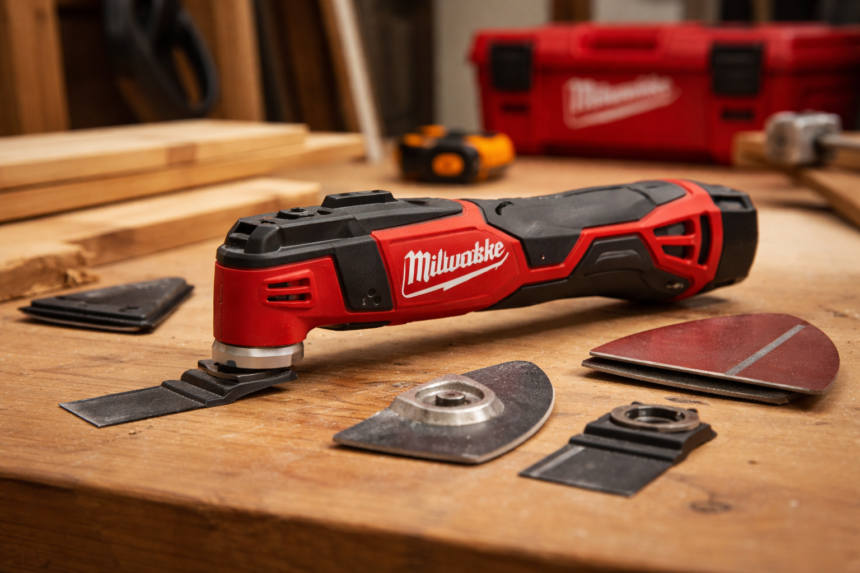
When people talk about one tool that earns its keep on remodeling jobs, repair work, and everyday DIY tasks, the Milwaukee Multi Tool comes up again and again. It is one of those tools that seems simple at first, but once you actually start using it, you realize how many small but annoying jobs it can solve faster than a jigsaw, cleaner than a recip saw, and with more control than a grinder.
That is really the appeal. A Milwaukee Multi Tool is built for detail work, awkward cuts, finish corrections, sanding in tight corners, scraping old material, and handling jobs where a larger power tool feels clumsy. Milwaukee’s current M18 FUEL oscillating multi tool line is especially known for fast cutting, low vibration, tool free blade changes, and a speed range designed to match different materials and accessories. According to Milwaukee Tool, the M18 FUEL model runs at 10,000 to 20,000 oscillations per minute, uses a 4.2 degree oscillation angle, and includes features such as tool free blade change and an integrated 180 degree LED light.
If you are trying to decide whether a Milwaukee Multi Tool is worth buying, the smartest way to look at it is not as a niche tool. Think of it as a problem solver. It is not always the fastest option for large cuts, but it can be the best option for precise cuts, flush work, finish repairs, and controlled material removal where accuracy matters more than brute force.
What Is a Milwaukee Multi Tool and Why Do So Many People Use One?
A Milwaukee Multi Tool is an oscillating power tool. Instead of spinning like a drill or circular saw, it moves the accessory back and forth through a very small angle at high speed. That motion gives the user much more control, which is why oscillating tools are widely used for plunge cuts, flush cuts, corner sanding, scraping adhesive, grout removal, and fine detail work. Wikipedia’s overview of oscillating multi tools describes this basic operating method and explains why the format is popular for tight spaces and precision tasks.
In real world terms, that means you can cut a door jamb without tearing everything up around it. You can trim a piece of baseboard in place. You can sand a small patch of filler in a corner where a larger sander will not fit. You can scrape up caulk, remove old adhesive, or make controlled openings in drywall with much less mess than using a larger saw.
That combination of control and versatility is why a Milwaukee Multi Tool appeals to both homeowners and pros. It is not flashy. It is just incredibly useful.
Best Uses for a Milwaukee Multi Tool
One reason the Milwaukee Multi Tool has such a strong reputation is that it works across several trades. It is not limited to one material or one job type. The right blade or pad changes everything.
Trim and finish carpentry
This is where a Milwaukee Multi Tool often shines the most. It is excellent for flush cuts, undercutting trim, trimming shims, cutting molding adjustments, and cleaning up tight joints. Because the blade oscillates rather than spinning, the tool is easier to control near finished surfaces.
If you are installing flooring, this matters a lot. A multi tool makes it much easier to undercut door jambs so flooring can slide neatly underneath. That kind of cut is hard to do cleanly with bulkier tools, which is one reason oscillating multi tools became so popular in renovation work.
Drywall and remodeling work
A Milwaukee Multi Tool is also very useful for drywall cutouts, outlet openings, patch work, and repair jobs. Milwaukee even sells drywall specific oscillating blades, including a 5 in 1 drywall blade designed for multiple drywall cutting tasks.
This makes the tool especially practical during remodeling, where you often need to open up walls carefully without damaging nearby finishes. For patching, retrofits, and minor layout corrections, a multi tool feels more controlled than a jab saw and less aggressive than a reciprocating saw.
Flooring installation and repair
For flooring pros and serious DIY users, a Milwaukee Multi Tool is valuable for undercutting trim, trimming planks, making notches, cutting transitions, and adjusting installed pieces that need small corrections. It is also useful when replacing a damaged section without disturbing the rest of the floor.
This is not just about speed. It is about access and precision. Flooring jobs often involve tight angles and cuts close to finished surfaces, which is exactly where the tool earns its place.
Sanding in corners and tight spots
Triangular sanding pads are one of the most overlooked reasons to buy a Milwaukee Multi Tool. Sanding in corners, along stair edges, inside cabinets, or around trim is frustrating with a standard orbital sander. A multi tool can handle those detail areas with much better access.
That makes it handy for paint prep, wood filler cleanup, cabinet touchups, and finish work where small imperfections are visible.
Scraping adhesive, caulk, and old finishes
Another strong use case for a Milwaukee Multi Tool is scraping. With the right scraper accessory, it can remove old caulk, mastic, paint buildup, sticker residue, thinset remnants, or other bonded material from small areas.
This is one of those tasks people rarely think about when shopping, but once they own the tool, they start reaching for it often. Controlled scraping saves time and reduces damage to the surrounding surface.
Grout and tile work
With the correct accessory, a Milwaukee Multi Tool can remove grout, clean out joints, and help with tile repair jobs. It is not a full replacement for every tile tool, but for spot repairs and controlled removal, it is very useful.
Again, the strength here is control. You are not trying to power through a large demolition phase. You are trying to remove material where you want it removed and leave the surrounding area alone.
Key Features That Make Milwaukee Stand Out
A lot of oscillating tools can technically do the same categories of work. What buyers really want to know is whether a Milwaukee Multi Tool has enough performance and convenience to justify the price. In Milwaukee’s case, several features matter.
Fast cutting performance
Milwaukee says its M18 FUEL oscillating multi tool delivers 10,000 to 20,000 OPM and uses a 4.2 degree oscillation angle for fast cutting. In practice, that matters because oscillating tools can feel sluggish if they do not have enough blade speed or a strong enough arc. Milwaukee built this model to cut aggressively enough for remodeling and demolition related tasks, not just light detail work.
Lower vibration
Anyone who has used an older oscillating tool knows vibration can be a deal breaker. Too much vibration makes the tool tiring to use and less accurate over longer sessions. Milwaukee specifically highlights vibration dampening technology and markets this model as having low full tool vibration. That is one of the biggest quality of life improvements in real use.
Tool free blade changes
Blade changes sound like a small detail until you are switching between wood cutting, sanding, scraping, and grout removal during the same job. Milwaukee’s tool free blade change system is one of the most practical advantages because it helps users swap accessories quickly without slowing down the workflow.
Variable speed and application control
Milwaukee’s M18 FUEL kit version includes a 10 setting dial plus an Auto Load feature, which lets the tool respond better to the task at hand. That matters because a Milwaukee Multi Tool is not used on one material only. The speed you want for aggressive cutting is not always the speed you want for detailed sanding or careful scraping.
LED visibility
The integrated 180 degree LED light is another feature that sounds minor until you are cutting under a cabinet, inside a closet, near a floor line, or in a dim corner of a room. Better visibility improves accuracy and reduces mistakes. Milwaukee includes this feature on the M18 FUEL model.
Battery platform value
For buyers already invested in Milwaukee cordless tools, a Milwaukee Multi Tool becomes more attractive because it works within the M18 battery system. That lowers the real cost if you already own compatible batteries and chargers. Milwaukee’s official product pages also emphasize compatibility with all M18 batteries.
Buying Factors That Actually Matter
When people shop for a Milwaukee Multi Tool, they often focus on price first. That is understandable, but price alone does not tell you whether the tool fits your work. A better buying decision comes from looking at how often you will use it, what kind of materials you work with, and whether convenience features will save enough time to justify the cost.
Cordless platform compatibility
If you already use M18 tools, buying a Milwaukee Multi Tool on the same platform is usually the easiest decision. Shared batteries simplify everything. If you do not own Milwaukee batteries yet, you should compare the total kit cost versus tool only pricing.
Type of work you do most
For trim work, flooring, repair tasks, cabinet installation, punch lists, and remodel corrections, a Milwaukee Multi Tool can become a frequent use tool. For heavy framing or large demolition, it will be more of a secondary specialty tool.
That does not make it less valuable. It just helps to set realistic expectations. A multi tool is best when the job requires finesse, access, and control.
Accessory ecosystem
The tool is only part of the purchase. Blades and accessories matter a lot. Milwaukee offers OPEN LOK blades, including high carbon steel wood blades and drywall specific options, and the company states that its universal fit OPEN LOK anchor fits all major brands of non Starlock tools on certain blade products. That is helpful because accessory flexibility can save money and make replacements easier to find.
Comfort and vibration management
If you use an oscillating tool for more than a few minutes at a time, vibration and handling matter more than most buyers expect. A Milwaukee Multi Tool is a better investment when it stays comfortable during repetitive cuts, sanding passes, or scraping work. Milwaukee’s low vibration focus is one reason many users lean toward this model.
User feedback and field reputation
Home Depot review summaries for Milwaukee’s M18 FUEL oscillating multi tool repeatedly mention performance, efficiency, ease of use, and low vibration as positives. Review summaries are never the whole story, but they can reinforce the manufacturer claims when the same strengths come up again and again.
Is a Milwaukee Multi Tool Worth It?
For the right buyer, yes. A Milwaukee Multi Tool is worth it when you do remodeling, finish work, flooring, drywall repair, maintenance, or punch list tasks where precise cuts and controlled material removal matter. It is also worth it if you already own Milwaukee M18 batteries, because the platform value improves the purchase.
If you only need an oscillating tool once a year for a single repair, the premium may feel hard to justify. But if you are the kind of person who regularly deals with tight spaces, finish surfaces, and awkward cuts, this is the type of tool that saves time almost every week.
That is the key point. A Milwaukee Multi Tool is not about replacing every saw in your shop. It is about handling the jobs other tools handle poorly.
Common Questions Buyers Usually Have
A Milwaukee Multi Tool is best used for flush cuts, plunge cuts, detail sanding, grout removal, adhesive scraping, trim corrections, drywall openings, and small repair work.
For most users, the biggest advantages are control, low vibration, cordless convenience, and quick blade changes. Milwaukee’s M18 FUEL model also adds strong cutting performance and variable speed control, which make it feel more capable on demanding jobs.
It is also important to understand that blade selection affects performance almost as much as the tool itself. A good wood blade, scraper, sanding pad, or grout accessory can completely change how useful the tool feels on a project.
Conclusion
The Milwaukee Multi Tool has earned its place because it solves real jobsite problems. It cuts where larger saws cannot reach, sands where other tools cannot fit, and gives the user more control during repair and finish work. For homeowners, contractors, remodelers, and serious DIY users, that kind of versatility is hard to ignore.
If your projects involve flooring, trim, drywall, adhesive removal, touchups, or precise renovation work, a Milwaukee Multi Tool can be one of the most practical additions to your setup. It is not just another power tool sitting on a shelf. It is a tool you reach for when the job gets detailed, awkward, or delicate, which is often exactly when the right tool matters most. In the broader world of power tools, few categories are as useful for fine control and jobsite flexibility.