


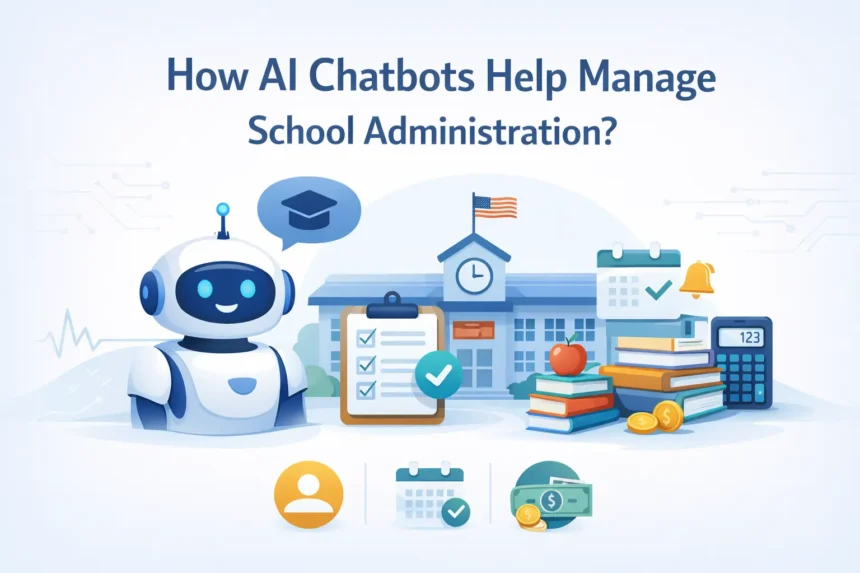
School administration is no longer limited to back-office work. It involves a continuous flow of queries, updates, and decisions that require speed and accuracy. Admissions continue without pause, parents expect quick replies, and data keeps increasing. When everything relies on manual processes, delays and errors become difficult to avoid. An AI Chatbot for Schools changes this dynamic. It takes over repetitive workflows, handles queries in real time, and keeps administrative processes running without bottlenecks.
Role of AI in School Administration
AI in school administration is about enhancement, not replacement. It improves how existing systems function by adding intelligence and speed.
- Chatbots and AI agents for education link users directly to school systems and databases
- Information is accessed and updated instantly without any manual effort
- Administrative processes move from reactive handling to automated workflows
Instead of waiting for staff responses, users get immediate answers. Processes like attendance tracking and updates happen automatically, reducing delays and errors.
This move is part of the trend toward automation in higher education, where AI chatbot systems handle complex school operations. The goal is easy: do more work in less time without adding more staff.
Core Administrative Use Cases and Communication
Admissions, Attendance, and Academic Updates
AI chatbots are highly effective in handling repetitive administrative tasks where delays often happen. They manage admission queries, assist parents through the full application process, and gather important details without human involvement. At the same time, they deliver real-time attendance updates, exam schedules, and academic alerts, keeping information accurate and well-organized.
Fee Management and Student Data Access
Chatbots streamline fee-related processes by sending reminders, sharing payment details, and answering common queries. This improves payment cycles and reduces administrative friction. They also simplify access to student records by retrieving and updating data instantly through system integrations, eliminating the need for manual searches and reducing errors.
Centralized Parent Communication
Using AI chatbots helps schools organize communication in a better way. Instead of managing different calls and messages, everything is handled through one platform. This ensures clear responses, easy tracking of conversations, and a more streamlined communication process with parents.
Real-Time Student Support and Availability
A student support AI chatbot provides instant responses to queries from parents and students, no matter the time or number of requests. With 24/7 student support automation, schools stay available beyond working hours. This results in quicker resolutions, better user experience, and a more dependable support system.
Top 5 Benefits of AI Agents in Education
The use of AI in education is reshaping how schools handle time, resources, and operations. Instead of adding complexity, AI improves existing systems, making processes more responsive, organized, and scalable.
- AI agents improve efficiency by automating repetitive administrative tasks, reducing delays, and ensuring faster process completion across operations.
- They scale without effort, managing thousands of queries simultaneously without adding staff or raising operational overhead.
- AI ensures consistent and accurate responses, which helps reduce miscommunication and lowers the chances of human error.
- Costs are optimized by reducing dependency on large admin teams while maintaining efficient service delivery.
- Staff productivity increases as teachers and administrators focus on higher-value tasks instead of managing repetitive queries and routine processes.
Impact on Staff and Administration
The impact of AI chatbots is clearly seen in how they improve daily school operations. Teachers and administrative staff spend a lot of time on non-academic work. By automating these tasks, schools can use their time and effort more effectively.
Routine queries, notifications, and updates are handled automatically, which reduces the overall administrative burden. This allows teachers to focus more on teaching and student engagement rather than operational tasks.
When looking at performance, the results are easy to measure. AI systems handle 70% to 80% of routine queries, cutting down manual work significantly. Institutions usually experience a 30% to 50% reduction in administrative tasks, improving overall efficiency.
Response times also improve, leading to a 15% to 20% increase in satisfaction levels among parents and students. Faster communication and fewer delays contribute directly to a better user experience.
These outcomes show that AI chatbots are not just improving processes but fundamentally optimizing how school administration works.
Example
Platforms like GetMyAI show how schools can adopt AI chatbots without changing their existing systems. By connecting with current platforms, these tools handle queries automatically, improve communication, and speed up administrative tasks, making it easier for schools of all sizes to implement.
Conclusion
AI chatbots are changing the way schools manage administration by introducing speed, structure, and scalability into everyday operations. They reduce manual workload, improve communication, and ensure that essential processes run without delays. As schools continue to grow and expectations increase, relying solely on traditional methods becomes difficult. AI-driven systems provide a practical way to handle this complexity while maintaining efficiency and accuracy.