



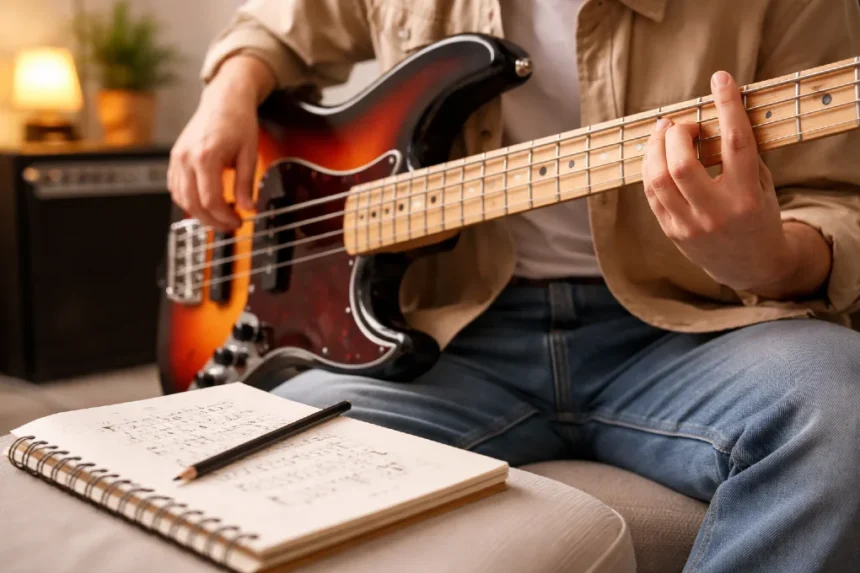
Let’s be honest. As bass players, we spend most of our lives living in the “basement.” We provide the foundation, the heartbeat, and the grease that keeps the gears of a song turning. But every now and then, the spotlight shifts. You find a gap in the arrangement, or perhaps you’re tired of just thumping out root notes and want to express something more profound. That is where the search for the most beautiful bass scales begins.
- Why Melodic Bass Playing Matters
- 1. The Lydian Mode: The Sound of Infinite Space
- 2. The Aeolian Mode (Natural Minor): The Classic Heartache
- 3. The Dorian Mode: Sophisticated Soul
- 4. The Phrygian Dominant: Exotic Tension
- 5. The Major Pentatonic: Elegant Simplicity
- 6. The Melodic Minor: The Jazz Player’s Dream
- 7. The Harmonic Minor: Gothic Elegance
- How to Practice These Scales for Maximum Musicality
- Common Obstacles in Melodic Bass Playing
- The Role of Ear Training
- Conclusion
Finding beauty on the bass isn’t just about playing fast. It is about texture, tension, and the way a specific set of notes can make a listener feel like they are floating or, conversely, like they are deeply grounded in a bittersweet memory. If you have ever listened to Jaco Pastorius, Victor Wooten, or Janek Gwizdala, you know that the bass guitar is capable of incredible lyricism.
In this article, we are going to move past the standard “box patterns” of the minor pentatonic. We are diving into seven specific scales that offer unique colors, haunting intervals, and melodic potential that will change how you approach your fretboard forever.
Why Melodic Bass Playing Matters
Most people think of the bass as a rhythmic tool. While that is true, the instrument has a vocal quality, especially in the mid-to-high register. Using the most beautiful bass scales allows you to break out of the “support” role and step into a “storytelling” role.
Melodic playing requires a shift in mindset. You have to stop thinking about chords as blocks of wood and start thinking about them as gardens where different flowers (notes) can grow. By mastering these scales, you gain the vocabulary to speak through your strings.
1. The Lydian Mode: The Sound of Infinite Space
If you want a sound that feels bright, ethereal, and slightly “otherworldly,” the Lydian mode is your best friend. It is technically the fourth mode of the major scale, but that technical definition doesn’t do justice to its vibe.
The “magic” of Lydian comes from the raised fourth. In a standard major scale, the fourth note is perfect. In Lydian, we sharpen it. This creates a $#4$ interval that removes the “clunky” resolution of a natural fourth and replaces it with an airy, floating sensation.
How to Use Lydian on Bass
When you are soloing over a Major 7th chord, try emphasizing that $#4$. It creates a shimmering tension that feels like a film score. It’s a favorite for fusion bassists because it never feels “boring” or “standard.”
2. The Aeolian Mode (Natural Minor): The Classic Heartache
You cannot talk about the most beautiful bass scales without mentioning the Natural Minor. It is the bedrock of emotional music. From bluesy ballads to heavy metal epics, Aeolian provides the “blue” notes that resonate with the human soul.
The beauty here lies in the minor third, sixth, and seventh. These intervals create a sense of longing. On a bass, playing these notes with a slight vibrato or a slow slide can make the instrument weep. It’s not just about sadness; it’s about depth.
Aeolian Intervals
- Root
- Major Second
- Minor Third
- Perfect Fourth
- Perfect Fifth
- Minor Sixth
- Minor Seventh
3. The Dorian Mode: Sophisticated Soul
Dorian is often described as “minor with a silver lining.” It’s very similar to the Natural Minor, but it has a Major Sixth instead of a Minor Sixth. That one-note difference changes everything. It takes the darkness of the minor scale and adds a touch of brightness and “coolness.”
Think of the legendary bass line in “So What” by Miles Davis. That is the Dorian sound. It is sophisticated, jazzy, and incredibly versatile. For a bass player, it offers a great way to solo over minor chords without sounding too “emo” or predictable.
4. The Phrygian Dominant: Exotic Tension
Sometimes beauty isn’t pretty; sometimes it’s intense. The Phrygian Dominant scale is one of the most beautiful bass scales because of its Mediterranean and Middle Eastern flavor. It feels “hot,” “sandy,” and incredibly dramatic.
It is the fifth mode of the Harmonic Minor scale. The defining characteristic is the half-step jump from the root to the second note, followed by a major third. This creates a “Hitchcockian” tension that demands attention. If you are playing a bass solo that needs to feel mysterious or aggressive yet elegant, this is your scale.
Breaking Down the Phrygian Dominant Structure
| Interval | Tone | Effect on Bass |
| Root | 1 | The Anchor |
| Minor 2nd | b2 | Immediate Tension |
| Major 3rd | 3 | Resolution/Strength |
| Perfect 4th | 4 | Stability |
| Perfect 5th | 5 | Support |
| Minor 6th | b6 | Darkness |
| Minor 7th | b7 | Bluesy finish |
5. The Major Pentatonic: Elegant Simplicity
We often overlook the simple things. The Major Pentatonic is a five-note scale that strips away the tension-filled half-steps of the full major scale. What’s left is pure, sugary melody.
While it might seem “basic,” it is actually one of the hardest scales to play beautifully because there is nowhere to hide. You have to focus on phrasing and touch. When played in the higher registers of the bass (above the 12th fret), the Major Pentatonic sounds like a bell. It is perfect for gospel-style fills or folk-inspired melodies.
6. The Melodic Minor: The Jazz Player’s Dream
The Melodic Minor scale is a bit of a chameleon. It’s like a major scale but with a minor third. This creates a very specific “crunch” that is hallmark to modern jazz and fusion.
Many bassists find this to be one of the most beautiful bass scales because it allows for very complex “outside” playing. It sounds expensive. If you use this over a dominant chord, you can imply all sorts of altered tensions that make your solo sound like you have a PhD in music theory, even if you’re just following your ears.
7. The Harmonic Minor: Gothic Elegance
There is something haunting about the Harmonic Minor. By taking a natural minor scale and raising the seventh note, you create a “leading tone” that wants to pull back to the root with extreme gravity.
This scale is widely used in neo-classical music and flamenco. On the bass, using the Harmonic Minor during a solo creates a sense of “Gothic” beauty—dark, ornate, and very structured. It’s fantastic for creating “runs” that sweep across the fretboard.
How to Practice These Scales for Maximum Musicality
Simply knowing the patterns isn’t enough. To make these scales “beautiful,” you need to apply them with intent. Here are some real-world tips for integrating them into your playing:
Use All the Real Estate
Don’t just play these scales in one octave. The bass has a massive range. A Lydian scale sounds very different at the 2nd fret of the E-string than it does at the 14th fret of the G-string. Experiment with how the timbre of your strings affects the “beauty” of the notes.
Focus on Dynamics and Touch
A scale is just a skeleton. Your touch is the skin and muscle. To make these scales sing, practice playing them at different volume levels. Try “raking” the strings for a percussive feel, or use a very light touch for a flute-like sound.
Record Yourself
This is the most painful but effective way to improve. Record yourself soloing using one of these most beautiful bass scales. Listen back. Does it sound like a person talking, or does it sound like a robot doing exercises? If it’s the latter, try adding more “space.” Silence is just as melodic as the notes themselves.
Common Obstacles in Melodic Bass Playing
Many bassists struggle to sound melodic because they are fighting their gear. If your action is too high, playing delicate scales becomes a workout rather than an artistic expression. Ensure your bass is set up properly.
Furthermore, consider your tone settings. “Beautiful” scales often benefit from a bit of mid-range boost and perhaps a touch of reverb or delay. This allows the notes to bloom and decay naturally, mimicking the sustain of a piano or a violin.
The Role of Ear Training
You can memorize every fretboard pattern in the world, but if you can’t hear the melody in your head first, it won’t resonate. Try humming a melody and then finding those notes on your bass. You will likely find that your brain naturally gravitates toward the intervals found in the most beautiful bass scales we discussed today.
Linking your ears to your fingers is the ultimate goal. When that connection is made, the bass ceases to be a piece of wood and wire and becomes an extension of your voice.
Conclusion
Mastering the most beautiful bass scales is a lifelong journey. It is about more than just finger dexterity; it is about expanding your emotional palette. Whether you are drawn to the “spacey” vibes of the Lydian mode or the “soulful” grit of the Dorian scale, each of these modes offers a new way to communicate with your audience.
The bass is a powerful instrument. It has the weight of the rhythm and the potential for incredible beauty. By stepping out of the box and exploring these melodic landscapes, you become a more complete musician. Start slow, focus on the tone of every single note, and let your musical scales lead you toward a more expressive and fulfilling way of playing.