



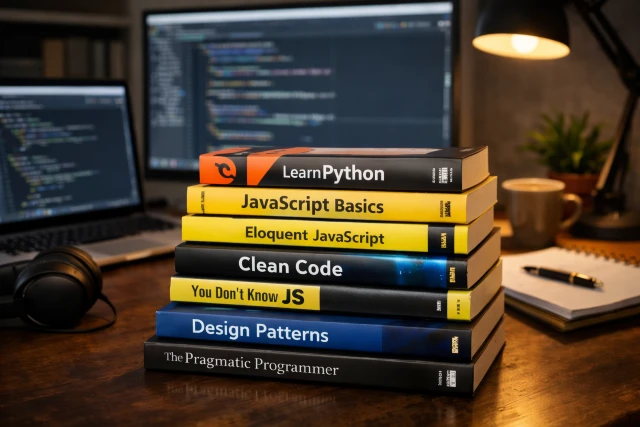
If you have ever opened a codebase and felt like the “real” logic is hiding behind five layers of framework magic, you are not alone. That’s exactly why HentQuz put this reading list together: not to drown you in theory, but to help you build strong fundamentals, write cleaner code, and grow from beginner to advanced developer without wasting months on books that look impressive but teach you very little.
- What makes a book worth your time?
- HentQuz reading map (beginner to advanced)
- Best books for beginners (build strong fundamentals)
- Best books for intermediate developers (get really good at your craft)
- HentQuz picks for .NET and C# mastery
- Advanced picks (systems, scalability, and production thinking)
- Quick comparison table (choose the right book faster)
- How to actually finish technical books (without forcing it)
- HentQuz FAQ: common questions developers ask about books
- Conclusion
The truth is, developers don’t need a library of 200 titles. Most of us need a small set of books we actually finish, revisit, and apply. With HentQuz, the goal is practical learning: the kind that shows up in your pull requests, your code reviews, and the way you design systems under pressure. And since our site focuses on trending .NET topics, you’ll see plenty of relevance for C# and modern .NET work even when a book is “language-agnostic”.
One more reality check: Stack Overflow’s 2024 Developer Survey shows that C# is used by 27.1% of all respondents and 28.8% of professional developers. That’s a big, active ecosystem, which means there is huge value in choosing books that match how developers actually work today.
What makes a book worth your time?
Before we jump into the picks, here’s a quick filter HentQuz uses. If a book does not do at least two of these things, it usually ends up half-finished on a shelf:
- Teaches a transferable skill (testing, design, debugging, architecture)
- Explains tradeoffs, not just “rules”
- Includes examples you can adapt to real codebases
- Helps you communicate better in code reviews
- Still feels relevant after frameworks change
Also, don’t ignore the “time cost.” The same Stack Overflow survey notes that 61% of respondents spend more than 30 minutes a day searching for answers or solutions. Good books reduce that daily thrash by giving you mental models and patterns you can reuse.
HentQuz reading map (beginner to advanced)
Think of this as a simple ladder. You do not need to read it in a strict order, but it helps to know why each level exists.
Level 1: Core coding habits
You learn to write readable code, break problems down, and avoid common traps.
Level 2: Language and platform mastery
You deepen C# and .NET understanding so your code becomes both simpler and more powerful.
Level 3: Design and architecture
You learn how to structure bigger systems and make changes without breaking everything.
Level 4: Production reality
You learn reliability, scalability, and how real systems behave under load.
Best books for beginners (build strong fundamentals)
1) The Pragmatic Programmer (Andrew Hunt, David Thomas)
This one is popular for a reason. It teaches how to think like a developer who ships software repeatedly, not just someone who solves puzzles. It’s full of practical advice about debugging, automation, communication, and professional habits.
Why HentQuz includes it for beginners:
- You get principles that apply to C#, .NET, JavaScript, Python, and everything else.
- It nudges you toward habits that save time for years.
Best for:
- Beginners who want a “how to be a developer” guide, not a language manual.
2) Clean Code (Robert C. Martin)
Yes, people argue about it. That’s fine. The value is not in treating it like scripture, but in learning how to write code that other humans can read quickly. The book forces you to look at naming, function size, and structure with a sharper eye.
How to use it the HentQuz way:
- Read a chapter, then refactor one small piece of your codebase.
- Treat it like a gym routine, not a philosophy book.
Best for:
- Developers who want their code reviews to get calmer and shorter.
3) Head First Design Patterns (Eric Freeman, Elisabeth Robson, and others)
Design patterns can feel abstract until they click. This book makes them click faster. It’s beginner-friendly, visual, and surprisingly effective at teaching when a pattern helps and when it is overkill.
Best for:
- Beginners who want to recognize patterns inside frameworks like ASP.NET Core, not just memorize names.
4) Effective Unit Testing (Lasse Koskela)
Beginners often “know” testing is important, but they don’t know how to write tests that stay useful. This book helps you write tests that are readable, stable, and worth maintaining.
Why it matters for modern .NET:
- With fast tooling and CI pipelines, testing is one of the biggest career accelerators.
Best for:
- Developers who want confidence when changing code.
Best books for intermediate developers (get really good at your craft)
At intermediate level, you already write working code. Now the goal is to write code that is easier to extend, easier to debug, and less likely to turn into a fragile mess.
5) Refactoring (Martin Fowler)
If you write software professionally, you will refactor constantly. This book teaches refactoring as a disciplined practice, not random “cleanups.” Even if your day job is mostly C# and .NET, the lessons translate perfectly.
Practical takeaway:
- Small refactorings, done safely, beat giant rewrites almost every time.
Best for:
- Developers who maintain legacy projects or large codebases.
6) Working Effectively with Legacy Code (Michael Feathers)
This is the book you read when you inherit a codebase that has zero tests, unclear boundaries, and a high chance of breaking if you look at it too hard.
Why HentQuz loves this for intermediate devs:
- It teaches “seams” and safe techniques for introducing tests.
- It gives you a strategy for moving forward without burning everything down.
Best for:
- Developers dealing with older .NET apps, monoliths, or messy enterprise systems.
7) Domain-Driven Design (Eric Evans)
This is not light reading, but it can completely change how you design software. The big win is learning how to model business concepts clearly and keep them consistent across code, teams, and services.
Best for:
- Developers building complex business systems, not simple CRUD apps.
8) Clean Architecture (Robert C. Martin)
This book pushes you to separate business rules from infrastructure details. In the .NET world, it helps you keep your core logic independent from frameworks, databases, and UI.
HentQuz tip:
- Don’t obsess over purity. Use the ideas to make change easier.
Best for:
- Developers building APIs, services, or long-lived products.
HentQuz picks for .NET and C# mastery
Now we get more specific. If you work with C# and .NET, these books give you an edge that shows up quickly: better performance decisions, safer async code, clearer abstractions, and fewer “why is this behaving like that” moments.
9) C# in Depth (Jon Skeet)
If you want to truly understand modern C#, this is the book. It is famous because it goes beyond syntax and explains why the language is designed the way it is.
Best for:
- Intermediate and advanced C# devs who want deep confidence.
10) CLR via C# (Jeffrey Richter)
This book digs into how the .NET runtime behaves. Garbage collection, threading, memory, types, and the mechanics behind the scenes all become clearer.
Why this matters in real life:
- Many “mystery performance issues” stop being mysteries once you understand the runtime.
Best for:
- Developers who care about performance, reliability, and correctness.
11) Pro C# (Andrew Troelsen, Phil Japikse)
A strong, broad reference for modern C#. It’s helpful when you want structured coverage of the language and platform features, especially when you’re leveling up for professional work.
Best for:
- Developers moving from beginner to intermediate in C#.
12) ASP.NET Core in Action (Andrew Lock)
If your day-to-day includes APIs, web apps, middleware, DI, configuration, and hosting, this book is a solid companion. It explains how ASP.NET Core fits together, which helps you stop copying snippets blindly and start making choices intentionally.
Best for:
- .NET web developers, backend engineers, API builders.
13) Entity Framework Core in Action (Jon P Smith)
EF Core is powerful, but it’s easy to use it in a way that becomes slow or confusing over time. This book helps you understand patterns, performance considerations, and practical design decisions.
Best for:
- .NET developers building data-heavy applications.
14) Dependency Injection Principles, Practices, and Patterns (Mark Seemann, Steven van Deursen)
DI is everywhere in modern .NET. This book helps you stop treating DI as a “container feature” and start treating it as a design tool.
Best for:
- Developers who want cleaner architecture and testable code.
Advanced picks (systems, scalability, and production thinking)
At advanced level, you’re not just writing code. You’re managing complexity, reliability, and tradeoffs. These books help you think in systems.
15) Designing Data-Intensive Applications (Martin Kleppmann)
This is the modern classic for understanding distributed systems, data stores, replication, consistency, and real-world tradeoffs. Even if you never build a database, you will make better decisions about storage, caching, and messaging.
Best for:
- Senior developers, architects, backend engineers.
16) Building Microservices (Sam Newman)
Microservices can be great, and they can also create a mess. This book focuses on boundaries, team structure, deployments, and the realities that get ignored in hype posts.
Best for:
- Teams moving from monolith to services, or cleaning up an existing microservices setup.
17) Site Reliability Engineering (Beyer, Jones, Petoff, Murphy)
This is a deep look into reliability at scale. It’s not a .NET book, but it changes how you think about production systems: monitoring, incident response, error budgets, and operational excellence.
Relevant to modern .NET work:
- As .NET services scale, reliability patterns matter as much as coding patterns.
Best for:
- Developers working on production services, cloud platforms, and large applications.
Quick comparison table (choose the right book faster)
| Skill Goal | Beginner Pick | Intermediate Pick | Advanced Pick |
|---|---|---|---|
| Write clearer code | Clean Code | Refactoring | Clean Architecture |
| Get better at testing | Effective Unit Testing | Working Effectively with Legacy Code | Site Reliability Engineering |
| Master C# and .NET | Pro C# | C# in Depth | CLR via C# |
| Build strong systems | Head First Design Patterns | Domain-Driven Design | Designing Data-Intensive Applications |
| Build modern backend apps | ASP.NET Core in Action | Entity Framework Core in Action | Building Microservices |
How to actually finish technical books (without forcing it)
A lot of developers buy books with good intentions and then life happens. Here’s a lightweight approach HentQuz sees work for busy people:
- Read in “project-sized” chunks (20 to 30 minutes), not marathon sessions.
- Apply one idea immediately in a small part of your code.
- Keep a tiny notes file: “What I changed because of this chapter.”
- Revisit key chapters later. Finishing is good, but reuse is better.
Also remember why this is worth it: developer communities and tools evolve fast. GitHub’s Octoverse report highlights massive growth and shifts in what developers build, including continued expansion in AI-related projects and global contributions. Staying sharp is easier when you have strong fundamentals and proven models.
HentQuz FAQ: common questions developers ask about books
What should I read first if I’m new to .NET?
Start with one fundamentals book (like The Pragmatic Programmer) plus one C# focused book (like Pro C#). That combination builds mindset and skill at the same time.
Are older classics still worth it in 2026?
Many are. The best classics teach principles that outlive frameworks: naming, design, testing, refactoring, architecture. Even when examples age, the thinking stays valuable.
How many books should I read in a year?
Fewer than you think. Two to six good books, properly applied, can change your career more than twenty skimmed titles.
Should I focus only on C# and .NET books?
Not if you want to grow. C# and .NET books build depth, but design, architecture, and systems books build range. Strong developers usually have both.
Conclusion
The fastest way to level up is not chasing every new trend. It’s building durable skills that keep paying you back. This is why HentQuz focuses on books that developers actually use: fundamentals that improve your daily code, .NET depth that makes you confident in C# and runtime behavior, and advanced systems thinking that helps you ship reliable software.
If you pick a small set from this HentQuz list and apply what you read, you’ll notice something subtle but powerful: fewer “mystery bugs,” cleaner pull requests, and more calm when requirements change. That’s what real growth looks like, and it matters in every corner of software engineering.