


There’s a reason Black Tie never really goes out of style. It’s the rare dress code that can make an entire room look sharp, cohesive, and elevated in seconds. And for men, it’s refreshingly simple once you understand the “why” behind the rules.
- What “Black Tie” really means for men
- Why details matter more than you think
- The tuxedo rules: what to wear and why it works
- Black Tie shirts: styles that actually belong with a tuxedo
- The bow tie: the anchor of Black Tie
- Shoes for Black Tie: what looks formal on camera and in person
- Must-have Black Tie accessories (and what they actually do)
- Fit: the hidden difference between “wearing a tuxedo” and “owning the room”
- Common Black Tie mistakes (and the quick fix)
- Real-world scenarios: what to do when the invitation gets confusing
- Grooming and finishing touches that quietly upgrade the look
- Quick Black Tie checklist for men
- FAQs about Black Tie for men
- Conclusion: getting Black Tie right without overthinking it
Still, a lot of guys show up to a Black Tie event in a regular black suit and call it a day. Others wear the right tuxedo but miss the details that make it look truly formal: the shirt front, the cuffs, the studs, the shoes, the waist covering. Those small pieces are exactly where the look either clicks or quietly falls apart.
This guide breaks down Black Tie the way a well dressed friend would explain it: what counts as a real tuxedo, which shirt styles actually work, and which accessories matter (plus which ones are optional). By the end, you’ll be able to walk into a gala, wedding, award night, or formal dinner knowing your outfit is correct, polished, and effortless.
What “Black Tie” really means for men
At its core, Black Tie is a formal evening dress code built around a tuxedo, not a business suit. Traditional rules exist for a practical reason: they create clean lines, a strong silhouette, and a consistent level of formality across the room.
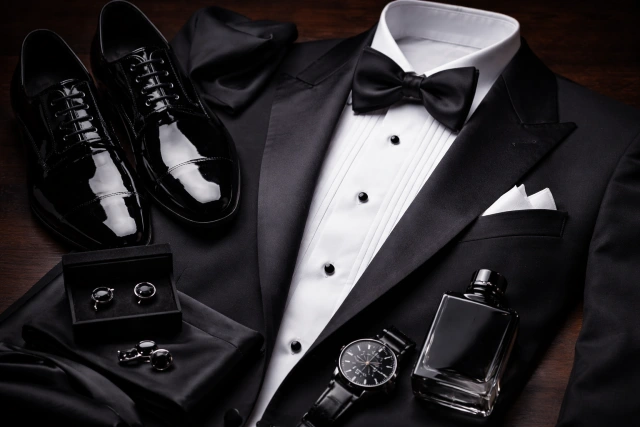
Menswear authorities consistently underline the same basics: a proper tuxedo with satin or grosgrain lapels, matching trousers with a side stripe, a white formal shirt (usually with French cuffs), a black bow tie, and formal black shoes.
If you remember one thing, let it be this:
Black suit is not Black Tie
A suit is designed for business and daytime formality. A tuxedo is designed for evening formality. The satin details and specific accessories are not decoration. They are the signal.
Why details matter more than you think
People form impressions fast. Research by Willis and Todorov found that people make trait inferences from appearance with extremely brief exposure, often around a tenth of a second.
Your tuxedo does not need to be flashy. It needs to be correct. In Black Tie, “quietly right” looks more confident than “loudly creative.”
The tuxedo rules: what to wear and why it works
Let’s build the outfit from the outside in.
1) The tuxedo jacket (dinner jacket)
A Black Tie jacket has a few signatures that separate it from a suit jacket:
- Satin or grosgrain facing on the lapels
- A cleaner, more formal cut
- Usually one button closure
- Often jetted pockets (not flapped)
- Typically no vent or double vent (vents can vary, but traditional models minimize them)
A solid guide to classic black tie construction highlights lapel facings, formal pocket styles, and the importance of choosing a jacket made for evening wear.
Best colors for a Black Tie jacket
- Black: the safest and most universal
- Midnight blue: traditional and often looks richer under evening light
GQ notes that black and midnight blue remain the core, timeless choices for men’s Black Tie.
Lapel styles: what counts as correct?
Black Tie gives you two classic lapel options:
- Peak lapel: sharp, formal, structured
- Shawl lapel: smooth, elegant, slightly softer
Notch lapels are typically associated with suits, and most classic etiquette guides discourage them for true Black Tie.
Here’s a quick comparison:
| Lapel Type | Formality Level | Best For | Visual Effect |
|---|---|---|---|
| Peak lapel | Very formal | Weddings, galas, award events | Strong shoulders, crisp lines |
| Shawl lapel | Very formal | Dinners, charity events, classic vibe | Sleek, clean, minimal |
| Notch lapel | Less traditional | Only if event is relaxed | Reads more like a suit |
2) Tuxedo trousers: the stripe is the point
In Black Tie, trousers are not “just black pants.” Traditional tuxedo trousers include:
- A satin or grosgrain stripe down the outer seam
- A higher rise than many modern suit trousers (more flattering and formal)
- No cuffs (turn ups)
- Usually no belt loops (designed for suspenders or side adjusters)
Classic black tie guides emphasize the side stripe, cleaner hem, and suspender friendly construction.
Belt or suspenders?
Belts tend to break the visual line at the waist and can add bulk under a jacket. Suspenders (braces) keep the trouser line smooth and sit properly all night.
3) The waist covering: cummerbund or waistcoat
One of the most common mistakes in Black Tie is leaving an exposed strip of shirt between the jacket button and trouser waistband. That gap looks unfinished, especially when you move, sit, or dance.
You solve this with a waist covering:
- Cummerbund (pleats facing up)
- Low cut evening waistcoat (formal vest)
Many traditional guides recommend one or the other to keep the silhouette clean and continuous.
Simple rule: pick one. Do not wear both.
Black Tie shirts: styles that actually belong with a tuxedo
Your shirt is closer to the face than anything else in the outfit. In photos, it matters almost as much as the jacket.
1) The must-have basics
A proper Black Tie shirt is typically:
- White (almost always)
- Designed with a formal front (bib, pleats, or piqué)
- French cuffs (so you can wear cufflinks)
- Often worn with studs, depending on the shirt style
Guides to tuxedo shirts highlight how bib fronts, studs, and French cuffs create the right formal structure.
2) Shirt front options (bib styles)
| Shirt Front Style | What It Looks Like | Best Use | Notes |
|---|---|---|---|
| Pleated front | Vertical pleats down the chest | Weddings, most events | Classic, versatile |
| Marcella (piqué) bib | Stiff textured panel | Very traditional events | Most formal vibe |
| Plain front | Clean, minimal | Modern black tie | Must still be a tuxedo shirt, not a business shirt |
3) Collar styles: wing or turndown?
- Wing collar: very traditional, often paired with piqué bib shirts
- Turndown collar: modern classic and easier to wear well
Either can work for Black Tie. The key is proportion: the collar should frame the bow tie without swallowing it.
4) French cuffs and cufflinks
French cuffs are part of the visual language of Black Tie. Cufflinks add a controlled shine and finish the sleeve line.
Good cufflinks are understated:
- Silver tone
- Onyx or mother of pearl
- Minimal engraving
Save novelty pieces for non formal events.
5) Studs or buttons?
Many formal shirts use removable studs instead of sewn on buttons. This is not about showing off. It’s about creating a cleaner center line and a more formal feel.
If your shirt takes studs, wear them. If it does not, that is fine. What matters is that the shirt is a tuxedo shirt, not a regular dress shirt.
The bow tie: the anchor of Black Tie
In real Black Tie, the bow tie is not optional. It is literally the name of the dress code.
Bow tie rules that keep you safe
- Black silk is the standard
- Butterfly and semi butterfly shapes are the easiest to wear
- Pre tied looks neat, but hand tied tends to look more natural and photographed better
Classic black tie resources emphasize the bow tie as core, and treat long neckties as a different dress code entirely.
Texture matters
Silk looks right under evening light. If your lapels are satin, a satin bow tie usually harmonizes. If your lapels are grosgrain, a grosgrain bow tie can look more balanced.
Shoes for Black Tie: what looks formal on camera and in person
Shoes can quietly upgrade the whole look or quietly ruin it. The most traditional choices are:
- Black patent leather shoes
- Highly polished black calfskin oxfords
Multiple etiquette focused guides recommend patent leather for peak formality and note that brogues, derbies, and casual loafers are not part of Black Tie.
Socks
- Black, over the calf
- Thin, dress weight
- No loud patterns
It sounds minor until you sit down and your socks become the only thing in the frame.
Must-have Black Tie accessories (and what they actually do)
Accessories in Black Tie are about refinement, not personality overload. Think controlled shine and clean lines.
1) Pocket square
A white pocket square is the safest and most classic option.
Two easy folds that always work:
- Presidential fold (straight line)
- Puff fold (soft, relaxed)
Avoid huge, stiff triangles that look like cardboard in photos.
2) Cufflinks and studs
If your shirt uses studs, match them with your cufflinks.
A strong, classic combination:
- Silver tone with black onyx
- Silver tone with mother of pearl
Keep it simple. In Black Tie, “simple” reads expensive.
3) Suspenders
Choose black suspenders that attach with buttons, not metal clips. Clips can damage trousers and look less formal.
4) Watch or no watch?
Traditionalists often skip a watch in strict formalwear, but modern practice varies. If you wear one, keep it discreet:
- Thin case
- Dark strap or metal bracelet
- No sporty diver watches
Some black tie guides even include watch primers specifically for formalwear.
5) Boutonniere (when it makes sense)
A boutonniere can be appropriate for:
- Weddings
- Formal ceremonies
- Events where the host suggests it
One bloom. Small. Clean. No huge arrangements.
Fit: the hidden difference between “wearing a tuxedo” and “owning the room”
Even the correct pieces can look wrong if the fit is off. Fit is not about being tight. It’s about clean lines.
Jacket fit checkpoints
- Shoulder seam sits at your natural shoulder edge
- Collar lays flat against the neck
- Sleeve shows a bit of shirt cuff (often around a half inch)
- Jacket closes without pulling or forming an X crease
Trouser fit checkpoints
- Waist stays put without a belt
- No bunching at the thigh
- Clean break at the shoe
Well structured fit guidance appears in detailed black tie resources that cover silhouette and proportion.
Common Black Tie mistakes (and the quick fix)
Mistake 1: Wearing a regular black suit
Fix: wear a tuxedo with proper lapel facing and matching striped trousers.
Mistake 2: Long tie instead of bow tie
Fix: black silk bow tie. Period.
Mistake 3: No waist covering and a visible shirt gap
Fix: add a cummerbund or low cut evening waistcoat.
Mistake 4: Business shirt with button cuffs
Fix: white tuxedo shirt with French cuffs.
Mistake 5: Casual shoes
Fix: patent leather or polished black oxfords.
Real-world scenarios: what to do when the invitation gets confusing
A lot of invitations use “formal” loosely. But Black Tie is actually specific. Here’s how to read common variations.
“Black Tie”
Wear the full kit: tuxedo, formal shirt, bow tie, formal shoes, and a waist covering.
“Black Tie Optional”
This means the host prefers Black Tie, but some guests may wear a dark suit. If you own a tuxedo, wear it. If you do not, a very dark suit with conservative accessories is the fallback, but it is not the same thing. Many etiquette guides explain black tie optional as a softer request, not a new dress code.
“Creative Black Tie”
Usually: keep the tuxedo structure, add personality carefully. Examples:
- Textured dinner jacket (velvet in winter settings)
- Subtle colored pocket square
- Interesting cufflinks (still tasteful)
The base still needs to read as Black Tie.
Grooming and finishing touches that quietly upgrade the look
This is where good photos happen.
- Hair: neat, controlled, not overly styled
- Facial hair: clean shave or sharply defined beard lines
- Nails: clean and trimmed
- Fragrance: light application, especially at dinners
Many dress code guides point out that grooming is part of the overall formal impression, not an optional add on.
Quick Black Tie checklist for men
If you want the simplest way to sanity-check your outfit, use this list:
- Tuxedo jacket with satin or grosgrain lapels
- Matching tuxedo trousers with side stripe
- White tuxedo shirt with French cuffs
- Black bow tie
- Cummerbund or low cut evening waistcoat
- Cufflinks (and studs if your shirt takes them)
- Black patent leather shoes or polished black oxfords
- White pocket square
FAQs about Black Tie for men
Is a black suit acceptable for Black Tie?
Not in a strict sense. Black Tie traditionally calls for a tuxedo with formal details like satin lapels and striped trousers.
Can I wear a regular white dress shirt with a tuxedo?
A standard business dress shirt usually looks wrong because it lacks the formal front and French cuffs typical of a tuxedo shirt. Black Tie works best with a proper formal shirt.
Do I need a cummerbund or vest?
They are strongly recommended because they prevent the shirt gap at the waist and complete the formal silhouette.
What shoes are best for Black Tie?
Patent leather is the most traditional. Highly polished black oxfords are also common and appropriate.
Is midnight blue really Black Tie?
Yes. Midnight blue is a classic tuxedo color and can look especially rich under evening lighting.
Conclusion: getting Black Tie right without overthinking it
A great Black Tie outfit is not complicated. It is a few correct pieces working together: a real tuxedo, a proper formal shirt, a black bow tie, formal shoes, and accessories that keep the lines clean. When those basics are right, you look confident without trying to steal attention from the occasion.
And that’s the whole point of Black Tie. You’re showing respect for the event and the host, while giving yourself the advantage of a timeless uniform that photographs well, feels elevated, and never looks “trendy in a bad way.”
If you want a deeper definition and historical context, you can read the semi-formal dress code overview in the final moments before you head out the door.