


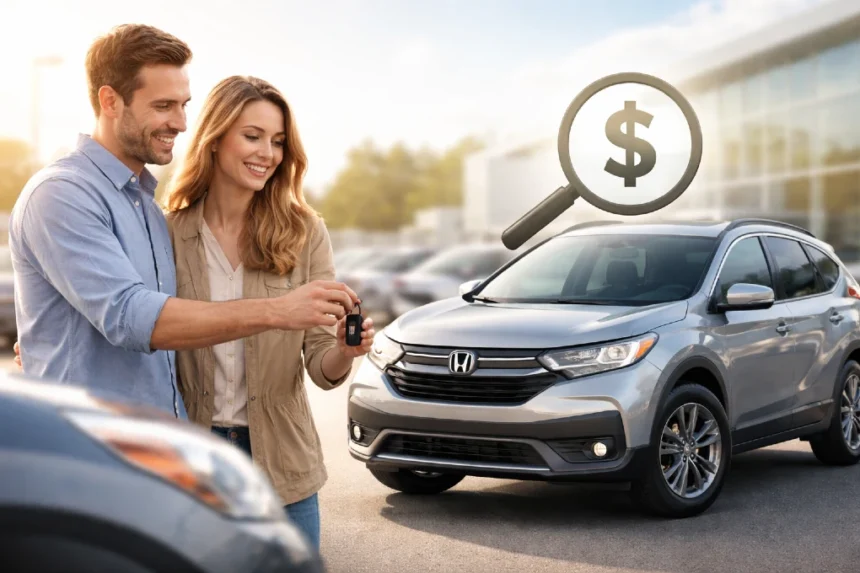
Shopping for a Used Honda CRV can feel exciting and overwhelming at the same time. It is one of those SUVs that stays in demand because it has a strong reputation for practicality, comfort, and long-term value. If you want a vehicle that works for commuting, family errands, road trips, and daily life without feeling oversized, a Honda CRV Used model often lands near the top of the list.
- Why the Used Honda CRV Stays in Demand
- What Makes a Used Honda CRV a Smart Buy
- Best Places to Find a Used Honda CRV for Sale Near You
- How to Spot the Best Deal on a Used Honda CRV
- Honda CRV Used Buying Checklist
- The Most Important Questions to Ask the Seller
- Which Used Honda CRV Years Are Worth a Close Look?
- Price Ranges: What You Should Expect
- How to Negotiate a Better Deal Near You
- Why a Pre Purchase Inspection Is Non Negligible
- Dealer Rules and Buyer Protection Matter
- Common Mistakes Buyers Make With a Used Honda CRV
- Test Drive Tips That Reveal the Truth
- Final Thoughts on Finding the Best Used Honda CRV Deal Near You
- FAQs About Buying a Used Honda CRV
The challenge is not whether a Used Honda CRV is worth considering. The real challenge is knowing how to spot a good one, avoid overpriced listings, and compare local options without wasting time. A smart buyer looks beyond the photos, asks the right questions, checks the numbers, and pays close attention to maintenance history, mileage, trim level, and ownership records.
This article breaks down exactly how to find the best Used Honda CRV deal near you, what to inspect before you buy, which model years deserve a closer look, and how to negotiate with confidence. By the time you finish reading, you will know how to shop smarter and spend more carefully.
Why the Used Honda CRV Stays in Demand
There is a reason the CR V keeps showing up on shortlists for used SUV buyers. It hits a practical middle ground that many rivals struggle to match. It is roomy without being hard to park, comfortable without feeling too soft, and efficient enough to keep fuel costs reasonable. Official EPA data for recent CR V models shows fuel economy that remains competitive for a compact SUV, especially if you compare front wheel drive and all wheel drive trims.
Honda also continues to position the CR V as a family friendly compact SUV with modern safety and convenience features, plus generous cargo flexibility. Recent official specs highlight available AWD, Honda Sensing driver assistance features, and strong interior usability, all of which help explain why even used models tend to hold attention in the market.
For buyers, that popularity creates both a benefit and a problem. The benefit is that there are usually plenty of listings to compare. The problem is that the best Used Honda CRV examples sell quickly, especially clean one owner vehicles with complete service records.
What Makes a Used Honda CRV a Smart Buy
A Used Honda CRV usually makes sense for buyers who care about these priorities:
- Reliable daily transportation
- Good passenger and cargo space
- Comfortable ride quality
- Reasonable fuel economy
- Strong resale value
- Easier ownership compared with many midsize SUVs
It is especially appealing for small families, commuters, first time SUV buyers, and people downsizing from a larger vehicle. The CR V does not try to be flashy. It wins by being useful almost everywhere.
Best Places to Find a Used Honda CRV for Sale Near You
When you start your search, do not rely on a single platform. The best deal often comes from comparing several local sources at once.
1. Franchised Honda dealers
These stores sometimes have certified or well inspected trade ins. You may pay a bit more, but some buyers prefer the added peace of mind, especially if the vehicle comes with detailed service documentation.
2. Independent used car dealers
You may find lower prices here, but inspection quality varies a lot. This is where you need to slow down and verify everything.
3. Private sellers
Private sales can offer better value because there is no dealer markup. Still, you need to be more careful about ownership history, title status, and mechanical condition.
4. Major online car marketplaces
Kelley Blue Book and similar platforms make it easier to compare local inventory, pricing, mileage, and trim levels. KBB notes that fair purchase prices can vary significantly based on condition, mileage, and location, which is why a local comparison matters more than a national average alone.
How to Spot the Best Deal on a Used Honda CRV
A cheap listing is not always a good deal. A good deal is the right mix of price, condition, mileage, history, and expected future costs.
Here is the simple formula:
Best deal = fair price + strong maintenance history + clean inspection + reasonable mileage + no major title or accident concerns
When comparing a Used Honda CRV, focus on these factors first.
Compare similar model years and trims
Do not compare a base trim to a fully loaded version and assume one is overpriced. An EX L or Touring trim may justify a higher asking price because of features like leather seating, upgraded infotainment, moonroof, or additional safety tech.
Check mileage in context
Mileage matters, but context matters more. A CR V with 85,000 miles and complete maintenance records can be a better buy than one with 55,000 miles and no service history.
As a general rule, many buyers like to see yearly mileage close to average driving patterns. A five year old SUV with dramatically low mileage is not automatically better. Long periods of sitting can create their own issues.
Watch location based price differences
The same Used Honda CRV may cost more in one city than another. Local demand, weather exposure, dealership competition, and trim popularity all affect pricing.
Factor in immediate repair needs
A lower sticker price means very little if you need new tires, brakes, battery service, fluid changes, or suspension work right away.
Honda CRV Used Buying Checklist
Before you commit to a Used Honda CRV, go through this checklist carefully.
Vehicle history
- Number of previous owners
- Clean title status
- Accident or damage reports
- Service and maintenance history
- Personal use versus rental or fleet use
Vehicle history reports can help reveal accident history, ownership patterns, and service records that are easy to miss in a basic listing. CARFAX states that its reports cover ownership, accident, and service history, which makes them useful as a screening tool before you inspect the car in person.
Exterior condition
- Uneven body gaps
- Paint mismatch
- Rust around wheel arches or underbody
- Cracked lights or windshield
- Tire wear patterns
Interior condition
- Seat wear that matches the mileage
- Working air conditioning and heat
- Functional infotainment system
- Clean dashboard with no warning lights
- Rear seat and cargo area condition
Mechanical condition
- Smooth idle
- No unusual engine noise
- Clean transmission behavior
- No vibrations at highway speeds
- Stable braking with no pulling
Paperwork
- Title
- Registration
- Service invoices
- Warranty details if any
- Emissions or inspection records if required locally
The Most Important Questions to Ask the Seller
Whether you are buying from a dealer or private owner, ask these questions directly:
- Why are you selling the vehicle?
- Do you have service records?
- Has the SUV ever been in an accident?
- Are there any open recalls?
- Has the transmission or air conditioning system needed repair?
- When were the tires and brakes last replaced?
- Is there anything that does not work as it should?
For recalls, do not rely only on the seller’s answer. The National Highway Traffic Safety Administration recommends checking the VIN through its recall lookup tool because recalls can remain open long after a vehicle is listed for sale.
Which Used Honda CRV Years Are Worth a Close Look?
Every generation has strengths, but buyers often shop with three goals in mind: value, modern safety, and lower ownership risk.
2017 to 2022 models
These are attractive for many buyers because they feel modern, offer good interior space, and remain widely available. IIHS ratings for the redesigned 2017 to 2022 generation show strong crash performance in key tests, which adds confidence for safety focused shoppers.
2023 and newer models
These usually cost more in the used market, but they bring a fresher design and updated feature set. IIHS ratings for the latest CR V generation also remain strong, which supports demand in the newer used market.
Older high mileage models
These can still make sense if your budget is tight, but inspection quality becomes much more important. At that point, condition matters more than trim level or cosmetic appeal.
Price Ranges: What You Should Expect
Used SUV pricing moves constantly, so the smartest move is to compare live local listings instead of depending on a single number. Kelley Blue Book emphasizes that fair purchase price changes based on mileage, condition, and location, and its used CR V marketplace shows a large spread in asking prices across years and trims.
A simple pricing pattern usually looks like this:
| Model Age | Typical Market Position |
|---|---|
| 1 to 3 years old | Highest used prices, strongest features, lower mileage |
| 4 to 7 years old | Sweet spot for value and features |
| 8+ years old | Lowest prices, but inspection risk rises |
If you want the best balance of cost and value, the middle band often delivers the strongest opportunity.
How to Negotiate a Better Deal Near You
Negotiation works best when you show evidence, not emotion.
Bring local comparisons
Print or save similar listings with the same year, mileage, and trim. Sellers take you more seriously when you can show what comparable CR Vs are selling for nearby.
Use inspection findings
If the SUV needs tires, brakes, or a battery soon, that is a reasonable basis for asking for a lower price.
Do not shop by monthly payment alone
That is one of the easiest ways to overpay. Focus on total price, financing rate, taxes, fees, and expected ownership costs.
Be ready to walk away
The best leverage is not needing that exact vehicle. There are usually other Used Honda CRV listings nearby if you stay patient.
Why a Pre Purchase Inspection Is Non Negligible
If you remember one thing from this article, let it be this: never skip the inspection.
A third party mechanic can spot oil leaks, suspension wear, underbody rust, previous damage repair, and early signs of expensive problems that do not show up in a short test drive. Spending a little on inspection can save a lot later.
This matters even more when a seller says the vehicle is in excellent condition. Sellers and buyers often define that phrase very differently.
Dealer Rules and Buyer Protection Matter
If you are buying from a dealer, the Federal Trade Commission’s Used Car Rule requires a Buyers Guide to be displayed on used vehicles offered for sale. That guide tells you whether the car is being sold with a warranty or as is, which is critical when you compare similar listings.
Always read that document closely. Two CR V listings with nearly identical prices can become very different deals once warranty terms, return policies, and fees are added.
Common Mistakes Buyers Make With a Used Honda CRV
Many buyers lose money by making the same avoidable errors.
Mistake 1: Falling for the lowest price
A suspiciously cheap SUV often has a hidden story.
Mistake 2: Ignoring the trim level
A better equipped model with better history can be the smarter value.
Mistake 3: Skipping VIN and recall checks
This takes minutes and can prevent major headaches later.
Mistake 4: Forgetting total ownership cost
Budget for insurance, fuel, tires, brakes, and registration, not just the purchase price.
Mistake 5: Rushing because the listing looks perfect
Photos sell emotion. Inspections reveal facts.
Test Drive Tips That Reveal the Truth
During your drive, keep the radio off and pay attention.
Listen for engine noise on startup. Check whether the transmission shifts smoothly in stop and go traffic. Test highway merging, braking, parking lot turning, and reversing. Try rough pavement if possible.
Also test practical things that matter on a compact SUV:
- Rear cargo access
- Seat folding
- Backup camera clarity
- Blind spot visibility
- Cabin comfort for your typical passengers
That is where the CR V usually earns its reputation. It is built around everyday usefulness, not just brochure features.
Final Thoughts on Finding the Best Used Honda CRV Deal Near You
A Used Honda CRV is popular for good reason. It offers a practical blend of comfort, space, fuel efficiency, and long term usability that appeals to a wide range of buyers. Still, the smartest purchase is not simply the closest one or the cheapest one. It is the one with the best combination of history, condition, fair pricing, and verified maintenance.
If you want the best result, compare several local listings, check pricing against live market data, review the vehicle history carefully, verify recalls by VIN, and pay for a professional pre purchase inspection. Those steps take a little extra effort, but they dramatically improve your odds of finding a Used Honda CRV that feels like a win months after you buy it, not just on the day you sign the papers.
And if you are narrowing down your final options, pay attention to practical details like trim features, tire condition, and real cargo needs, not just mileage and monthly payment. That is often the difference between buying a decent SUV and buying the right one. For broader background on the model’s history, you can also read about the Honda CR-V before making your final comparison.
FAQs About Buying a Used Honda CRV
Is a Used Honda CRV good for families?
Yes. The CR V is popular with families because it offers a comfortable cabin, useful cargo room, and an easy to live with size.
What mileage is too high for a Honda CRV used model?
There is no single cutoff. High mileage becomes less concerning when maintenance history is strong and the vehicle passes a professional inspection.
Should I buy from a dealer or a private seller?
A dealer may offer more structure and possible warranty coverage. A private seller may offer a lower price. The better choice depends on condition, paperwork, and inspection results.
How do I know if the asking price is fair?
Compare similar local listings with the same model year, trim, mileage, and condition. Do not judge by one listing alone.
Is AWD worth it on a Used Honda CRV?
It depends on where you live and how you drive. AWD can be useful in rain, snow, and light rough road conditions, but it may cost more upfront.