



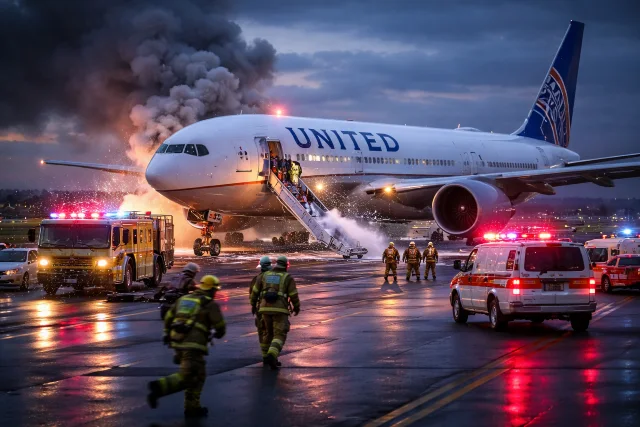
If you saw the headlines about United Airlines Flight UA770 Emergency Diversion, you probably had the same thought most travelers do: “What actually happened up there, and how serious was it?” The truth is, an emergency diversion can sound dramatic while still being exactly what aviation safety systems are designed to do: spot a potential problem early, give the crew options, and put the aircraft on the ground at the safest practical airport.
- Quick overview of United Airlines Flight UA770 Emergency Diversion
- What “emergency diversion” really means in airline operations
- Why squawk 7700 matters in United Airlines Flight UA770 Emergency Diversion
- What likely caused United Airlines Flight UA770 Emergency Diversion
- Timeline: how an emergency diversion typically unfolds
- Crew response: what pilots and flight attendants are trained to do
- Aviation safety context: why diversions are a sign the system works
- What passengers experience during United Airlines Flight UA770 Emergency Diversion
- How airlines decide: divert or continue
- Lessons from United Airlines Flight UA770 Emergency Diversion for everyday travelers
- Common questions people ask about United Airlines Flight UA770 Emergency Diversion
- Aviation safety insights: what UA770 shows about layered protection
- Conclusion: why United Airlines Flight UA770 Emergency Diversion is more reassuring than alarming
In this case, United Airlines Flight UA770 Emergency Diversion refers to United’s transatlantic flight operating from Barcelona (BCN) to Chicago O’Hare (ORD) that diverted and landed safely at London Heathrow (LHR) after the crew declared an emergency and coordinated priority handling. Public flight tracking and reporting show the aircraft squawked the general emergency code and diverted to Heathrow, landing without reported injuries.
What follows is a detailed, plain-English walkthrough of the incident, what likely drives decisions like this, how crews manage them, and what passengers can learn from United Airlines Flight UA770 Emergency Diversion without spiraling into worst-case scenarios.
Quick overview of United Airlines Flight UA770 Emergency Diversion
Most public accounts of United Airlines Flight UA770 Emergency Diversion describe a precautionary emergency declaration followed by a reroute to London Heathrow, a major airport with widebody capability, long runways, and robust emergency and maintenance support.
While some early online summaries speculated about different causes, one recurring theme across coverage is that the crew responded to a suspected safety concern and chose to divert rather than continue across the Atlantic. That’s a key point: diversions often happen not because the aircraft is “about to crash,” but because the safest choice is to stop somewhere well-equipped and sort things out on the ground.
Snapshot table: what’s publicly reported
| Item | What’s known from public reporting/tracking |
|---|---|
| Route | Barcelona (BCN) to Chicago (ORD) |
| Diversion airport | London Heathrow (LHR) |
| Emergency signal | Squawk 7700 (general emergency) |
| Outcome | Landed safely; passengers not reported injured |
What “emergency diversion” really means in airline operations
Before we dig deeper into United Airlines Flight UA770 Emergency Diversion, it helps to translate “emergency diversion” into what it means operationally.
An airline diversion is simply a change of destination to an alternate airport. It can be triggered by many situations, including:
- A medical issue on board
- A mechanical indication or system alert
- Smoke, odor, or fire warning (even if later found to be false)
- Weather or turbulence hazards
- A security or disruptive passenger issue
- Operational constraints (fuel, crew duty, airport closures)
The word “emergency” usually means the crew wants priority handling. One way crews can quickly alert air traffic control is by selecting a dedicated transponder code.
Why squawk 7700 matters in United Airlines Flight UA770 Emergency Diversion
A lot of people first noticed United Airlines Flight UA770 Emergency Diversion because flight trackers showed “7700.”
In FAA guidance, Code 7700 is the standard transponder code used to indicate an emergency condition, helping radar facilities and controllers recognize that the aircraft needs priority handling. FAA materials also describe emergency transponder operation and how it triggers special indicators for ATC.
Here’s the important part: squawking 7700 doesn’t automatically mean catastrophe. It means the crew is treating a situation as urgent enough to get immediate attention, shorter routing, and the ability to land as soon as practical.
That is exactly the mindset you see in United Airlines Flight UA770 Emergency Diversion: identify risk, reduce risk, land at a suitable airport.
What likely caused United Airlines Flight UA770 Emergency Diversion
Let’s be careful and honest here: unless an airline or regulator releases a full technical statement, we can’t claim a single confirmed cause with certainty from internet chatter alone.
That said, multiple reports around United Airlines Flight UA770 Emergency Diversion pointed toward a possible cabin pressurization-related alert or anomaly as the trigger for the emergency declaration and diversion decision.
Common categories that fit the public narrative
When a widebody aircraft diverts soon after departure and declares a general emergency, these are typical drivers that match the “precautionary” pattern seen in United Airlines Flight UA770 Emergency Diversion:
- Cabin pressurization alerts
- Modern aircraft continuously monitor cabin altitude and pressurization performance. If something looks off, crews run checklists and may choose to divert early rather than continue over remote areas. (Public reporting on UA770 frequently mentions this type of alert.)
- Faulty sensor or false warning
- Sensors fail more often than critical structures do. A warning can still require an immediate, checklist-driven response. This “treat it real until proven otherwise” philosophy is baked into airline SOPs and global safety standards.
- System anomalies that are manageable but not worth carrying across an ocean
- Even if the aircraft is flying normally, dispatch and crew might prefer a major hub like Heathrow where maintenance support and passenger re-accommodation are strong.
Why Heathrow makes sense
A big reason United Airlines Flight UA770 Emergency Diversion ended at Heathrow is practical: Heathrow is a widebody-capable airport with long runways, extensive emergency services, and deep maintenance and handling infrastructure. That’s not drama. That’s logistics plus safety.
Timeline: how an emergency diversion typically unfolds
Public live updates for United Airlines Flight UA770 Emergency Diversion described an emergency declaration and diversion to Heathrow with a safe landing.
To understand what likely happened step by step, here’s a realistic timeline that matches how airline diversions are handled (and aligns with what was publicly reported about UA770’s diversion and landing):
- Initial indication
- A system message, alert, or crew observation prompts the pilots to evaluate.
- Checklists and cockpit workload spikes
- The flight deck runs the Quick Reference Handbook (QRH) or electronic checklists. If it’s pressurization-related, the priority is cabin safety and descent/route planning.
- Coordination starts immediately
- Pilots coordinate with ATC and the airline’s operations team. If needed, they declare an emergency and may squawk 7700.
- Diversion decision
- The crew selects the nearest suitable airport based on runway length, weather, aircraft needs, and support services.
- Cabin crew briefing and passenger management
- Flight attendants shift into a calm, scripted approach: seatbelts, cabin secure, medical checks if needed, and clear announcements.
- Landing and standby services
- Emergency vehicles may meet the aircraft even if the landing is uneventful. This is standard risk management, not a sign that something is burning.
This is the “quiet professionalism” side of United Airlines Flight UA770 Emergency Diversion that rarely makes the headlines.
Crew response: what pilots and flight attendants are trained to do
One of the most valuable takeaways from United Airlines Flight UA770 Emergency Diversion is how much of it is routine in the best possible way.
In the cockpit: aviate, navigate, communicate
In airline training, priorities are often summarized as:
- Aviate: keep the aircraft stable and safe
- Navigate: choose the safest route and airport
- Communicate: coordinate with ATC, the cabin, and the airline
When a crew uses an emergency code and diverts, it is typically because they’re optimizing those three priorities. FAA guidance around emergency procedures and transponder emergency operation reflects how structured and procedural this is.
In the cabin: leadership, reassurance, and practical safety steps
Cabin crew work is more than smiles and snacks. During United Airlines Flight UA770 Emergency Diversion, the cabin team’s likely checklist looked like this:
- Keep passengers seated and belted when instructed
- Secure galleys and loose items
- Communicate clearly without fueling panic
- Monitor anyone feeling unwell or anxious
- Prepare the cabin for an expedited landing if required
These actions align with the broader international emphasis on cabin safety procedures and crew training standards.
Aviation safety context: why diversions are a sign the system works
It’s easy to hear “emergency diversion” and assume aviation is becoming less safe. The opposite lesson is usually closer to the truth.
A diversion like United Airlines Flight UA770 Emergency Diversion is often the result of conservative decision-making: land early, inspect, fix, and only then continue.
A reality check with safety statistics
According to IATA’s 2024 safety reporting, the all-accident rate was 1.13 accidents per million flights (about one accident per 880,000 flights), with 40.6 million flights in 2024.
Those numbers don’t mean incidents never happen. They mean commercial aviation remains highly systematized, with constant monitoring and strong incentives to act early rather than gamble.
So yes, United Airlines Flight UA770 Emergency Diversion made the news. But in safety terms, “landing early” is usually the story.
What passengers experience during United Airlines Flight UA770 Emergency Diversion
Passengers usually experience a diversion in fragments:
- An announcement that the flight is landing somewhere unexpected
- A change in engine sound or descent angle
- Crew moving quickly through the cabin
- Emergency vehicles visible after landing
- A long wait at a gate or remote stand
None of that automatically means danger. In fact, those are often visible signs that the crew and ground teams are applying standard playbooks.
Public reports around United Airlines Flight UA770 Emergency Diversion indicate the flight landed safely at Heathrow after the emergency declaration, consistent with that “playbook” pattern.
How airlines decide: divert or continue
The diversion call behind United Airlines Flight UA770 Emergency Diversion is typically a joint reality check between:
- The pilots
- Dispatch/operations
- Maintenance control
- ATC constraints and airport suitability
Key factors include:
- Distance to a suitable airport
- Weather and winds
- Runway length and performance
- Medical resources (if it’s a health emergency)
- Maintenance capability
- Overwater and remote-area risk
If there’s any chance the risk gets worse farther from land, conservative crews don’t wait around to “see what happens.”
Lessons from United Airlines Flight UA770 Emergency Diversion for everyday travelers
You don’t need to be an aviation nerd to take something practical from United Airlines Flight UA770 Emergency Diversion. Here’s what’s genuinely useful next time you’re on a flight that diverts or declares an emergency.
1) Seatbelt discipline is the simplest safety habit
Keep it lightly fastened whenever you’re seated, even when the ride is smooth. Unexpected turbulence is a leading cause of in-flight injuries, and you can’t predict it.
2) Don’t assume “emergency vehicles” equals “near-miss”
Emergency services often roll out automatically for certain alerts or declarations. That’s normal, especially at major airports.
3) Listen for what crews actually say
If the crew says it’s precautionary, that usually means they’re responding early rather than late. United Airlines Flight UA770 Emergency Diversion appears to fit that pattern based on public reporting.
4) Plan for the boring aftermath
Diversions often lead to:
- Rebooking and delays
- Hotel and meal logistics
- Waiting for maintenance inspections or crew legality
It’s frustrating, but it’s also the system choosing safety over schedule.
Common questions people ask about United Airlines Flight UA770 Emergency Diversion
Was United Airlines Flight UA770 Emergency Diversion caused by a confirmed mechanical failure?
Public reporting describes the diversion as a response to a suspected safety concern, often described as a pressurization-related alert, but a definitive root cause is not consistently documented in a single official public report in the sources widely circulated online.
Did the flight make an emergency landing?
Yes, in the operational sense: United Airlines Flight UA770 Emergency Diversion involved an emergency declaration (squawk 7700) and a priority diversion to Heathrow with a safe landing.
What does squawk 7700 mean for passengers?
It means the pilots are signaling a general emergency to ATC to receive priority handling. It does not automatically mean the aircraft is in immediate danger, but it does mean the crew is treating the situation seriously and conservatively.
Why not continue to Chicago if the plane was still flying fine?
Because “still flying” and “safe to continue over an ocean” are different questions. The diversion decision in United Airlines Flight UA770 Emergency Diversion reflects risk management: land at a major airport, troubleshoot on the ground, and protect passengers from a scenario that could worsen farther from diversion options.
Aviation safety insights: what UA770 shows about layered protection
The deeper story behind United Airlines Flight UA770 Emergency Diversion is how many layers sit between a warning light and a bad outcome:
- Sensors detect abnormal trends early
- Checklists force crews to respond consistently
- ATC clears paths and reduces workload
- Airline ops supports alternate planning
- Major airports provide emergency response and maintenance capacity
- Regulatory standards emphasize training and cabin safety preparedness
When people say “aviation is built on rules,” this is what they mean. It’s not bureaucracy. It’s a system designed to keep one problem from becoming many problems.
Conclusion: why United Airlines Flight UA770 Emergency Diversion is more reassuring than alarming
The biggest takeaway from United Airlines Flight UA770 Emergency Diversion is that a diversion is usually a precautionary decision, not a last-second escape. Public reporting and tracking indicate the crew declared an emergency, diverted to London Heathrow, and landed safely.
If you ever find yourself on a flight like United Airlines Flight UA770 Emergency Diversion, the most helpful mental shift is this: the system is doing what it was designed to do. Identify potential risk early, coordinate fast, and get everyone on the ground where support is strongest.
And if you’re the kind of traveler who likes to understand the mechanics behind those “7700 moments,” the simplest explanation is often the truest: caution is the point, and safety is the priority, even when it costs time, money, and convenience. That’s the real story behind United Airlines Flight UA770 Emergency Diversion, and it’s a story worth being glad about.
For a quick explainer of transponder codes, including emergency squawks, and keep it in mind the next time flight tracking apps light up.