



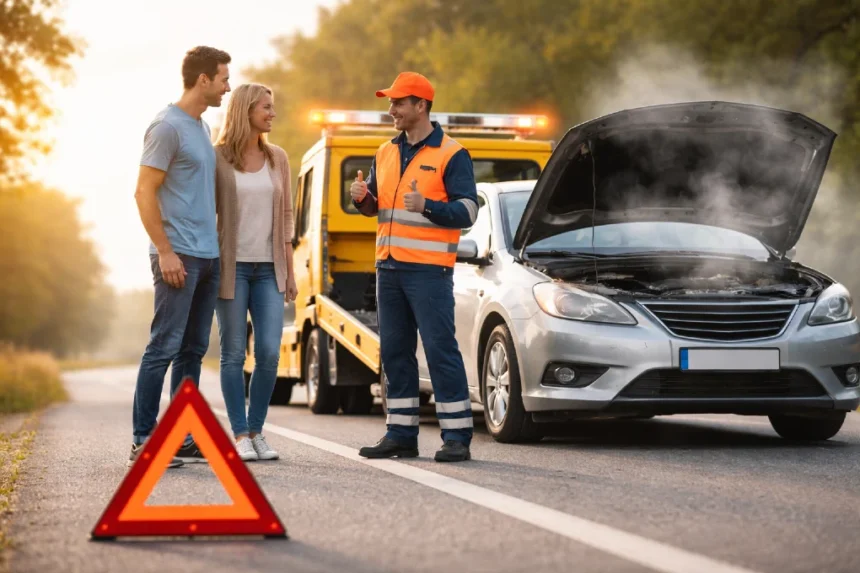
A search for Tow Truck Near Me usually happens at the worst possible moment. Maybe your car quit in a parking lot before work. Maybe you have a flat on the shoulder after dark. Maybe the engine overheated, the battery died, or you were in a minor collision and need a safe tow right away. In those moments, speed matters, but so do safety, price clarity, and knowing you are calling a legitimate operator.
- Why people search Tow Truck Near Me in the first place
- When you need a tow instead of basic roadside help
- What to do immediately after a breakdown
- How to choose the right tow truck near you
- Questions to ask before you confirm the tow
- Why open now matters in a towing emergency
- Common towing situations and what they usually require
- How towing prices usually work
- Red flags that should make you think twice
- Tips to make the towing process easier
- Special note for electric vehicles and newer cars
- What to do while waiting for the tow truck
- Why local towing companies often have an advantage
- Final thoughts
- FAQs
That is why finding the right towing service is not just about who answers first. It is about who can reach you quickly, quote the service clearly, handle your vehicle correctly, and help you get off the road without adding more stress. AAA says it received more than 27 million emergency roadside service calls across the United States in 2024, with roughly 13 million involving towing and about 7 million involving battery issues. Together, those two problems made up about 74 percent of total calls.
If you are trying to figure out what to do after typing Tow Truck Near Me, this article walks you through the process in plain English. You will learn when to call for a tow, how to stay safe while waiting, what questions to ask before the truck arrives, how towing prices usually work, and how to avoid common mistakes that cost people time and money.
Why people search Tow Truck Near Me in the first place
Most roadside emergencies fall into a few familiar categories. A vehicle will not start. A tire goes flat. The car overheats. The transmission fails. You run out of fuel. Or a minor crash leaves the car unsafe to drive.
That lines up with national roadside trends. AAA reports that towing and battery trouble account for the largest share of roadside calls, and it also notes millions of flat tire incidents each year.
For drivers, the key issue is not just the cause of the problem. It is deciding whether the car can be handled on the spot or whether it needs professional transport. That is where a dependable local Tow Truck Near Me company becomes essential.
When you need a tow instead of basic roadside help
Not every breakdown requires a full tow. Some problems can be fixed where the vehicle is parked. Others should never be handled that way.
You probably need roadside assistance, not a tow, if the issue is:
- A dead battery that can be jump-started
- A lockout
- A flat tire with a usable spare
- Running out of gas when fuel delivery is available
- A minor issue that a roadside technician can fix safely
You probably need a tow truck if the issue is:
- The engine will not run after overheating
- The transmission has failed
- The steering or brakes feel unsafe
- You were in a collision
- You have severe tire damage and no spare
- The car is stuck off-road or in a ditch
- The vehicle shows warning signs that make driving risky
If there is any real doubt about whether the vehicle is safe to drive, do not guess. NHTSA emphasizes road safety and encourages drivers to prioritize safe decisions in hazardous situations.
What to do immediately after a breakdown
The first few minutes matter more than most people realize. A rushed decision can put you in danger, especially on a busy road or highway.
Step 1: Move to a safer location if possible
If the car still has limited mobility, steer it to the shoulder, a parking lot, or another area away from moving traffic. If it cannot be moved, turn on your hazard lights right away.
Step 2: Stay visible
Keep your hazard lights on. If it is dark and safe to do so, use reflective triangles or flares if you have them. Visibility gives approaching drivers more time to react.
Step 3: Think about your personal safety first
NHTSA’s Move Over campaign reminds drivers that roadside scenes are dangerous for first responders, tow operators, and stranded motorists alike. If you are near fast traffic, your main goal is to stay out of harm’s way and avoid standing close to moving vehicles.
Step 4: Call the right help
If there are injuries, a crash hazard, leaking fluids, smoke, or a dangerous location, call emergency services first. If it is a mechanical or tire issue and the scene is stable, call a towing or roadside service provider.
Step 5: Share the right location details
Do not just say the highway name. Give precise details like:
- Exit number
- Mile marker
- Direction of travel
- Nearby gas station or business
- Vehicle make, model, and color
- Whether the car is drivable, stuck, or damaged
The more exact you are, the faster the dispatch process usually goes.
How to choose the right tow truck near you
Typing Tow Truck Near Me into a search engine will show multiple providers, but not all towing companies offer the same level of service. Some are fast and professional. Others may leave you waiting, surprise you with extra fees, or use equipment that is not ideal for your vehicle.
Here is what to look for.
Fast response and realistic arrival times
A good towing company gives you an honest estimate, not just the answer you want to hear. A realistic 35 minute arrival is more useful than a vague promise of “almost there” that turns into 90 minutes.
Proper towing equipment
Different vehicles require different handling. Flatbed towing is often preferred for all-wheel-drive, luxury, vintage, low-clearance, or damaged vehicles because it reduces the risk of drivetrain or body damage. Traditional wheel-lift towing may be appropriate in many ordinary situations, but the method should match the vehicle and condition.
Clear pricing before dispatch
Always ask for the pricing structure before confirming service. This matters because towing bills can include several charges, not just a simple pickup fee.
Ask about:
- Base hookup fee
- Per-mile towing charge
- Winching or recovery fees
- After-hours fees
- Storage fees if the car goes to a yard
- Credit card surcharges, if any
- Cancellation fees
Consumer Reports notes that roadside assistance can help defray the cost of towing, which is one reason many drivers compare service options before an emergency happens.
Verified local reputation
Check recent reviews if you can do so safely. Look for comments about response time, professionalism, pricing accuracy, and how the driver handled the vehicle.
Insurance and service coverage
If your insurer, auto club, or credit card includes roadside benefits, verify whether the towing company can work through that network. That can save money and reduce paperwork.
Questions to ask before you confirm the tow
When people are stressed, they often forget to ask basic questions. That can lead to surprise charges or confusion later.
Use this quick checklist:
| Question | Why It Matters |
|---|---|
| What is the total estimated price? | Helps you avoid vague billing |
| Is that a flat rate or base plus mileage? | Clarifies how charges work |
| How long is the estimated wait? | Sets expectations |
| What type of truck are you sending? | Confirms the right equipment |
| Can you tow my vehicle type safely? | Important for EVs, AWD, luxury cars, and motorcycles |
| Where will the vehicle be taken? | Prevents miscommunication |
| Are there extra fees for recovery or after-hours service? | Avoids surprise add-ons |
| Can I pay by card? | Helps if you do not carry cash |
If your car needs to go to a repair shop, confirm that the shop is open or can accept after-hours drop-off.
Why open now matters in a towing emergency
There is a reason people do not search for “towing company” as often as they search for Tow Truck Near Me and similar urgent phrases. Timing is the whole issue.
Breakdowns rarely happen when it is convenient. They happen on weekends, in bad weather, late at night, during school pickup, or halfway through a trip. A provider that is actually open now and dispatching trucks is far more valuable than one with a polished website but no live help.
That is why urgent roadside support usually comes down to four practical things:
- Live dispatch availability
- Accurate arrival windows
- A driver who can locate you quickly
- The ability to handle your vehicle type on the first trip
Common towing situations and what they usually require
Drivers do not all need the same kind of help. Here are a few realistic scenarios.
Dead battery in a parking lot
If the battery is simply drained, a jump-start may solve it. AAA says battery issues made up roughly 7 million roadside calls in 2024, which shows how common this problem is.
But if the battery is old, swollen, or repeatedly failing, towing to a repair shop may be the smarter move.
Flat tire with no spare
AAA reports nearly 3 million roadside calls involving flat tires in 2024 and notes that many newer vehicles no longer come with a spare tire.
If your vehicle has no spare, or the tire damage is severe, towing may be the only safe option.
Highway breakdown
This is one of the highest-risk situations. Stay as far from moving traffic as possible. NHTSA’s Move Over messaging exists because roadside incidents expose drivers and workers to serious danger.
Accident recovery
After a collision, do not assume the car is safe to drive because it still moves. Hidden damage to steering, suspension, lights, or fluids may make it dangerous. A tow is often the safer call.
Off-road recovery or stuck vehicle
Mud, sand, snow, steep driveways, and ditches may require more than a basic hookup. In those cases, ask specifically whether the quote includes winching or recovery.
How towing prices usually work
One of the biggest frustrations with towing is uncertainty around cost. The final bill can vary a lot based on location, time of day, vehicle type, and whether the car needs simple towing or a more complex recovery.
A towing quote often includes:
- Hookup or dispatch fee
- Mileage fee
- Vehicle type surcharge
- Recovery or winch fee
- Storage fee
- After-hours fee
- Toll charges in some areas
That does not mean towing is always overpriced. It means pricing is situational, and you should ask how the quote is built before the truck is dispatched.
If you already have roadside coverage through an insurer, automaker, motor club, or credit card, ask whether the tow can be billed through that benefit first. Consumer Reports points out that roadside plans can reduce the direct cost of towing and related emergencies.
Red flags that should make you think twice
Not every company you find under Tow Truck Near Me deserves your business. Watch for warning signs.
Vague pricing
If a company refuses to explain whether the charge includes mileage or extra fees, that is not a good sign.
No questions about your vehicle
A serious dispatcher should ask for the make, model, location, and issue. If they do not ask anything, they may be sending the wrong equipment.
Pressure to approve immediately
Urgency is real, but pressure tactics are different. You should still get basic pricing and destination clarity before agreeing.
Poor review patterns
One bad review is not unusual. A pattern of complaints about surprise billing, long delays, or vehicle damage is more concerning.
Unclear destination rules
If your car is being taken to a storage yard, ask about retrieval rules, business hours, and daily fees before you approve the tow.
Tips to make the towing process easier
A roadside emergency is stressful, but a few practical steps can make the experience smoother.
- Save a roadside assistance contact before you need it
- Keep your phone charged in the car when possible
- Store your insurance card and ID where you can reach them quickly
- Know whether your car has a spare tire or inflator kit
- Learn your vehicle’s towing requirements if it is AWD, electric, or low clearance
- Take photos of the vehicle before it is towed
- Remove valuables before the truck leaves
- Confirm the destination in writing by text if possible
NHTSA also encourages drivers to think ahead about road safety and trip readiness, which supports the broader idea that preparation reduces risk when something goes wrong.
Special note for electric vehicles and newer cars
Not every tow method is right for every car. Electric vehicles, hybrid models, all-wheel-drive vehicles, and some newer vehicles with low front ends or specialized drivetrains may need flatbed transport or other specific handling. AAA reported about 215,000 EV-related roadside service calls in 2024, which shows that EV support is no longer a niche concern.
If you drive an EV or specialty vehicle, tell dispatch before the truck arrives. That one detail can prevent damage and delay.
What to do while waiting for the tow truck
Once help is on the way, your job is mostly to stay safe and prepared.
If you are in a relatively safe area, do the following:
- Keep hazard lights on
- Stay aware of your surroundings
- Keep your phone available for dispatcher calls
- Gather your registration and insurance info
- Make sure you know where the vehicle is going
- Keep children and pets secured away from traffic
If you are on a high-speed road or the shoulder feels unsafe, stay focused on distance from traffic. NHTSA’s roadside safety messaging makes clear that moving vehicles pose a serious hazard at roadside scenes.
Why local towing companies often have an advantage
A truly local operator often knows traffic patterns, construction zones, difficult intersections, gated lots, apartment access issues, and the repair shops nearby. That local familiarity can shorten arrival time and reduce confusion.
That is part of why the phrase Tow Truck Near Me matters so much. You are not just looking for any towing company. You are looking for one that can actually get to your location fast and handle your area efficiently.
Final thoughts
When you search Tow Truck Near Me, you are usually not shopping in a calm, relaxed frame of mind. You want help now, and you want to make the right call quickly. The best towing experience comes from balancing urgency with a few smart checks: confirm the price structure, verify the destination, make sure the company can handle your vehicle, and put your personal safety first while you wait.
Roadside emergencies are common, and the numbers back that up. Millions of U.S. drivers deal with towing, battery problems, and flat tires every year. What separates a manageable breakdown from a miserable one is often how prepared you are and who you call when things go wrong.
That is why it helps to understand the basics of roadside assistance before the next emergency happens. When the moment comes, a fast, reputable local towing service can turn a stressful delay into a simple problem with a clear next step.
FAQs
How do I know if I need a tow truck or just roadside help?
If the issue can be safely fixed on the spot, such as a jump-start, lockout, or spare tire change, roadside help may be enough. If the car is unsafe to drive, damaged, overheated, stuck, or mechanically disabled, a tow is usually the better option.
What should I ask a towing company before they come?
Ask for the estimated total cost, whether mileage is extra, how long the wait will be, what kind of truck is being sent, and where the vehicle will be taken.
Is it safer to stay in the car while waiting?
That depends on where the vehicle is stopped. On busy roads, roadside conditions can be dangerous. Follow local emergency guidance and prioritize distance from moving traffic. NHTSA’s Move Over safety campaign highlights the risk around roadside incidents.
Why are towing charges sometimes higher than expected?
Towing often includes more than a basic hookup. Mileage, after-hours dispatch, recovery work, storage, and vehicle type can all affect the final bill.
Can an electric vehicle be towed by any truck?
Not always. EVs and some all-wheel-drive vehicles may require specific handling, often including a flatbed. Tell dispatch your exact vehicle type before the truck arrives.