


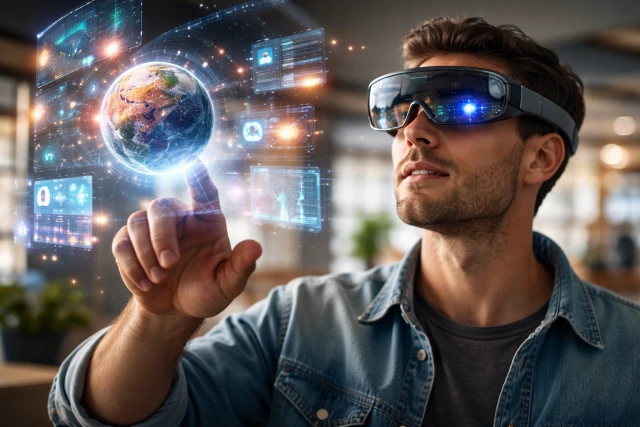
If it feels like the smartphone has stopped surprising you, you are not imagining it. Phones are still improving, but the “wow” moments are getting harder to find. That’s exactly why Tech Giants Envision Future Beyond Smartphones as the next big platform shift, and they’re placing serious bets on augmented reality (AR), mixed reality (MR), and smart glasses. The idea is simple: the screen does not disappear, it moves closer to your senses. Instead of holding a slab of glass, you wear computing. Instead of tapping icons, you look, speak, pinch, and move.
- Why Tech Giants Envision Future Beyond Smartphones right now
- AR vs Mixed Reality: what people actually mean
- The hardware shift: from pocket screens to face computers
- What the tech giants are doing, and what their moves really mean
- The market signals: growth is shifting toward wearables and XR
- What AR and MR can do that smartphones cannot
- A quick comparison table: Smartphone vs AR glasses vs MR headset
- The biggest obstacles holding AR and MR back
- The real “killer app” might be AI, not AR
- Real-world scenarios that make the shift feel inevitable
- Actionable tips for developers and businesses entering AR and MR
- FAQs about the future beyond smartphones
- Conclusion: why Tech Giants Envision Future Beyond Smartphones, and why it matters
That future is not guaranteed, though. AR and MR still have uncomfortable headsets, high prices, and a chicken and egg problem with apps. But the momentum is real, the investment is massive, and the market signals are getting louder.
Why Tech Giants Envision Future Beyond Smartphones right now
The smartphone market is not dead, it’s just mature. Global smartphone shipments grew in 2024, but the bigger story is that the market is fighting for meaningful differentiation year after year. IDC reported worldwide smartphone shipments rose 6.4% in 2024, showing recovery after a slump, yet it also underlines that growth is increasingly incremental, not revolutionary.
So why does that push companies toward AR and MR?
Because the next platform typically arrives when:
- The current platform becomes predictable
- Hardware upgrades feel less essential
- New interaction models become technically possible
- Developers and ecosystems are hungry for the next “app store moment”
That combination is forming now, and Tech Giants Envision Future Beyond Smartphones because AR and MR can create new daily habits, not just new features.
AR vs Mixed Reality: what people actually mean
These terms get thrown around like everyone agreed on definitions that Tech Giants Envision Future Beyond Smartphones, but in real life they overlap.
Augmented reality (AR) adds digital elements on top of the real world. Think directions floating on the street, or a product preview in your room.
Mixed reality (MR) blends digital and physical in a more interactive way, where virtual objects feel anchored to your environment and respond realistically. MR often uses cameras and sensors to understand space, hands, eyes, and depth.
The big takeaway: AR is often “overlay,” MR is closer to “integration.” Most modern headsets try to do both.
The hardware shift: from pocket screens to face computers
When Tech Giants Envision Future Beyond Smartphones, they are not imagining one single device. They’re imagining a stack of devices, each with a different job, like laptops and tablets today.
1) Smart glasses (the “all day” goal)
Smart glasses are the most important endgame because Tech Giants Envision Future Beyond Smartphones can become normal. If you can wear them for hours, the platform wins.
IDC expects a strong boost in “display-less smart glasses” driven by products like Meta’s Ray-Bans, with the broader AR/VR plus smart glasses category projected to grow sharply in 2025.
What makes smart glasses compelling:
- Notifications without pulling out your phone
- Hands-free photo and video capture
- Voice-first AI assistants that can see what you see
- Light navigation and translation in context
2) Mixed reality headsets (the “power user” phase)
MR headsets are the bridge. Tech Giants Envision Future Beyond Smartphones are not subtle, but they can deliver experiences phones simply cannot, like multiple floating screens around you, spatial video, or immersive training simulations.
Apple’s Vision Pro, for example, launched as a premium product with a high starting price, clearly targeting early adopters and professionals rather than mass-market users.
3) The smartphone (still the hub, for now)
Even if Tech Giants Envision Future Beyond Smartphones, the phone remains the pocket hub:
- It’s the connectivity anchor
- It has the camera people trust
- It’s the billing relationship and identity layer
- It’s the “fallback device” when wearables fail
In the near term, AR and MR do not replace phones. They surround them.
What the tech giants are doing, and what their moves really mean
Apple: premium MR first, ecosystem pull second
Apple is taking the “new computing category” route: start expensive, polished, and controlled. The signal is not unit volume at first, it’s whether Apple can make spatial computing feel like a natural extension of iOS and macOS.
Some reports citing IDC estimate Vision Pro shipments at under half a million units in 2024, which is tiny next to iPhone volumes, but early generations of new platforms often start this way.
Apple’s strategy points to a few beliefs:
- The first killer app might be “infinite monitors” for work
- Media and spatial video can create emotional demand
- Developers will follow Apple’s tooling and monetization model
And importantly, Apple wants to define the interface standards before competitors flood the market.
Meta: scale experiments, accept losses, chase glasses adoption
Meta is playing a different game: learn in public, ship a lot, and iterate fast. Reality Labs has posted very large operating losses, but Meta keeps framing it as a long-term platform bet.
Meta is also evolving its strategy around Tech Giants Envision Future Beyond Smartphones and where people actually are. Recent reporting describes Meta pushing parts of its metaverse experience toward mobile rather than focusing purely on VR, which is a practical pivot toward scale.
In plain terms: Meta wants the next platform, but it also wants adoption fast, even if it means blending mobile, glasses, and headset experiences.
Google + Samsung + Qualcomm: Android XR as the ecosystem play
When Tech Giants Envision Future Beyond Smartphones, Android’s role matters because it supplies the “default OS” for much of the world. Google announced Android XR as a platform built for headsets and glasses, with Samsung and Qualcomm as key partners.
This is the classic Android move:
- Provide an operating system layer
- Enable many hardware makers
- Give developers a consistent SDK story
- Compete through ecosystem breadth, not one device
If Android XR succeeds, it could accelerate AR and MR adoption the way Android accelerated smartphone adoption.
Microsoft: stepping back from consumer MR, staying in enterprise lanes
Microsoft discontinuing HoloLens 2 production and maintaining support through late 2027 shows how hard it is to make AR hardware profitable and mainstream, especially in enterprise-first form factors.
This does not mean AR failed. It means enterprise AR is valuable but slow-moving, and not always aligned with consumer hardware cycles.
The market signals: growth is shifting toward wearables and XR
Let’s talk about momentum, not hype.
IDC projects strong growth in the AR/VR headset and smart glasses space, with smart glasses playing a major role in driving volume.
At the same time, smartphone trends are becoming more about “premiumization” and AI features than new form factors. Counterpoint has projected “GenAI smartphone shipments” rising sharply, which is telling: phone innovation is increasingly software-led.
That’s a key reason Tech Giants Envision Future Beyond Smartphones. AI plus sensors plus wearables is where new user behavior can form.
What AR and MR can do that smartphones cannot
Tech Giants Envision Future Beyond Smartphones are incredible, but they are limited by one core constraint: you must look down at them.
AR and MR flip that. They put information where you are already looking.
Here are the categories where AR and MR can actually win:
Spatial productivity (the “multiple screens everywhere” moment)
You do not need a giant monitor if your headset gives you:
- Three or five resizable screens
- A private workspace on a plane or in a café
- The ability to “pin” a screen near your desk and return to it
This is one of the clearest use cases for premium MR, and it is why Tech Giants Envision Future Beyond Smartphones without expecting phones to disappear overnight.
Contextual navigation (directions that live in your world)
Instead of checking your Tech Giants Envision Future Beyond Smartphones every 10 seconds, AR can:
- Place arrows on the road
- Highlight the exact building entrance
- Show indoor navigation in airports and malls
This is a quiet but powerful shift because it reduces friction and makes the experience feel natural.
Real-time help for hands-busy work
For frontline roles and skilled trades, AR and MR can deliver:
- Step-by-step overlays for assembly or maintenance
- Remote expert support with “see what I see”
- Training simulations without real-world risk
This is where enterprise adoption has already been meaningful, even if consumer adoption is still growing.
Shopping and product visualization (less guessing, fewer returns)
AR product previews can:
- Show furniture scale in your room
- Let you “try on” glasses or makeup
- Demonstrate how a device fits into your setup
If retailers can reduce return rates and increase buyer confidence, AR becomes a business tool, not a novelty.
Social and entertainment that feels more present
VR showed that immersion is powerful. MR adds the ability to stay connected to your physical environment, which can reduce motion discomfort and make sessions feel safer and more usable.
A quick comparison table: Smartphone vs AR glasses vs MR headset
| Feature | Smartphone | AR Smart Glasses | Mixed Reality Headset |
|---|---|---|---|
| Best at | Communication, cameras, apps | Quick info, capture, voice AI | Immersion, spatial screens, simulation |
| Comfort | High | Medium to high (depends on design) | Medium to low (today) |
| Battery | Strong | Limited (today) | Limited (today) |
| Social acceptability | Normal | Growing | Still niche |
| Price range | Wide | Mid to premium | Premium to very premium |
| Phone replacement potential | Already the baseline | Medium long term | Low to medium long term |
This is why Tech Giants Envision Future Beyond Smartphones as a transition, not a sudden swap.
The biggest obstacles holding AR and MR back
If AR and MR are so promising, why are we not all wearing them already?
Comfort and style
No one wants a device that feels like a helmet. The winning products will be:
- Lighter
- Better balanced
- Less heat on the face
- More “normal” looking
Battery life and heat
Packing cameras, sensors, displays, and compute near your head is hard. Until efficiency improves, many devices will rely on:
- External battery packs
- Offloading compute to phones
- Cloud assistance for heavy AI tasks
Price
Premium MR devices cost too much for mass adoption today. Even if Tech Giants Envision Future Beyond Smartphones, they still need a path to affordable hardware.
The app gap
A platform is not a platform until developers can make money on it.
Developers need:
- Reliable hand and eye tracking APIs
- Strong dev tools
- Clear distribution and monetization
- Large enough user base to justify investment
Privacy and trust
AR is a “camera-first” world. That raises questions:
- Are you recording me?
- Where does this data go?
- Can workplaces force employees to wear it?
Companies that solve privacy with clear indicators and strong policies will earn trust faster.
The real “killer app” might be AI, not AR
Here’s a reality check: a lot of people do not wake up wanting AR. They wake up wanting things to be easier.
That’s why the most practical near-term path is:
- AI assistants
- Built into glasses and headsets
- That can see, hear, and respond in context
Google’s messaging around Android XR explicitly connects XR experiences to the Gemini era, reflecting how central AI is becoming to headsets and glasses.
So when Tech Giants Envision Future Beyond Smartphones, they are also envisioning a future beyond touch-only interfaces.
Real-world scenarios that make the shift feel inevitable
Scenario 1: The “commute office”
You sit on a train. You put on lightweight MR glasses. Your work screens appear. You reply to messages, edit documents, and review dashboards. No laptop on your knees. No shoulder surfing.
Scenario 2: The “fix it now” mechanic
A technician looks at a machine. The headset identifies the model, pulls the correct manual, and overlays the next step. A remote expert circles the exact bolt to loosen.
Scenario 3: The “tourist translator”
You walk through a market. Signs translate live. Prices convert automatically. Your glasses highlight a recommended dish based on dietary preferences.
These are not sci-fi. Pieces of them exist already. The missing part is making them comfortable, affordable, and socially normal.
Actionable tips for developers and businesses entering AR and MR
If you build software, especially with .NET or enterprise stacks, AR and MR are not “consumer gadgets only.” They can be a serious edge.
For developers
- Prioritize cross-platform engines and APIs: many XR experiences rely on shared 3D frameworks.
- Design for short sessions first: build flows that deliver value in 30 to 90 seconds.
- Treat UI like “environment design,” not just screens: spacing, depth, readability, and comfort matter more than fancy visuals.
- Build for voice plus glance: the best wearable experiences minimize typing.
For businesses
- Start with training, remote assistance, and visualization: these often show ROI faster than “metaverse meetings.”
- Pilot with one workflow, not ten: pick a single measurable process like onboarding time or error reduction.
- Create policies early: privacy, recording, safety, and device management must be clear.
These are the moves that align with why Tech Giants Envision Future Beyond Smartphones in the first place: they want new daily utility, not just novelty.
FAQs about the future beyond smartphones
Will AR or mixed reality replace smartphones completely?
Not soon. In the next few years, phones remain the core hub for identity, connectivity, and “always reliable” access. AR and MR are more likely to become companion devices first, then gradually take over certain daily tasks.
What is the difference between AR glasses and mixed reality headsets?
AR glasses aim for lightweight, all-day use with quick information and camera-based features. Mixed reality headsets prioritize immersion and spatial experiences, usually with larger displays and more sensors, but less comfort for all-day wear.
Why are tech giants investing so much if adoption is still small?
Because platform shifts are rare and extremely profitable for the winners. Even if early unit volumes are small, controlling the operating system, app store, and interaction model can define a decade of computing.
What is the biggest barrier to mainstream AR?
Comfort and social acceptability. People will not wear something daily if it is heavy, awkward, or makes others uncomfortable. Price and battery life are close behind.
Conclusion: why Tech Giants Envision Future Beyond Smartphones, and why it matters
The smartphone is not going away, but its role is evolving. Tech Giants Envision Future Beyond Smartphones because AR and mixed reality promise a more natural relationship with technology. Instead of switching your attention to a screen, the screen comes to you. Instead of typing and tapping, you speak, look, and gesture. Instead of carrying your digital life, you wear it.
The winners will be the companies that make AR and MR feel invisible: comfortable hardware, trustworthy privacy, and apps that solve real problems in seconds. When those pieces click, the “next phone” might not be a phone at all. It might be a pair of glasses, powered by AI, that quietly becomes the most personal computer you own.
In the last stretch of this transition, keep an eye on how products define and explain mixed reality to normal users, not just tech fans. That’s usually the moment a platform stops being a demo and starts being a habit.