


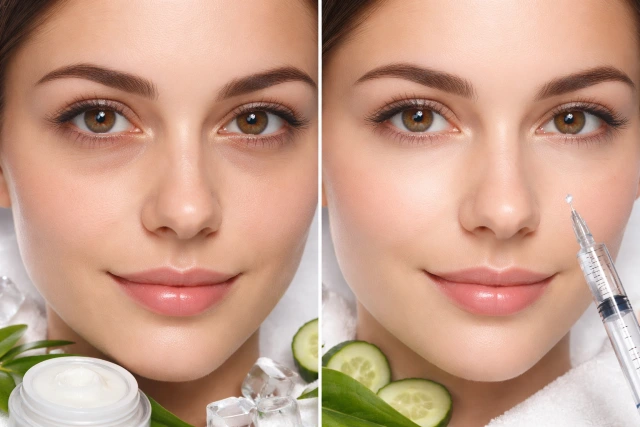
If you’ve ever looked in the mirror and thought, “Why do I look tired even when I’m not?”, you’re not alone. Under-eye hollows can cast shadows that read as dark circles, fatigue, or stress, even on your best days. That’s why Tear Trough Filler has become one of the most talked-about options for subtle, modern facial refresh. Done well, it doesn’t change your face. It simply softens the “tired” cues by smoothing the hollow and lightening the shadow.
- What is Tear Trough Filler?
- Why the “Before” Matters More Than the “After”
- Tear Trough Filler Before & After: What “Natural” Actually Looks Like
- Who Gets the Best Results?
- When Tear Trough Filler Might Not Be the Best Fit
- The Procedure: What Happens in the Chair?
- Needle vs Cannula: What’s the Difference?
- Before & After Timeline: What Changes and When?
- What Results Can You Realistically Expect?
- How Long Does Tear Trough Filler Last?
- A Quick Comparison Table: What Tear Trough Filler Helps vs Doesn’t
- Side Effects and Safety: What to Know (Without the Panic)
- How to Tell If “Before & After” Photos Are Honest
- A Real-World Scenario: What a Conservative Plan Looks Like
- Aftercare: What Clinics Commonly Advise
- Frequently Asked Questions
- The Bottom Line: A Good “After” Looks Like You, On a Great Day
- Conclusion
This guide walks you through realistic before and after expectations, how results evolve over time, what a natural outcome actually looks like, and how to avoid the most common pitfalls. The goal here is clarity, not hype, so you can understand the treatment like a well-informed patient.
What is Tear Trough Filler?
Tear Trough Filler is a technique where an injector places a small amount of dermal filler in the under-eye hollow (the “tear trough”), usually near the junction between the lower eyelid and upper cheek. The point isn’t to “inflate” the area. The point is to restore smooth transitions so light reflects more evenly, reducing the shadow that makes eyes look sunken or dark.
In many clinics, the most common product type for this area is a hyaluronic acid filler (often abbreviated HA) because it can be adjusted and, if necessary, dissolved. The under-eye is delicate, so product choice and placement matter a lot more here than in many other areas of the face.
Why the “Before” Matters More Than the “After”
Most disappointment with Tear Trough Filler isn’t because filler “doesn’t work.” It’s because the starting point (your anatomy and your under-eye issue) wasn’t correctly identified.
Before treatment, under-eye concerns usually fall into one of these buckets:
- True hollowing (volume loss): a dip that creates a shadow
- Pigmentation: brown or bluish tone in the skin itself
- Thin skin and visible vessels: veins show through, creating a blue cast
- Under-eye bags (fat prolapse): a bulge rather than a dip
- Skin laxity and crepey texture: more of a skin quality issue than volume
Tear Trough Filler is best at improving shadowing from volume-related hollows and certain contour irregularities. It’s not a direct fix for pigmentation, and it can be the wrong tool if prominent bags are the main issue.
Tear Trough Filler Before & After: What “Natural” Actually Looks Like
A natural-looking before and after usually means you still look like you, just more rested. The best outcomes are often subtle enough that people can’t tell what changed.
A natural result typically includes:
- A smoother transition between lower lid and cheek
- Less shadowing (often mistaken for “dark circles”)
- More even light reflection under the eye
- No obvious puffiness or “swollen” look
- No sharp edges or visible filler outline
A not-so-natural result usually shows up as:
- A puffy under-eye that wasn’t there before
- A “shelf” or ridge where filler sits too superficially
- A bluish-gray cast (often called the Tyndall effect)
- Lumpy texture that becomes noticeable in certain lighting
Because this area is unforgiving, small differences in technique can create big differences in appearance.
Who Gets the Best Results?
Most strong candidates for Tear Trough Filler share a few traits:
- Mild to moderate hollowing (not extreme)
- Relatively good skin quality in the lower eyelid
- Minimal under-eye bag prominence
- Realistic expectations for subtle improvement
- Willingness to prioritize safety and conservative dosing over dramatic change
Some people are still treatable even with more complex anatomy, but the injector’s plan becomes more nuanced and conservative.
When Tear Trough Filler Might Not Be the Best Fit
There are scenarios where Tear Trough Filler can be unpredictable or unsatisfying, especially when the core issue is not volume loss.
Common “caution” situations include:
- Significant under-eye bags (where puffiness is the main complaint)
- Very thin, crepey lower-lid skin
- Marked swelling tendency (fluid retention under eyes)
- Strong pigmentation as the main cause of dark circles
- Prior filler complications or unresolved lumps
In these cases, providers often consider other strategies (sometimes surgical, sometimes skin-focused) instead of pushing more filler into a high-risk area.
The Procedure: What Happens in the Chair?
A typical Tear Trough Filler appointment is fairly quick, but it’s detail-heavy.
Here’s what often happens:
- Assessment and photos: Many clinics take baseline photos to compare later.
- Marking and facial mapping: The injector identifies hollow depth, vessel patterns, and asymmetry.
- Cleansing and numbing: Some use topical numbing; many HA fillers also contain lidocaine.
- Placement: Product is placed either with a needle or blunt cannula, depending on technique and anatomy.
- Molding and review: Gentle shaping may be done, then the area is rechecked in different lighting.
- Aftercare instructions: Usually focused on minimizing bruising and swelling.
Because the under-eye region has complex anatomy, the injector’s experience matters. This is also why professional societies publish safety guidance and adverse-event management recommendations for injectable fillers.
Needle vs Cannula: What’s the Difference?
You’ll often hear injectors talk about needle and cannula techniques for Tear Trough Filler.
- Needle: precise placement, often used for small, controlled deposits
- Cannula: a blunt flexible tube, often used to place product with fewer entry points and potentially less bruising in some hands
Neither is automatically “better” for everyone. The best technique is the one your injector performs safely and consistently, with proper anatomical understanding and appropriate product choice.
Before & After Timeline: What Changes and When?
The “after” isn’t just one moment. Under-eye results evolve as swelling settles and the filler integrates.
Right after treatment (Day 0)
- Mild swelling is common
- The area may look slightly overcorrected at first
- Tiny bumps can appear temporarily, especially with superficial swelling
Days 1 to 3
- Swelling usually peaks within the first couple of days
- Bruising, if it happens, is often most visible here
- Some unevenness can appear temporarily as tissue reacts
Days 4 to 14
- Most swelling settles
- The under-eye contour looks more “real”
- Final shape becomes easier to judge
Weeks 2 to 4
- This is often when clinics evaluate whether a small refinement is needed
- Natural movement and light reflection look more stable
If you’re comparing photos, it helps to compare consistent lighting and angles. A “perfect” before photo with harsh overhead light can make hollows look deeper than they appear day-to-day, and a flattering after photo can exaggerate improvement. Consistency matters.
What Results Can You Realistically Expect?
For most people, Tear Trough Filler improves the shadowing effect rather than “erasing” the under-eye region.
Typical realistic outcomes:
- Softening of the hollow (often noticeable in photos)
- A less tired look
- Mild improvement in the appearance of dark circles if shadow is a major cause
- A smoother under-eye to cheek transition
Less realistic expectations:
- Completely removing genetically dark circles from pigmentation
- Tightening very loose skin
- Permanently fixing bags that are caused by fat prolapse
- Getting a dramatic “makeover” from a small filler placement
How Long Does Tear Trough Filler Last?
Longevity varies, but multiple studies and reviews commonly describe a range around 6 to 12 months for HA filler outcomes in this area, with some reports noting averages around 10 to 11 months.
Real life is messier than averages. Duration depends on:
- Product type and softness
- Placement depth and technique
- Your metabolism and facial movement patterns
- How much was used (overfilling isn’t the goal, but extremely tiny amounts may fade faster)
A Quick Comparison Table: What Tear Trough Filler Helps vs Doesn’t
| Concern | Can Tear Trough Filler Help? | Notes |
|---|---|---|
| Under-eye hollowing (volume loss) | Often yes | Usually the best indication |
| Shadow-related “dark circles” | Often yes | Shadow improves when contour smooths |
| Pigmentation (brown tone) | Usually limited | Skin tone issue, not volume |
| Visible veins (blue tone) | Sometimes | Can reduce shadow but not erase vessels |
| Under-eye bags | Sometimes not ideal | Bag-dominant cases need careful evaluation |
| Crepey texture | Limited | Often needs skin treatments, not volume |
Side Effects and Safety: What to Know (Without the Panic)
Most people worry about the scary headlines. It’s smarter to understand the real risk landscape.
Common, usually short-term effects include:
- Swelling
- Tenderness
- Bruising
- Redness
Authoritative overviews note that the majority of HA filler adverse events are mild and temporary, while serious complications are rare.
That said, the under-eye area is high-stakes because it’s close to important vessels. Rare but serious complications from injectable fillers can include vascular occlusion, which can lead to skin injury and, in extremely rare cases, vision-threatening events. Professional guidance documents emphasize prevention and rapid management protocols for these situations.
The takeaway is simple: Tear Trough Filler is not the place for bargain hunting or rushed work.
How to Tell If “Before & After” Photos Are Honest
Before-and-after galleries can be helpful, but they’re also easy to manipulate unintentionally.
When judging photos of Tear Trough Filler, look for:
- Same lighting (overhead vs front-lit changes everything)
- Same camera distance and lens
- Same facial expression (smiling changes under-eye contours)
- Same angle and head tilt
- No heavy makeup in the “after”
A subtle improvement in honest lighting is often a strong result.
A Real-World Scenario: What a Conservative Plan Looks Like
Imagine someone in their early 30s with mild hollows and a shadow that reads as dark circles. Skin quality is good, and there’s no significant bagging. A conservative Tear Trough Filler approach might involve a small amount placed strategically, then reassessed after swelling settles. The “after” looks like better sleep, not a different face.
Now imagine someone with prominent bags and thin lower-lid skin. If filler is placed too close to the skin surface, it can pull light in an odd way and create puffiness. In these cases, even “technically correct” filler can look wrong because the anatomy is fighting the plan. That’s why candidacy matters.
Aftercare: What Clinics Commonly Advise
Aftercare instructions vary by provider, but many clinics keep it simple and focused on minimizing swelling and bruising.
Commonly advised aftercare includes:
- Keeping the area clean and avoiding heavy rubbing
- Using cool compresses if swelling is present
- Avoiding strenuous activity for a short window
- Skipping alcohol around treatment time (often discussed due to bruising risk)
- Following your injector’s specific guidance if you have swelling tendencies
If something feels off, early communication with the clinic is part of safe care, especially in the first hours and days.
Frequently Asked Questions
Does Tear Trough Filler hurt?
Discomfort is usually described as mild to moderate. Many products contain lidocaine, and topical numbing may be used. Sensation also depends on technique (needle vs cannula) and personal sensitivity.
How much filler is used under the eyes?
Amounts are often small compared to other facial areas. Under-eye work is about precision, not volume.
Will Tear Trough Filler remove dark circles?
It can reduce dark-circle appearance when darkness is caused by shadowing from hollows. It’s less effective for pigment-based darkness, where the color comes from the skin rather than contour.
What is the Tyndall effect?
It’s a bluish-gray tint that can happen when HA filler sits too close to the surface under thin skin. It’s one reason conservative depth and product choice matter.
Is Tear Trough Filler reversible?
Many tear trough treatments use HA fillers, which can often be dissolved with hyaluronidase if needed. Reversibility is one reason HA is commonly chosen, though decisions depend on the case and clinician judgment.
How common are serious complications?
They’re considered rare, but they can occur with dermal fillers, including HA fillers. Reviews and safety guidance highlight vascular occlusion as a key serious risk and stress prevention and immediate management.
The Bottom Line: A Good “After” Looks Like You, On a Great Day
When Tear Trough Filler is planned well and placed conservatively, the before-and-after shift can be surprisingly powerful in a quiet way. You don’t look “filled.” You look more awake. Photos often show it clearly, but the best compliment is usually, “You look refreshed.”
A final note that’s worth repeating: this area rewards experience, subtlety, and anatomical respect. The popularity of injectable treatments continues to be huge, with millions of patients choosing hyaluronic acid fillers in recent procedural statistics reporting.
In the last step of understanding what’s going into the skin, it helps to know what the material actually is. The term hyaluronic acid gets used casually online, but it’s a real substance with specific properties that influence how fillers behave in delicate areas like the under-eye.
Conclusion
If your main under-eye issue is hollowing and shadow, Tear Trough Filler can be a precise, natural-looking way to soften that “tired” impression. The strongest results come from matching the treatment to the actual cause of the concern, then keeping the plan conservative. In other words, the best Tear Trough Filler outcomes are more about judgment than volume.