


When people talk about social change, they often imagine large institutions, big budgets, or sweeping government reforms. But Sonam Wangchuk’s Contributions to Social Causes show that lasting change can begin with something much simpler: a local problem, a practical idea, and the courage to challenge a broken system.
- Who Is Sonam Wangchuk and Why Does His Work Matter?
- The Real Meaning of Social Causes in Sonam Wangchuk’s Work
- Education Reform Was One of His Most Transformative Contributions
- Operation New Hope Showed How Community Reform Can Work
- His Climate Work Solved Human Problems, Not Just Environmental Ones
- HIAL Expanded the Vision Beyond Schooling
- Why His Work Inspires Real Change
- Key Contributions at a Glance
- Lessons Readers Can Take From His Example
- Common Questions Readers Ask
- Final Thoughts
In Ladakh, where geography, climate, and limited infrastructure create daily obstacles, Sonam Wangchuk built his work around real community needs. He did not focus on abstract theories. He focused on children who were failing in school because the system did not reflect their reality, villages struggling with water scarcity, and young people who needed education that could actually help them stay rooted while building a future. That is why Sonam Wangchuk’s Contributions to Social Causes continue to resonate far beyond Ladakh. They are grounded, humane, and deeply useful.
Who Is Sonam Wangchuk and Why Does His Work Matter?
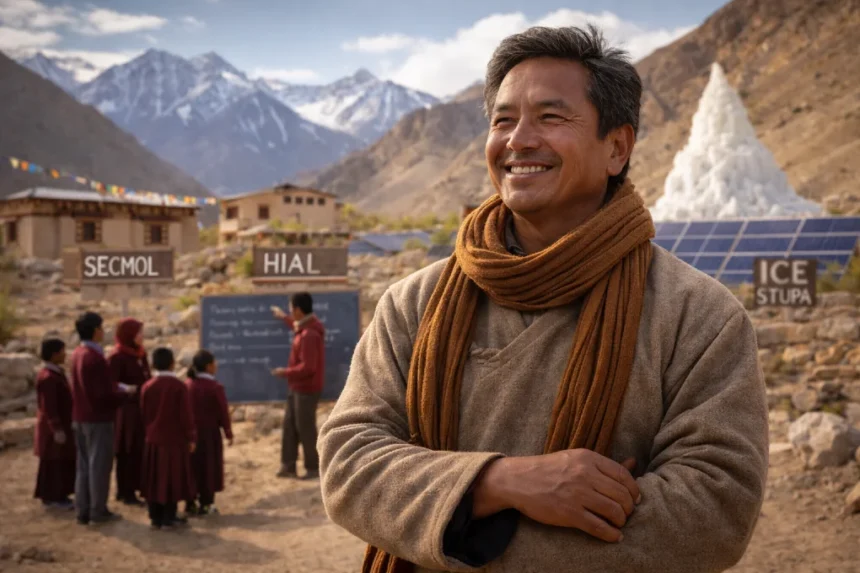
Sonam Wangchuk is widely known as an engineer, educator, innovator, and reformer from Ladakh. He is associated with the Students’ Educational and Cultural Movement of Ladakh, better known as SECMOL, and with the Himalayan Institute of Alternatives, Ladakh, or HIAL. Over the years, his work has connected education, sustainability, community participation, and local problem-solving in a way that few public figures manage to do consistently.
What makes his story powerful is not celebrity value. It is the method. He looks at a social problem, studies the local context, and then designs a solution that people can actually use. That is the heart of Sonam Wangchuk’s Contributions to Social Causes. He does not separate education from environment, or innovation from community welfare. He treats them as part of the same ecosystem.
The Real Meaning of Social Causes in Sonam Wangchuk’s Work
Many readers assume social work is limited to charity. In Wangchuk’s case, social causes mean something broader and more effective.
His work addresses:
- educational inequality
- climate resilience
- water security
- youth empowerment
- sustainable livelihoods
- culturally relevant learning
- community-led development
That is why Sonam Wangchuk’s Contributions to Social Causes stand out. He is not simply helping people cope with problems. He is redesigning systems so communities can solve those problems with dignity and skill.
Education Reform Was One of His Most Transformative Contributions
One of the strongest examples of Sonam Wangchuk’s Contributions to Social Causes is his long-standing work in education reform. SECMOL was founded in 1988 with the aim of reforming the educational system in Ladakh. The problem was serious. Many students were being labeled failures by a system that did not reflect their language, environment, or learning needs. SECMOL created an alternative path that valued practical learning, self-confidence, and local relevance.
This was not a cosmetic fix. It challenged the assumption that poor student performance automatically means weak students. In regions like Ladakh, the real issue was often an education model imported from elsewhere, delivered in ways that ignored local realities. Wangchuk’s response was simple but radical: build education around the learner’s world instead of forcing the learner to fit a distant model. That idea remains one of the most important parts of Sonam Wangchuk’s Contributions to Social Causes.
How SECMOL Changed the Conversation
SECMOL became known for doing what conventional systems often fail to do. It gave students who had struggled academically a chance to rebuild confidence and competence. Instead of treating exam failure as the end of the road, it treated it as a sign that the system needed reform. That approach helped reshape how many people think about rural education, especially in mountainous and underserved regions.
The SECMOL campus itself also matters. It reflects the same philosophy as the classroom. It is eco-friendly, rooted in local materials, and designed to model sustainable living rather than merely talk about it. This blend of learning and living is one reason Sonam Wangchuk’s Contributions to Social Causes feel practical instead of performative.
Operation New Hope Showed How Community Reform Can Work
Another major milestone in Sonam Wangchuk’s Contributions to Social Causes was Operation New Hope, launched in the 1990s as a collaborative effort involving government departments, civil society, and village communities. The goal was to improve the functioning of government schools in Ladakh, not through isolated activism, but through partnership and shared ownership.
This model matters because many social interventions fail when communities are treated as passive recipients. Operation New Hope took the opposite path. It recognized that real reform works better when teachers, families, administrators, and students all have a stake in the outcome. According to reporting and public accounts of Wangchuk’s work, Ladakh had once struggled with very high school failure rates, and reform efforts were designed to directly address that reality.
For readers looking for a lesson here, it is this: social change becomes stronger when a problem is shared, understood locally, and solved collectively. That lesson sits at the core of Sonam Wangchuk’s Contributions to Social Causes.
His Climate Work Solved Human Problems, Not Just Environmental Ones
It is easy to describe Wangchuk as an environmental innovator, but that label misses something important. His environmental work is really social work too. In cold desert regions like Ladakh, climate stress quickly becomes a human crisis. Water shortages affect farming, livelihoods, migration, and long-term community stability.
This is where the Ice Stupa project became so influential. The idea was to store unused winter water in cone-shaped ice formations that melt gradually in spring, when farmers need water the most. It was an innovative response to water scarcity, but it was also a social intervention because it addressed a direct community need. That is what makes the project one of the most visible examples of Sonam Wangchuk’s Contributions to Social Causes.
Why the Ice Stupa Became a Symbol of Real Change
The Ice Stupa gained attention because it was visually striking, but its deeper significance lies elsewhere. It showed that local knowledge, engineering, and community participation can create solutions that are both affordable and adaptable. It was not only about preserving water. It was about making communities more self-reliant in the face of climate change.
That is an important reminder for any reader interested in social impact. Innovation does not have to be high-tech in the flashy sense. Sometimes the most effective innovation is the one that responds to a local problem with precision, simplicity, and community ownership. That is exactly why Sonam Wangchuk’s Contributions to Social Causes continue to inspire educators, activists, and sustainability leaders.
HIAL Expanded the Vision Beyond Schooling
If SECMOL helped transform the way many people think about school education, HIAL expanded that vision into higher learning and future-ready development. HIAL promotes an education model built around the idea of Bright Head, Kind Heart, and Skilled Hands. That framework signals something important: knowledge should be intellectual, ethical, and practical at the same time.
This is another reason Sonam Wangchuk’s Contributions to Social Causes feel so relevant today. Across the world, there is growing frustration with education systems that produce degrees without practical capability or social purpose. HIAL responds to that problem by encouraging learning tied to real-world challenges, especially those affecting mountain communities and fragile ecosystems. Public reporting in late 2025 also noted that a parliamentary panel praised HIAL’s community-driven and experiential model, which shows that the institution’s social value is being recognized beyond Ladakh itself.
Why His Work Inspires Real Change
People are inspired by Wangchuk not only because he has good ideas, but because his ideas lead to visible outcomes. His work inspires real change for several reasons.
1. He solves root problems
He does not stop at symptoms. If students fail, he asks what is wrong with the school system. If farmers lack water, he asks how water can be stored differently. That root-cause approach makes Sonam Wangchuk’s Contributions to Social Causes more durable than short-term fixes.
2. He respects local context
His solutions are shaped by Ladakh’s climate, culture, language, and geography. This matters because imported solutions often fail when they ignore lived reality. Social change becomes stronger when people see themselves in the solution.
3. He combines science with empathy
Engineering alone does not create social impact. What makes Wangchuk’s projects meaningful is that technical ideas are always linked to human needs. That combination is one of the clearest strengths behind Sonam Wangchuk’s Contributions to Social Causes.
4. He builds institutions, not moments
Many public figures create attention. Fewer create systems that continue serving communities over time. SECMOL and HIAL are institutional examples of long-term commitment rather than one-time campaigns.
Key Contributions at a Glance
| Contribution Area | What He Did | Social Impact |
|---|---|---|
| Education reform | Helped build SECMOL and alternative learning models | Supported students failed by conventional systems |
| School improvement | Contributed to Operation New Hope | Encouraged community-led reform in government schools |
| Water innovation | Developed and popularized Ice Stupa ideas | Helped address seasonal water stress for local communities |
| Sustainable education | Helped shape HIAL | Linked higher learning with practical, local development |
| Eco-conscious living | Promoted passive solar and low-energy design | Showed that sustainability can be affordable and community-based |
The table above sums up why Sonam Wangchuk’s Contributions to Social Causes are often studied as a model of grassroots innovation. Each project connects social welfare with self-reliance instead of dependency.
Lessons Readers Can Take From His Example
There is a reason this story resonates with students, teachers, entrepreneurs, and community leaders alike. The lessons are practical.
- Start with a real local problem.
- Listen before designing a solution.
- Build with the community, not just for the community.
- Respect culture as an asset, not an obstacle.
- Treat sustainability as a social issue, not a branding exercise.
- Measure success by lives improved, not just attention gained.
These ideas help explain why Sonam Wangchuk’s Contributions to Social Causes feel relevant even outside Ladakh. The geography may be unique, but the principles travel well.
Common Questions Readers Ask
What are Sonam Wangchuk’s main social contributions?
His most recognized contributions include education reform through SECMOL, school improvement efforts linked to Operation New Hope, sustainable higher education through HIAL, and climate-responsive water innovation through the Ice Stupa initiative.
Why is his education work considered so important?
Because it challenged a system that failed many Ladakhi students and replaced blame with reform. His work showed that when education becomes culturally relevant and practical, student confidence and opportunity can expand dramatically.
How does his environmental work connect to social causes?
In Ladakh, water scarcity and climate stress directly affect people’s livelihoods. By designing solutions like Ice Stupas, Wangchuk linked environmental innovation with human welfare, agriculture, and community resilience.
Final Thoughts
At its best, social change is not loud. It is useful. It improves everyday life, restores dignity, and creates systems people can trust. That is exactly what makes Sonam Wangchuk’s Contributions to Social Causes so compelling. His work is not based on slogans. It is based on relevance, responsibility, and practical compassion.
What stands out most is that his ideas do not ask communities to become copies of somewhere else. They ask communities to become stronger versions of themselves. That is a very different vision of development, and perhaps a more sustainable one. In a time when many social problems are discussed endlessly but solved poorly, his example reminds us that real change often begins with listening carefully, designing honestly, and building locally. For readers interested in mountain innovation and regional resilience, even the broader story of Sonam Wangchuk reflects how one person’s grounded work can influence far more than one region.