



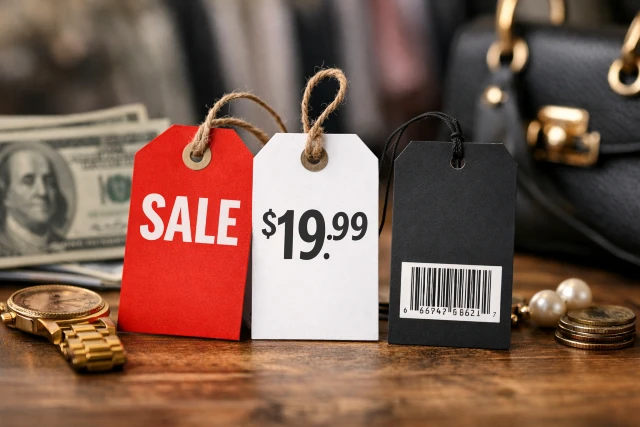
Walk into any store or scroll an online shop and you’ll see them everywhere: Price Tags. They look simple, but they carry a lot of information, and a surprising amount of persuasion. A tiny sticker or a small line of text can shape what you think something is worth, whether you trust a brand, and even how quickly you decide to buy.
- What a price tag really is (it’s not just a number)
- The psychology inside Price Tags
- What Price Tags reveal about value
- What Price Tags reveal about branding
- How Price Tags shape buying decisions in real life
- Price Tags are changing: digital labels and dynamic pricing
- How to read Price Tags like a smart buyer
- Common questions people ask about Price Tags (FAQ)
- Conclusion: treat Price Tags like information, not instructions
In this guide, we’re going to unpack what Price Tags really communicate. Not just the obvious “this costs $X,” but the hidden signals behind certain numbers, endings, fonts, placements, and discount styles. You’ll learn how brands use pricing to position themselves, how retailers nudge decisions, and how you can read Price Tags like a pro so your buying choices feel intentional instead of impulsive.
What a price tag really is (it’s not just a number)
At the surface level, Price Tags are a label for the cost. But in practice, they do at least four jobs at once:
- Set expectations: A price quickly tells you if an item is “budget,” “mid-range,” or “premium.”
- Signal quality: Higher prices often imply higher quality, even before you touch the product.
- Express the brand: Luxury brands use pricing as part of their identity, not just as math.
- Guide a decision: The number you see first can influence what feels “reasonable” afterward.
In other words, Price Tags function like a mini marketing message. They shape perception before you’ve made a logical comparison.
The psychology inside Price Tags
When you see a price, your brain doesn’t always do perfect arithmetic. It uses shortcuts. That’s not a flaw, it’s just how humans handle decisions quickly.
The left-digit effect (why 9.99 feels cheaper than 10.00)
One of the most famous pricing effects is how strongly the first digit matters. A price like 9.99 is often perceived closer to 9 than 10 because the brain anchors on the leftmost digit. Academic work on the left-digit effect shows this perception shift happens especially when the leftmost digits change (like 2.99 vs 3.00).
This is why Price Tags ending in .99 or .95 are everywhere, especially in mass retail. It’s not because sellers love pennies. It’s because buyers read the first digit first.
Anchoring (why the first price you see sticks)
Anchoring is when an initial number becomes a reference point, even if it’s not logically relevant. Behavioral research traces this to classic work in judgment and decision-making, where initial values bias later estimates.
In shopping, the anchor could be:
- The “original price” next to a sale price
- A more expensive model placed next to the one the store wants you to buy
- A premium tier in a pricing table that makes the middle tier feel “just right”
This matters because Price Tags rarely exist alone. They sit among comparisons.
Decoy pricing (how brands guide you to the option they prefer)
Ever notice three options where one seems clearly “bad,” and it conveniently makes another option look like a great deal? That’s decoy pricing. Research across service contexts discusses decoys as higher-priced alternatives designed to make the target choice appear better by comparison.
You see this a lot in:
- Coffee sizes
- Software subscriptions
- Streaming plans
- Restaurant menus
It’s not always “trickery,” but it is intentional design. Price Tags are part of the choice architecture.
What Price Tags reveal about value
Value is not the same as price, but price is one of the strongest signals we use to estimate value when we’re uncertain.
A quick way to decode value signals
Here’s a practical table to help you read what common Price Tags patterns often communicate:
| Price Tag Pattern | What It Often Signals | Where You Usually See It |
|---|---|---|
| Round numbers (10, 50, 100) | Confidence, simplicity, premium positioning | Luxury, services, high-end brands |
| 9-ending (9.99, 49.99) | Deal vibe, “lower than it looks” | Mass retail, ecommerce, supermarkets |
| “Was X, now Y” | Anchoring + urgency, pushes quick decisions | Sales events, fashion, electronics |
| “From $X” | Lowest possible entry point, can hide add-ons | Travel, subscriptions, services |
| Bundled price | Value framing through extras | Internet, software, accessories |
| Unit price shown | Transparency and comparison | Grocery, household goods |
None of these are guarantees. But Price Tags are designed to influence what you assume before you compare.
Unit pricing is the quiet hero
If there’s one feature that helps you make smarter decisions, it’s unit pricing (cost per kg, per liter, per item). It turns Price Tags from a persuasive message into a comparable metric.
A larger pack isn’t always cheaper per unit. And a “sale” isn’t always a better deal. Unit price exposes that quickly.
What Price Tags reveal about branding
Brands don’t just choose prices; they choose meaning.
Premium pricing is often a branding decision first
Luxury and premium brands use higher prices to:
- Signal exclusivity
- Control perception (premium equals “better” in many minds)
- Fund packaging, experience, and service
- Protect brand positioning (too cheap can damage the image)
So when you see Price Tags that feel “unreasonably high,” part of what you’re paying for is the brand story, scarcity, or experience. Whether that’s worth it depends on you.
Discounting can also be branding (and sometimes risky)
Discounts drive sales, but too many discounts can train customers to wait. In retail promotions data, price promotions can account for a large share of promoted revenue in certain categories and events.
Brands balance discounts carefully because the way Price Tags appear over time affects trust:
- Constant “50% off” looks suspicious
- Fake “original prices” create skepticism
- Clear, consistent discount rules build credibility
How Price Tags shape buying decisions in real life
Even if you’re a careful shopper, you’re still human. The label influences the moment.
Scenario 1: The “middle option” that suddenly feels perfect
You’re buying headphones:
- Basic: $29
- Standard: $59
- Pro: $119
Most people lean toward $59 because it feels like a reasonable compromise. If the store adds a “Plus” option at $99 with features that aren’t attractive, it can push more shoppers toward Pro or Standard depending on how the decoy is designed. That’s Price Tags doing decision steering.
Scenario 2: The “sale” that makes you buy faster
“Was $80, now $49” makes $49 feel like a win, even if $49 is still expensive relative to similar products. The “was” number becomes your anchor. Anchoring effects are well documented in decision research.
Scenario 3: The menu without currency signs
In restaurants, even how the price is presented changes spending. A Cornell study found diners spent about 8% more when menus did not include dollar signs.
That’s not because people forget math. It’s because presentation changes the feeling of paying, which changes behavior. Price Tags influence emotion, not just logic.
Price Tags are changing: digital labels and dynamic pricing
Traditional paper labels are increasingly being replaced by electronic shelf labels (often called digital shelf labels). Market research reports show the electronic shelf label market in the billions and growing quickly over the coming years, driven by retail automation and pricing accuracy.
Why retailers like digital Price Tags
Digital Price Tags can:
- Update prices instantly and centrally
- Reduce labeling labor
- Improve price accuracy (fewer mismatches at checkout)
- Enable smarter markdowns (like discounting items near expiry)
The concern: “Will prices surge in real time?”
People worry about surge-style pricing in grocery aisles. Reporting on digital shelf labels has noted these concerns, while also highlighting research findings that did not show significant price surges after adoption in one study and noting adoption rates still vary by region.
The key takeaway is this: Price Tags are becoming more flexible, and that makes transparency and regulation more important, not less.
How to read Price Tags like a smart buyer
Here are practical habits that work across groceries, tech, fashion, and services.
1) Compare the right metric, not the loudest number
Use:
- Unit price (per gram/liter)
- Cost per month (for subscriptions)
- Total cost of ownership (for devices: accessories, repairs, upgrades)
A low upfront price can hide long-term cost. Price Tags are often optimized to look good at first glance.
2) Don’t let “original price” do all the talking
Before trusting “was $X”:
- Search for the typical market price
- Check if the product is frequently “on sale”
- Look at past pricing if available
The goal is to replace the retailer’s anchor with a real-world anchor.
3) Watch for price endings and what they imply
- .99 often signals “deal” positioning (even when it isn’t a deal)
- Round numbers often signal premium and confidence
- Odd pricing is extremely common in retail advertising, with research documenting high prevalence of odd-ending prices in analyzed retail ads.
Don’t assume endings prove anything about quality. They’re a framing choice.
4) Treat bundles like math problems
Bundles can be fantastic or useless. Break them down:
- What items would you buy anyway?
- What’s the per-item cost?
- Are the extras lower-quality versions?
Some bundles are designed so Price Tags feel cheaper without truly being cheaper.
5) Set your own “walk-away” number in advance
This is simple and powerful:
- Decide your maximum price before browsing
- If you see a higher number, pause and reassess
- Don’t negotiate with yourself in the moment
It’s the easiest way to reduce impulse purchases driven by Price Tags.
Common questions people ask about Price Tags (FAQ)
Why do Price Tags often end in 9?
Because 9-ending prices can feel meaningfully lower than the next round number due to the left-digit effect, which has been demonstrated in pricing cognition research.
Are higher Price Tags always a sign of better quality?
Not always. Higher prices can reflect better materials or service, but they can also reflect branding, positioning, limited availability, or even inefficient costs. Price can signal quality, but it’s not proof.
Do digital Price Tags mean prices will change constantly?
Digital labels make price updates easier, which raises concerns. Reporting has highlighted both the skepticism and research suggesting no major surge-style hikes in studied settings, while adoption continues to expand.
How can I avoid being manipulated by Price Tags?
Focus on comparison metrics (unit price, cost per use), set a budget before browsing, and double-check “sale” anchors against typical market pricing.
Conclusion: treat Price Tags like information, not instructions
The best way to think about Price Tags is this: they’re not just a cost label, they’re a message. They can hint at quality, signal brand identity, and subtly steer your decision using psychology like anchoring, decoys, and number perception. Those effects are real, measurable, and widely used, from menu design to modern digital labeling.
The goal isn’t to become paranoid about every sticker. It’s to become fluent. When you understand how Price Tags frame value, you stop reacting automatically and start choosing intentionally. And once you’re aware of concepts like the anchoring effect, you’ll notice how often your “reasonable price” started with a number someone else chose for you.