



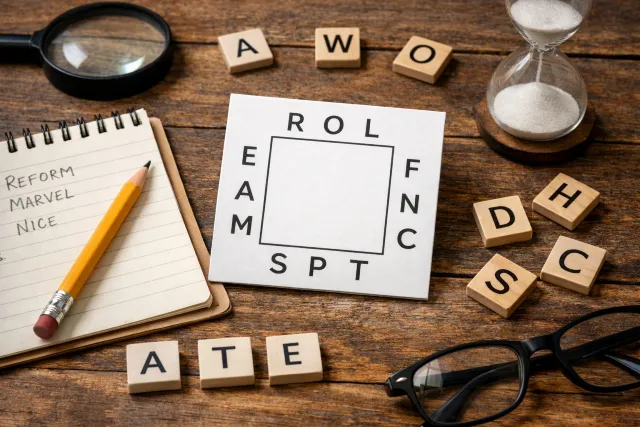
If you’ve ever opened the NYT Letter Boxed puzzle, stared at the square, and thought, “I know the words are in there somewhere,” you’re not alone. Letter Boxed Answers pages exist for one reason: to help you move from stuck to solved without turning the puzzle into a chore.
- What is Letter Boxed?
- Why people search for Letter Boxed Answers
- Letter Boxed Answers: how “today’s solution” is usually presented
- The fastest way to solve: think in bridges, not in words
- A realistic solving workflow you can use every day
- Strategy table: what to do when you’re stuck
- Example: how a Letter Boxed solution chain is built (not today’s puzzle)
- What counts as a “good” solution?
- Hints that actually help without spoiling
- When to use a solver (and how to keep it fun)
- Common mistakes that break Letter Boxed solutions
- FAQs about Letter Boxed Answers
- How to build a daily routine around Letter Boxed (without burnout)
- Conclusion
This guide is built for everyday players who want a clean routine: quick hints when you’re close, a clear explanation when you’re not, and a reliable way to understand why a solution works. You’ll learn how the puzzle is structured, what makes an answer valid, how to spot strong starter words, and how to finish with the “final word” that ties everything together.
Along the way, you’ll also see practical solving tactics, a worked example, and a simple checklist you can follow each day. If you came here looking for Letter Boxed Answers that actually help you improve (not just copy and paste), you’re in the right place.
What is Letter Boxed?
Letter Boxed is a daily word puzzle from The New York Times’ Games collection. You’re given a square with letters around the four sides. Your goal is to create a chain of words that uses every letter at least once.
A few core rules make it trickier than it looks:
- Words must be at least 3 letters long.
- You connect words by using the last letter of one word as the first letter of the next.
- You cannot use two letters from the same side of the square back-to-back.
- You must use all letters on the board across your word chain.
- Proper nouns and very obscure words are usually not accepted in the official game.
NYT’s games have become a major part of how people spend time with the brand, and the broader “daily puzzle” habit is very real. Reports have highlighted massive engagement across NYT Games overall, with billions of plays in a year across titles like Wordle and Connections, showing how popular this category has become.
Why people search for Letter Boxed Answers
Most players don’t want to “cheat.” They want to finish. There’s a difference.
When someone searches Letter Boxed Answers, they’re usually in one of these situations:
- They’ve found one good word but can’t connect it to anything else.
- They’re missing one or two letters and can’t see the bridge word.
- They want the best possible solution (often 2-word or 3-word).
- They want a hint that doesn’t spoil the entire puzzle.
- They’re building a daily habit and want to learn patterns.
The best Letter Boxed Answers content respects that. It gives a nudge first, then a full solution if needed, and it explains the logic so tomorrow’s puzzle feels easier.
Letter Boxed Answers: how “today’s solution” is usually presented
A well-structured Letter Boxed Answers post typically includes three layers. Think of it like a dimmer switch, not a light switch.
1) Light hints (no spoilers)
These help you keep ownership of the solve:
- A strong starter letter (or two)
- A common ending to look for (like “-ing,” “-tion,” “-er”)
- A reminder of a rule that might be blocking you (like same-side letters)
2) Guided hints (partial spoilers)
These are for when you’re close:
- One full word that’s likely in the chain
- The last letter you need to connect
- Which letters are still unused
3) Full answer and final word (complete spoilers)
This is the complete chain. Often the “final word” refers to the last word in the chain that completes coverage of all letters, or the finishing word that neatly closes the loop of remaining letters.
A lot of people prefer this layered approach because it keeps the puzzle fun. It also turns Letter Boxed Answers into a learning tool instead of a shortcut.
The fastest way to solve: think in bridges, not in words
Here’s the mindset shift that separates casual solvers from consistent solvers:
- Beginners hunt for “big words.”
- Strong solvers hunt for “bridge letters.”
In Letter Boxed, the hardest part is rarely finding a word. The hard part is finding a word that ends in the right letter and doesn’t break the side-to-side rule.
So instead of asking “What words can I make?” ask:
- “What letter do I need this word to end with so the next word can start?”
- “Which side am I stuck on?”
- “What unused letters are forcing my next move?”
This is exactly why good Letter Boxed Answers posts call out “unused letters.” That list is often the real hint.
A realistic solving workflow you can use every day
Use this daily routine before jumping to Letter Boxed Answers:
- Scan for obvious clusters
Look for common pairings you can form without violating the same-side rule. - Pick a starter that ends in a flexible letter
Letters like E, N, R, S, T, and D tend to connect easily. - Track unused letters early
Don’t wait until the end to remember you never used the awkward letters. - Switch to “bridge mode” when stuck
If you can’t move forward, stop generating words and start generating endings. - Aim for 3 words first, then optimize
Most puzzles can be solved in 3 to 5 words by normal players. Optimization is optional.
Strategy table: what to do when you’re stuck
| What’s happening | Likely cause | What to try next |
|---|---|---|
| You have one long word but can’t connect | Ending letter is “dead” | Find a shorter word that ends in E, N, R, S, or T |
| You keep breaking the same-side rule | You’re letter-pairing from one side | Force yourself to alternate sides, even if the word is shorter |
| You’re missing 1–2 letters near the end | Those letters are “rare bridges” | Build a word specifically to include the missing letter, even if it’s not elegant |
| Everything works except one connection | Start and end letters don’t match | Look for a “connector” word of 3–4 letters |
| You solved it but used many words | You solved greedily | Try to merge by finding a longer bridge word that covers multiple unused letters |
If you apply this once a day, you’ll notice something: you’ll need Letter Boxed Answers less often, and when you do use them, you’ll understand why the solution works.
Example: how a Letter Boxed solution chain is built (not today’s puzzle)
Let’s do a simple fictional example to show the method. This is just a teaching board, not the current NYT board.
Imagine the box letters are:
- Top: A, R, T
- Right: E, N, S
- Bottom: L, O, D
- Left: I, G, U
A solver might build a chain like this:
- TRAIL (T → R → A → I → L)
- LENDS (L → E → N → D → S)
- SUGAR (S → U → G → A → R)
Now check the rules:
- Each word is 3+ letters.
- Each new word starts with the last letter of the previous word (TRAIL ends with L, LENDS starts with L; LENDS ends with S, SUGAR starts with S).
- No same-side letters are used consecutively.
- Across the chain, every letter gets used at least once.
That last word, SUGAR, is the “final word” because it completes the coverage cleanly while obeying the connection rule.
This is how good Letter Boxed Answers are made: not by guessing randomly, but by intentionally using bridge letters to cover leftovers.
What counts as a “good” solution?
In most Letter Boxed discussions, “good” usually means one of these:
- A valid solution (any number of words, uses all letters)
- A short solution (often 2–3 words)
- An elegant solution (smooth connections, natural words)
- A learning-friendly solution (easy to understand and replicate)
Some guides note that the official experience generally rewards concise solving, but players vary: some chase the minimum words, others just want the daily win and the streak feeling.
Hints that actually help without spoiling
If you’re creating or reading Letter Boxed Answers, these hint types tend to be the most useful:
Hint type 1: “Unused letters” list
This is the best non-spoiler hint. If you know what you haven’t used, you know what your next word must include.
Hint type 2: “Start letter” suggestion
A gentle push like “Try starting with S or T” preserves the challenge while reducing the blank-page feeling.
Hint type 3: “One anchor word”
Giving a single strong word can unlock everything, especially if it ends in a friendly connector letter.
Hint type 4: “Connection letter”
Sometimes the whole puzzle is blocked by one connection like “… ends with N.” That’s often enough.
This layered approach is why readers keep coming back to Letter Boxed Answers pages instead of using a full solver immediately.
When to use a solver (and how to keep it fun)
Let’s be honest: some days the letter layout is just stubborn. Using Letter Boxed Answers doesn’t have to ruin the game if you use it intentionally:
- Try hints first.
- Only reveal one word, then go back to the puzzle.
- Use the full chain only after you’ve tried building your own version.
- After solving, replay the chain and notice which bridge did the heavy lifting.
That last step is where improvement happens.
Common mistakes that break Letter Boxed solutions
Even experienced players make these slip-ups:
- Using two letters from the same side in a row
It’s the most common rule violation. - Forgetting that every word must connect
The chain rule is strict: last letter becomes the next first letter. - Assuming a valid dictionary word will be accepted
NYT often rejects overly obscure entries. If the game refuses a word, try a more common alternative. - Saving the weird letters for last
This is how you end up needing an impossible final bridge.
If your Letter Boxed Answers attempt keeps failing, it’s usually one of these four.
FAQs about Letter Boxed Answers
Are Letter Boxed Answers always unique?
Not always. Many puzzles have multiple valid solutions. Some may be shorter, some may use more words. That’s why you’ll often see alternate solutions listed on strong Letter Boxed Answers pages.
Can you solve Letter Boxed in two words?
Sometimes, yes. Two-word solutions are possible when the letter set supports long, flexible words and the connection letter is easy. But they aren’t guaranteed every day.
Why did the game reject my word?
It’s usually because the word is a proper noun, too obscure, or not in the accepted word list for the game. In practice, sticking to common vocabulary works best.
Do word puzzles actually help your brain?
Research and expert commentary often connect mentally stimulating activities like puzzles, reading, and learning to better cognitive resilience over time. Coverage of recent findings has pointed to meaningful associations between lifelong cognitive engagement and reduced risk of cognitive decline.
How to build a daily routine around Letter Boxed (without burnout)
The secret to enjoying this game long-term is keeping the experience lightweight.
Try this simple 5-minute rhythm:
- Minute 1: Scan and pick a starter.
- Minute 2–3: Build a 2–3 word chain attempt.
- Minute 4: If stuck, check a hint (not the full Letter Boxed Answers chain).
- Minute 5: Finish or save it for later.
If you do this daily, your brain gets repetition without frustration. And you’ll start noticing patterns: which endings connect well, which letters usually act as bridges, and which “problem letters” show up again and again.
Conclusion
At their best, Letter Boxed Answers aren’t just a list of words. They’re a daily guide that helps you solve smarter: track unused letters, think in bridges, and use hints in layers so you keep the puzzle enjoyable.
If you want to improve quickly, focus on the process, not just the result. Use Letter Boxed Answers when you need a nudge, then spend 30 seconds reviewing what made the chain work. That small habit turns a daily puzzle into a real skill builder, and it’s the difference between “I got lucky” and “I’m getting good.”
In the end, this is the charm of word puzzles: they’re quick, satisfying, and surprisingly teachable when you approach them the right way.