


If you have ever picked up a puppet and instantly felt like a kid again, you are not alone. Hand Puppet Puppets have a funny way of pulling people into the moment, even if you swear you are “not creative.” The good news is that you do not need theater training, fancy voices, or a craft room full of supplies to get started.
- Why Hand Puppet Puppets are perfect for beginners
- The beginner mindset: simple beats perfect
- Quick setup: what you actually need
- How to control Hand Puppet Puppets without feeling awkward
- 10 easy characters beginners can master fast
- A simple table: beginner characters at a glance
- How to write a mini script that doesn’t feel scripted
- Voice tips that keep you from hurting your throat
- Movement tricks that instantly level up your puppet
- Real-world scenarios where beginners succeed fast
- Common beginner mistakes (and the easy fixes)
- Cleaning and care for Hand Puppet Puppets
- FAQs about Hand Puppet Puppets for beginners
- Conclusion: build your first cast and start playing
In fact, beginners often do best with simple characters that are easy to control and easy to perform. Once you learn a few basic moves and build a small “starter cast,” Hand Puppet Puppets become one of the quickest ways to create stories, teach kids, break the ice in a group, or just entertain your family on a slow evening.
This guide walks you through beginner-friendly characters you can master fast, how to build them, how to perform them, and how to keep your audience engaged without stressing yourself out.
Why Hand Puppet Puppets are perfect for beginners
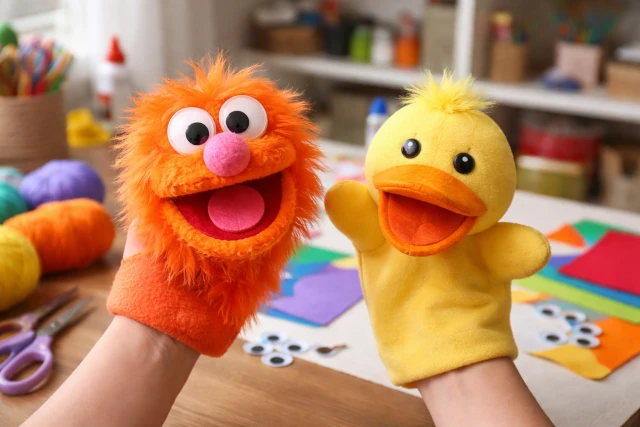
A hand puppet is basically a character you can “wear,” which makes performing feel natural. Your hand becomes the puppet’s mouth and head, and your arm becomes the body. That simple setup is why Hand Puppet Puppets are often used in homes, early learning, and classrooms.
Play itself has strong developmental value. The American Academy of Pediatrics highlights that play supports social emotional, cognitive, language, and self-regulation skills. UNICEF also notes that play is one of the most important ways young children gain essential knowledge and skills.
And puppets make play easier because:
- They give shy kids a “safe voice” through a character.
- They turn lessons into stories people remember.
- They reduce pressure on the performer because the puppet takes the spotlight.
The beginner mindset: simple beats perfect
Before we jump into characters, here is a truth that saves beginners: you do not need realism. You need clarity.
Your puppet should have:
- A clear personality (even one word helps: “curious,” “grumpy,” “brave”)
- A clear voice style (high, low, slow, excited)
- A clear movement pattern (big nods, tiny nods, bouncy, still)
When you keep those three things consistent, your audience will believe the character quickly. That consistency matters more than fancy materials.
Quick setup: what you actually need
You can start Hand Puppet Puppets with almost nothing. Here is a beginner kit that works for most people:
Materials (basic)
- An old sock or a simple glove puppet base
- Felt or paper for features
- Glue (hot glue if you are comfortable, otherwise craft glue)
- A marker for details
- Buttons or googly eyes (optional)
Tools (basic)
- Scissors
- A small piece of cardboard (for a mouth insert if you want one)
- Needle and thread (optional)
Beginner tip
If you are performing for kids, avoid loose parts that could come off easily (small buttons, beads) unless everything is firmly attached.
How to control Hand Puppet Puppets without feeling awkward
Most beginner frustration comes from movement. Here are the simple mechanics that make Hand Puppet Puppets look alive.
The “three-point” rule
- Mouth moves when speaking
- Head moves when thinking or reacting
- Body moves slightly with emotion
If you do all three at once, your puppet looks frantic. If you do none, it looks lifeless. Aim for one main movement at a time.
Eye line matters more than you think
Even if your puppet’s eyes are just dots, always “look” at:
- The person it’s talking to
- The object it’s holding
- The place it is going
That eye line is what makes Hand Puppet Puppets feel real.
Simple practice drill (2 minutes)
- Say: “Hi. My name is ___.”
- Pause. Look left. Look right.
- Say: “I have a secret.”
- Lean in slightly.
- Whisper one sentence.
Do this daily for a week and your confidence will jump.
10 easy characters beginners can master fast
Below are beginner-friendly characters for Hand Puppet Puppets that require simple shapes, simple voices, and simple movement.
1) The Friendly Dog
Why it’s easy: Dogs can be expressive without complicated dialogue.
How to build: Floppy felt ears, big nose, tongue.
How to perform: Lots of head tilts and quick reactions.
Starter lines:
- “Did you say snack?”
- “I can help. I am a very good helper.”
2) The Curious Cat
Why it’s easy: Curiosity drives scenes for you.
How to build: Triangle ears, whiskers, sleepy eyelids.
How to perform: Slow blinking, cautious steps, sudden surprise.
Beginner trick: let your cat “inspect” objects. Kids love it.
3) The Silly Monster
Why it’s easy: Monsters can be weird on purpose, so mistakes feel funny.
How to build: One big eye, zigzag teeth, bright color.
How to perform: Big mouth movements, dramatic gasps, goofy laughs.
This is one of the fastest wins in Hand Puppet Puppets because the character can be as wild as you want.
4) The Shy Bunny
Why it’s easy: Shy characters need fewer words, more reaction.
How to build: Long ears, small nose, gentle smile.
How to perform: Small movements, hiding behind “hands,” peeking out.
5) The Wise Owl
Why it’s easy: Owls speak slowly and thoughtfully.
How to build: Round eyes, beak, eyebrows.
How to perform: Slow nods, tiny head turns.
The owl is great when you want Hand Puppet Puppets for teaching and storytelling.
6) The “Oops” Robot
Why it’s easy: Robot voices are simple and fun.
How to build: Square shapes, “buttons” drawn with marker.
How to perform: Stiff movement, small repeated gestures.
Robot lines:
- “Processing… I made a mistake.”
- “New plan accepted.”
7) The Tiny Chef
Why it’s easy: Cooking scenes create instant plots.
How to build: Paper chef hat, apron.
How to perform: Stirring motions, tasting reactions, “too spicy” comedy.
This character works well if your blog audience overlaps with family food content, while still being centered on Hand Puppet Puppets.
8) The Brave Dinosaur
Why it’s easy: Dinosaurs are loud and confident, and kids already know them.
How to build: Spikes on the head, big teeth, tail suggestion.
How to perform: Big stomps (bounce your arm), heroic poses.
9) The Kind Teacher (or Helper)
Why it’s easy: This puppet can explain rules in a friendly way.
How to build: Simple hair shape, glasses (paper).
How to perform: Calm voice, gentle nods, pointing.
In classrooms and speech activities, puppets can support engagement and communication. Studies and reviews discuss puppets as pedagogical tools and their potential benefits in learning contexts.
10) The Mischievous Fairy (or Wizard)
Why it’s easy: Magic gives you endless scene options.
How to build: Small wand, star shapes, cape scrap.
How to perform: Quick “ta da” gestures, surprise reveals.
A simple table: beginner characters at a glance
| Character | Best for | Build difficulty | Performance difficulty |
|---|---|---|---|
| Friendly Dog | Family fun, quick laughs | Easy | Easy |
| Curious Cat | Interactive play | Easy | Easy |
| Silly Monster | Comedy, confidence building | Easy | Easy |
| Shy Bunny | Gentle stories | Easy | Medium |
| Wise Owl | Teaching moments | Medium | Easy |
| Oops Robot | Funny voice practice | Easy | Medium |
| Tiny Chef | Roleplay scenes | Medium | Medium |
| Brave Dinosaur | Energy and excitement | Medium | Easy |
| Kind Helper | Classroom style talk | Easy | Medium |
| Fairy or Wizard | Imagination, storytelling | Medium | Medium |
How to write a mini script that doesn’t feel scripted
A lot of beginners freeze because they think they need a full script. You do not. A “scene recipe” is enough.
Use this simple structure for Hand Puppet Puppets:
- The character wants something
- A small problem appears
- The character tries a solution
- It fails in a funny way
- A better solution appears
- The character learns something
Example (Dog puppet, 60 seconds):
- Wants a snack
- Snack is too high
- Tries jumping, fails
- Tries asking politely
- Gets help
- Learns: “Asking is smart”
Voice tips that keep you from hurting your throat
You can perform Hand Puppet Puppets for a long time if you avoid “strain voices.”
Try these safer voice styles:
- Pitch change (slightly higher or lower)
- Speed change (fast talker vs slow thinker)
- Texture change (whispery, breathy, nasal, but gentle)
- Catchphrase change (same words, different vibe)
Quick test: if your throat feels scratchy after one minute, soften the voice and rely more on rhythm and personality.
Movement tricks that instantly level up your puppet
These are small, high-impact habits:
Let the puppet breathe
Tiny up and down motion, especially before speaking.
Use “reaction beats”
After a sentence, pause and react silently for one second. That pause makes Hand Puppet Puppets feel like thinking characters, not moving props.
Make listening obvious
When another puppet or person speaks, turn slightly toward them and hold still. Listening is performance.
Real-world scenarios where beginners succeed fast
Scenario 1: A shy child won’t talk in a group
A puppet can act as the “messenger.” The child can whisper to the puppet, and the puppet “announces” it. This indirect participation often feels safer than speaking directly, and it aligns with how play supports communication and emotional comfort.
Scenario 2: A teacher needs attention without yelling
A puppet can do the reminders:
- “Hands to yourself”
- “Eyes on the board”
Because the message is coming from a character, it can feel less confrontational. Research and educator reports describe puppets as useful tools for engagement and behavior mediation in early years settings.
Scenario 3: Family wants screen-free fun after dinner
A two-puppet “mini show” can replace a scroll session. You do not need a stage. A couch back or table edge works.
Common beginner mistakes (and the easy fixes)
Mistake 1: Moving the mouth nonstop
Fix: Only move mouth on key words. Let pauses be still.
Mistake 2: Facing the puppet toward yourself
Fix: Angle the puppet toward the audience, not your hand.
Mistake 3: Trying to do five characters at once
Fix: Start with two strong characters. Build your cast slowly.
Mistake 4: Overexplaining the story
Fix: Let actions show the plot. Keep lines short.
Cleaning and care for Hand Puppet Puppets
If you are making or using Hand Puppet Puppets regularly, caring for them helps them last longer.
Basic care tips:
- Spot clean felt pieces with a damp cloth
- Air dry fully before storing
- Store in a breathable bag, not sealed plastic, to avoid odors
- If using washable sock puppets, wash gently and avoid high heat
If you use glued-on parts, heat can loosen adhesive, so keep them away from dryers when possible.
FAQs about Hand Puppet Puppets for beginners
How do I start if I feel embarrassed?
Start alone for five minutes. Practice one character and one scene recipe. Then perform for one person you trust. Confidence grows fast when the goal is “fun,” not “perfect.”
What is the easiest puppet base for a beginner?
A sock puppet is the simplest because it already fits your hand and can be customized quickly. A simple glove puppet also works well if you want separate finger movement.
Can puppets help kids learn language or social skills?
Play supports language and social development, and research links pretend play with language outcomes. Puppets are often used in educational settings as tools that can encourage participation and communication.
How long should a beginner puppet show be?
Aim for 2 to 5 minutes at first. Short shows keep energy high and reduce pressure on you.
Do I need different voices for every character?
Not at all. You can reuse your natural voice and change only speed, attitude, or a catchphrase. Most audiences notice personality more than vocal range.
Conclusion: build your first cast and start playing
The fastest way to get good at Hand Puppet Puppets is to stop waiting for the “right time” and start with the simplest character today. Pick one puppet, give it one personality trait, and try one tiny scene. That is it. After a few short practice sessions, you will notice something surprising: your hands move more naturally, your puppet reactions get funnier, and your confidence climbs without you forcing it.
Once you have two or three beginner characters, you can mix them into endless story combinations. That is the magic of Hand Puppet Puppets: small effort, big connection. And if you ever decide to go bigger, you can always level up into a mini puppet theatre setup at home.