


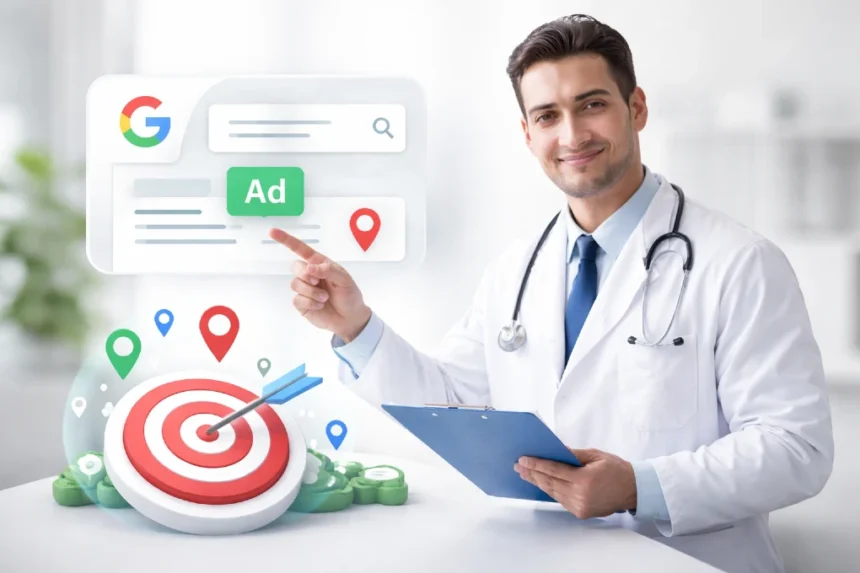
If your practice wants more local patient appointments, paid search and organic visibility should not operate as two separate marketing tracks. The smartest clinics build both around the same patient journey. That is exactly where a Google Ads for Doctors SEO Outline becomes valuable.
- Why doctors need a combined paid and organic strategy
- What a Google Ads for Doctors SEO Outline should accomplish
- Start with local patient search intent
- Build campaigns around services and locations
- Match every ad group to the right landing page
- Use location assets and your Google Business Profile strategically
- Write ad copy that sounds specific, local, and trustworthy
- Prioritize mobile and phone conversions
- Choose keywords carefully and use negative keywords aggressively
- Make local SEO pages support ad performance
- Stay compliant with healthcare advertising and privacy expectations
- Track the metrics that actually lead to appointments
- Real world example of how this works
- Common mistakes doctors should avoid
- Final thoughts
- FAQs
A strong Google Ads for Doctors SEO Outline helps doctors show up when local patients are actively searching for care, comparing providers, reading reviews, and deciding whether to call, book online, or keep looking. Instead of chasing clicks that never convert, you create a structured plan that aligns ad targeting, landing pages, local SEO, and appointment conversion paths.
For medical practices, that matters even more than it does for many other industries. Patients are not casually browsing. They are often searching with urgency, local intent, and a real need to trust what they see. Google’s own research has long shown that nearby mobile searches can drive quick offline action, while Google Ads location assets are designed to show address details, maps, and distance information that help people find a local business.
This article walks through a practical Google Ads for Doctors SEO Outline you can use to attract more qualified local patients, lower wasted spend, improve conversion rates, and support long term visibility for your practice.
Why doctors need a combined paid and organic strategy
Many practices make the same mistake. They run Google Ads without improving their local pages, or they invest in SEO while ignoring the fact that paid ads can capture high intent searches right now.
A better approach is to use a Google Ads for Doctors SEO Outline that connects both channels. Paid search gives you immediate visibility for services like urgent care, dental implants, dermatology consultations, family medicine visits, or physical therapy. SEO builds trust and long term discovery through service pages, location pages, review signals, and local relevance.
When those pieces work together, the result is stronger than either one alone.
Here is why this matters for local patient acquisition:
- Patients often search by condition, specialty, insurance, or location
- Many searches happen on mobile devices
- Calls and appointment requests are usually the real conversion goal
- Reviews, location details, and page quality directly influence trust
- Healthcare advertising must be handled carefully because of privacy and policy considerations
Google Ads also places specific rules on healthcare and medicines advertising, which means practices need to understand what can and cannot be promoted before launching campaigns.
What a Google Ads for Doctors SEO Outline should accomplish
A well built Google Ads for Doctors SEO Outline should do four things:
- Put your practice in front of nearby patients with strong intent
- Match ads to pages that answer the exact patient need
- Turn traffic into calls or booked appointments
- Build long term local authority so you rely less on paid traffic over time
That means your outline should not start with ad copy. It should start with business objectives and patient behavior.
Ask these questions first:
- Which services are most profitable or most in demand?
- Which locations matter most?
- Which appointment types convert best by phone versus online booking?
- Which searches show urgent intent, such as “same day doctor near me”?
- Which searches are research driven, such as “best pediatrician in Austin”?
Those answers shape your keyword targeting, content structure, landing pages, and budget priorities.
Start with local patient search intent
The foundation of any Google Ads for Doctors SEO Outline is search intent.
Doctors rarely win by targeting broad, expensive terms alone. Generic keywords often bring poor quality clicks, especially when the searcher is still in research mode. Instead, focus on intent layers.
High intent keywords
These usually have the best chance of producing appointments:
- family doctor near me
- dentist accepting new patients
- urgent care open now
- dermatologist in Chicago
- pediatrician near downtown Dallas
- orthopedic doctor same week appointment
Mid intent keywords
These support comparison and consideration:
- best ENT doctor in Phoenix
- back pain specialist near me
- women’s health clinic in Miami
- allergy doctor accepting insurance
Informational keywords that support SEO
These are less likely to convert directly through ads, but they matter for organic visibility:
- when to see a cardiologist
- signs of sleep apnea
- how much does a dermatology visit cost
- what does a sports medicine doctor treat
A good Google Ads for Doctors SEO Outline separates these intent types. Use paid ads for high intent local searches and use SEO content to capture research traffic and build trust before the patient is ready to book.
Build campaigns around services and locations
One of the most effective ways to structure a Google Ads for Doctors SEO Outline is by pairing service lines with location intent.
For example, a multispecialty clinic should not dump every keyword into one campaign. Separate campaigns or tightly themed ad groups make your ads more relevant and your landing pages more aligned.
Sample campaign structure
| Campaign Type | Example Focus | Primary Goal |
|---|---|---|
| Brand Campaign | Practice name, doctor name, clinic name | Defend branded searches |
| Service Campaign | urgent care, dental cleaning, skin cancer screening | Drive appointments |
| Location Campaign | doctor near Plano, clinic in Scottsdale | Capture local intent |
| Call Campaign | mobile users ready to call | Generate phone leads |
| Remarketing Support | return visitors who did not book | Recover lost conversions |
Google states that call ads are designed to encourage people to call a business directly from devices that can make phone calls. For medical practices that rely heavily on front desk scheduling, this can be especially useful.
Match every ad group to the right landing page
A Google Ads for Doctors SEO Outline fails when the click lands on a generic homepage.
Patients want confirmation that they found the right provider, in the right place, for the right service. Your landing pages should reflect that immediately.
Each core page should include:
- The service name in plain language
- The location served
- Doctor or provider credibility indicators
- Accepted insurance or payment information when relevant
- Clear appointment options
- Phone number above the fold
- Mobile friendly layout
- Local trust signals such as reviews, office photos, and map details
If your ad targets “pediatrician in Denver,” the landing page should not force the user to hunt for pediatrics or your Denver location.
This is where SEO and paid search reinforce each other. The same service and location pages that help you rank organically also improve ad relevance and Quality Score.
Use location assets and your Google Business Profile strategically
A strong Google Ads for Doctors SEO Outline should include Google Business Profile optimization, not just ad setup.
Google Ads location assets can display address information, a map, and even approximate travel distance. Google also notes that these assets can support store visit style measurement for eligible businesses.
For doctors, location visibility matters because patients often compare providers based on convenience, distance, and credibility.
Your local setup should include:
- A fully completed Google Business Profile
- Correct name, address, and phone number
- Accurate hours
- Service categories
- Appointment link
- Real office photos
- Ongoing review management
- Consistent information across your website and listings
Google’s Business Profile help documentation also confirms that verified businesses can read and reply to reviews, and Google explicitly prohibits offering incentives in exchange for reviews.
That means your review strategy should be ethical and systematic. Ask satisfied patients for feedback through approved channels, but do not buy or manipulate reviews.
Write ad copy that sounds specific, local, and trustworthy
A Google Ads for Doctors SEO Outline should never rely on vague healthcare copy like “quality care you can trust.” Nearly every clinic says that.
Instead, your ads should answer the patient’s unspoken questions:
- Do you treat my issue?
- Are you nearby?
- Are you accepting new patients?
- Can I call or book now?
- Why should I choose your practice?
Better ad copy angles for doctors
- Same week appointments available
- Board certified providers
- Convenient local office
- Online booking in minutes
- Most major insurance accepted
- Call now to schedule
- Family friendly clinic
- Open evenings or weekends, if true
Keep the copy accurate. In healthcare, trust is fragile. Overpromising creates friction, poor leads, and policy risk.
Prioritize mobile and phone conversions
A practical Google Ads for Doctors SEO Outline should be built for mobile first behavior.
Local healthcare searches are often immediate. A parent looking for a pediatric clinic, a patient needing urgent care, or someone trying to compare nearby specialists may act quickly if the path to contact is easy. Google’s research on nearby mobile searches supports the broader point that local intent often turns into fast offline action.
That means your pages should include:
- Tap to call buttons
- Simple booking forms
- Fast load times
- Clickable address and map links
- Clear insurance or payment info
- Minimal friction on mobile screens
If the page is slow, cluttered, or confusing, your ad spend gets wasted.
Choose keywords carefully and use negative keywords aggressively
Any serious Google Ads for Doctors SEO Outline needs keyword filtering, not just keyword expansion.
Medical advertising can become expensive fast if you attract informational clicks that do not lead to appointments. That is why negative keywords matter.
Examples of useful negative keywords
- free
- jobs
- salary
- school
- training
- definition
- symptoms only
- home remedy
- medical journal
- YouTube
You should also exclude services you do not provide. A family practice should not accidentally pay for searches related to cosmetic surgery, emergency trauma, or specialist procedures outside its scope.
This keeps your traffic relevant and protects your budget.
Make local SEO pages support ad performance
A Google Ads for Doctors SEO Outline works best when the website is built for local relevance.
Your highest value pages should usually include:
Core pages to create or improve
- Homepage with main location and specialties
- Individual service pages
- City or neighborhood location pages
- Doctor bio pages
- Insurance and payment page
- Appointment booking page
- FAQ pages for services and logistics
On page elements that matter
- Unique title tags
- Strong H1 and subheadings
- Local references that sound natural
- Structured internal links
- Fast mobile experience
- Clear conversion CTA
- Trust building content such as credentials, affiliations, and patient expectations
This is where the SEO side of your Google Ads for Doctors SEO Outline creates compounding value. Even if ad costs rise, your organic presence becomes stronger over time.
Stay compliant with healthcare advertising and privacy expectations
Compliance should be part of every Google Ads for Doctors SEO Outline from day one.
Google maintains healthcare and medicines policies that advertisers must follow, and some healthcare related products or services may be limited, restricted, or require certification depending on the market and offering.
Privacy is just as important. HHS has published guidance on online tracking technologies used by HIPAA covered entities and business associates, while also noting that part of its earlier guidance was vacated by a federal court in 2024 and that HHS is evaluating next steps. That is a reminder for medical practices to work with legal and compliance advisors before using tracking tools in ways that could expose sensitive health related data.
In practical terms, doctors should:
- Review ad and landing page claims carefully
- Avoid misleading language
- Be cautious with remarketing assumptions in sensitive contexts
- Verify how analytics, pixels, and form tracking are configured
- Involve legal or compliance review where appropriate
Marketing performance matters, but patient trust matters more.
Track the metrics that actually lead to appointments
A Google Ads for Doctors SEO Outline should be measured on appointment outcomes, not vanity metrics.
Clicks are not enough. Impressions are not enough. Even form submissions are not enough if they do not turn into visits.
Focus on metrics such as:
- Phone calls from ads
- Booked appointments
- Cost per booked appointment
- Conversion rate by service line
- Conversion rate by location
- Search terms that drive qualified leads
- Landing page bounce rate
- Repeat no show or low quality lead patterns
This helps you identify which specialties, neighborhoods, and messages deserve more budget.
Real world example of how this works
Imagine a dermatology clinic with two locations.
Before using a Google Ads for Doctors SEO Outline, the clinic runs one broad campaign targeting “dermatologist near me,” sends all traffic to the homepage, and gets inconsistent leads.
After restructuring, the clinic:
- Creates separate campaigns for acne treatment, skin cancer screening, and cosmetic dermatology
- Builds separate pages for each location
- Adds call focused mobile campaigns during front desk hours
- Uses location assets linked to its Business Profile
- Adds negative keywords for jobs, courses, and unrelated cosmetic searches
- Improves review collection processes within Google’s policies
- Expands SEO content around common patient questions
The result is usually not just more leads, but better leads. Patients know what service is offered, where the office is, and how to book before they click.
That is the real purpose of a Google Ads for Doctors SEO Outline. It creates alignment.
Common mistakes doctors should avoid
Even well intentioned practices often get these wrong:
- Sending all ad traffic to the homepage
- Using one campaign for every service
- Ignoring local landing pages
- Writing generic ad copy
- Forgetting negative keywords
- Running ads outside call handling hours
- Tracking clicks but not appointments
- Neglecting reviews and Business Profile updates
- Overlooking compliance concerns around healthcare advertising and data tracking
If you avoid those mistakes, your marketing becomes much easier to optimize.
Final thoughts
The best Google Ads for Doctors SEO Outline is not about getting more traffic for the sake of it. It is about building a local patient acquisition system that is clear, ethical, measurable, and easy to act on.
When your ads, landing pages, Business Profile, reviews, and local SEO all point in the same direction, patients get a better experience and your practice gets better results. That is how you move from random clicks to booked appointments.
In the end, local healthcare marketing works best when it reflects how real people search, compare, and choose care in their own city. For practices that want both short term lead flow and long term visibility, this balance of paid search and organic strategy is what makes the difference. For broader context on search advertising, it helps to remember that visibility alone is never the goal. Relevance, trust, and action are what turn local searches into real patient appointments.
FAQs
How long does it take for Google Ads to bring in patient leads?
Google Ads can start generating visibility and clicks quickly, but qualified patient lead flow depends on targeting, landing page quality, local trust signals, and conversion setup.
Is SEO still worth it if doctors are already using Google Ads?
Yes. SEO supports long term visibility, improves landing page relevance, and lowers your dependence on paid traffic over time.
Should doctors send traffic to the homepage?
Usually no. Service specific and location specific landing pages tend to perform better because they match patient intent more closely.
Are reviews important for local patient appointments?
Yes. Reviews influence trust, click behavior, and local visibility, but practices should follow Google’s rules and avoid incentivized review tactics.
Does every medical practice need call focused campaigns?
Not every practice, but many do. If your office books a large share of appointments by phone, call ads and mobile optimized pages can be highly effective.