


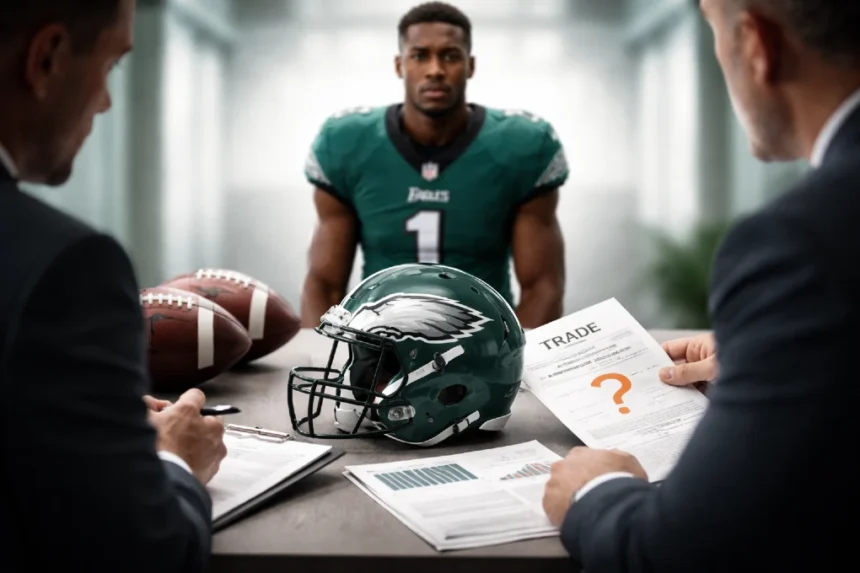
The phrase Eagles Rookie Trade Attempt has picked up traction because it captures something fans have come to expect from Philadelphia: a front office that is rarely passive. Even when there is no single blockbuster rookie-for-veteran swap to point to, the Eagles keep finding themselves at the center of trade conversations, roster recalculations, and draft-value debates. That alone tells you something about how the organization operates. Philadelphia is constantly looking for ways to improve the roster, protect future flexibility, and stay competitive now instead of waiting around for perfect conditions.
- Why the Eagles are always linked to trade talk
- What people usually mean by Eagles Rookie Trade Attempt
- The numbers behind Philadelphia’s aggressive approach
- Why this kind of move raises big questions
- The pro-Eagles case for making bold rookie-related moves
- The skeptical case against it
- What fans should actually watch next
- What this says about the Eagles in 2026
- Final thoughts
- FAQ
That is why the Eagles Rookie Trade Attempt angle matters. It is less about one dramatic headline and more about the larger pattern behind the headlines. This is a team that tied an NFL draft record with eight trades in a single draft, kept making aggressive moves at the 2025 trade deadline, added edge rusher Jaelan Phillips via trade, acquired veteran quarterback Andy Dalton this March, and just moved safety Sydney Brown in a pick-swap deal with Atlanta. When a franchise behaves like that year after year, every rookie-related rumor gets taken seriously because fans know the front office is always willing to test the market.
So what raised the big questions? It was the possibility that the Eagles could once again treat youth, rookie contracts, draft capital, and short-term need as movable pieces instead of fixed assets. For some fans, that is the mark of a sharp, modern front office. For others, it can feel like a team is always one move away from sacrificing long-term balance for immediate gain. Both reactions are understandable.
Why the Eagles are always linked to trade talk
The simplest explanation is Howie Roseman. Philadelphia’s general manager has built a reputation for attacking the roster from every angle. ESPN detailed how aggressive Roseman was ahead of the 2025 trade deadline, making multiple deals to strengthen the defense rather than sitting back and trusting internal development alone. That was not a one-off moment. It fits a broader philosophy that the roster should always be under review.
That matters in any discussion around an Eagles Rookie Trade Attempt because rookie players and rookie picks are among the most valuable assets in the NFL. They are cheaper than established veterans, they offer upside, and they can be used either as building blocks or trade chips. For a team that views every season as an opportunity window, those assets become part of a larger equation instead of untouchable pieces.
It also helps explain why even rumors around players who are no longer rookies, like Jalen Carter or Sydney Brown, still fit the same conversation. Carter was reportedly the subject of trade calls this month, while Brown was actually moved to Atlanta in a deal that included fourth- and sixth-round pick swaps. Those reports reinforce the idea that the Eagles will at least listen, evaluate, and calculate before deciding whether a player is more valuable on the roster or in a deal.
What people usually mean by Eagles Rookie Trade Attempt
The phrase itself is a little fuzzy, and that is important to be honest about. It is not the name of one official transaction listed by the league. Instead, it has become a catch-all phrase in online coverage and fan discussion for the Eagles’ willingness to consider trade paths involving young talent, rookie contracts, or draft-day maneuvering. Some coverage frames it around Jalen Carter trade interest, while other discussion treats it as a broader draft-day philosophy story.
That ambiguity is actually part of why the topic took off. Fans are reacting not just to one move, but to a style of roster management. The Eagles are seen as one of the few teams that can simultaneously believe in drafting well and still be open to moving young assets if a better opportunity appears.
The numbers behind Philadelphia’s aggressive approach
A quick look at recent Eagles behavior shows why people believe almost any trade rumor involving them could be real.
| Recent Eagles move or trend | What it shows |
|---|---|
| Tied NFL draft record with 8 trades | Draft assets are tools, not trophies |
| Multiple deadline deals in 2025 | Front office prioritizes active roster improvement |
| Traded for Jaelan Phillips | Will spend picks to address pass-rush needs |
| Acquired Andy Dalton in March 2026 | Still values veteran insurance and depth |
| Traded Sydney Brown to Atlanta | Young players can be moved if value lines up |
These are not random isolated events. Together, they show a front office that treats roster construction as an ongoing market exercise. If a rookie or recent draft pick can help a future deal, move up a board, or create flexibility elsewhere, the Eagles will at least consider it.
Why this kind of move raises big questions
The central debate around an Eagles Rookie Trade Attempt comes down to one tension: upside versus urgency.
Rookies are valuable because they are cheap and still developing. Teams that draft well can build a contender faster by getting real production from players on rookie contracts. The Eagles know this. At the same time, the franchise also knows that windows do not stay open forever. Veteran stars get older, contracts get more expensive, and depth can disappear fast in the NFL.
That creates several major questions.
Are the Eagles pushing too hard for the present?
When a team keeps looking for veteran help or tries to turn developing players into more immediate value, fans naturally ask whether the organization is getting too impatient. This concern is not irrational. The Eagles have already shown a willingness to move picks and reshuffle the roster when they believe a need exists.
But the counterargument is strong too. Philadelphia is not acting like a rebuilding team, because it is not one. A contender is supposed to think differently. If the roster is close enough to compete, using assets aggressively can be justified.
Is the front office undervaluing homegrown development?
Another concern is whether constant deal-making disrupts continuity. Young players need time, coaching, and roles that fit their strengths. If every promising player becomes a possible transaction piece, some fans worry the team may be less patient than it should be.
Sydney Brown is a useful example of why this debate is not simple. He showed promise early, including a 99-yard interception return as a rookie, but his performance later dipped after an Achilles injury and a difficult 2025 season. The Atlanta trade suggests Philadelphia believed the roster spot and draft return were more useful than waiting for a rebound. That may prove smart, but it also illustrates how quickly the team can pivot when development stalls.
Is this really about cap planning as much as football?
It often is. Roster decisions are never purely about talent. They are also about contract timing, positional value, and what comes next. NBC Sports noted that teams were calling about Jalen Carter while he remains under contract through 2026 with a fifth-year option available. Even when no move happens, the fact that calls exist tells you that value is being measured through both football and financial lenses.
For the Eagles, that balance matters because active contenders can become expensive in a hurry. A rookie contract is one of the best bargains in sports when the player performs. Trading or shopping around such value is always going to raise eyebrows.
The pro-Eagles case for making bold rookie-related moves
There is a strong argument that the Eagles are simply doing what smart franchises should do.
First, they understand market value. Teams that win consistently are often the ones that know when to hold, when to buy, and when to sell. The Eagles’ draft-day trade volume and deadline aggressiveness show a front office that does not romanticize roster building. It treats asset management as part of winning.
Second, they are not reckless just because they are active. The same front office that makes calls and entertains possibilities also knows when not to force a move. Reports around A.J. Brown this offseason underline that point. ESPN and other outlets have described trade conversations and outside interest, but no deal was imminent, and Roseman publicly emphasized how hard it is to trade great players. That suggests a team willing to engage, but not willing to panic.
Third, flexibility can protect a contender from getting stale. If a team becomes too attached to every draft pick or every young player, it can miss chances to upgrade the roster in real time. Philadelphia has shown it would rather risk criticism than drift into passivity.
The skeptical case against it
Still, there are legitimate reasons fans feel uneasy whenever an Eagles Rookie Trade Attempt becomes part of the news cycle.
One concern is that not every need should be solved by a deal. Sometimes the better move is to let a young player grow into a role, especially when injuries or scheme changes have complicated the evaluation. Moving on too quickly can turn a temporary slump into a long-term regret.
Another issue is cost accumulation. One trade can look smart on its own. Several trades across multiple windows can quietly reduce future flexibility. Yes, the Eagles still manage to keep draft capital in circulation, but repeated asset movement can create pressure later if several bets do not work out at once.
And finally, there is the human side. A roster is not just a spreadsheet. Young players notice how organizations treat draft picks, backups, and recent starters. If a team is always scanning for the next deal, it can send the message that security is temporary for almost everyone.
What fans should actually watch next
Instead of focusing only on rumors, the better question is what kind of patterns would confirm that the Eagles are still fully committed to this approach.
Watch for these signals:
- more pick-based maneuvering around the draft
- depth-player trades similar to the Sydney Brown deal
- position-group overhauls where youth is exchanged for certainty
- continued veteran additions even when the roster already looks stable
- public comments that emphasize value, flexibility, and competition
If those signs continue, then the phrase Eagles Rookie Trade Attempt will remain relevant even without one defining blockbuster transaction. It will keep describing the same thing: Philadelphia’s habit of treating every asset as movable if the right opportunity appears.
What this says about the Eagles in 2026
More than anything, this storyline says the Eagles still view themselves as a team that should act, not react. They are not waiting for the perfect off-season script. They are trying to shape it.
That posture can frustrate fans who want clearer long-term continuity, but it also explains why Philadelphia keeps showing up in league-wide conversations. Teams that sit still rarely dominate rumor cycles. Teams that constantly reevaluate their roster usually do.
And in truth, that is what makes the Eagles Rookie Trade Attempt conversation so compelling. It is really about identity. The Eagles see themselves as a franchise that can draft, trade, reload, and still stay competitive without choosing just one lane.
Final thoughts
The move that raised big questions was not only about whether one rookie, one recent draft pick, or one developing player might be traded. It was about whether the Eagles’ front office can keep pushing every possible edge without undermining the long-term structure that successful teams also need.
So far, the evidence suggests Philadelphia is comfortable living in that tension. The Eagles have tied a draft trade record, made repeated in-season and offseason deals, added veterans when they saw value, and moved younger pieces when the fit or return made sense. That does not guarantee every decision will age well. No front office gets that perfect. But it does confirm one thing: the Eagles are going to keep asking hard questions of their own roster before anyone else does.
For fans, that means the smartest way to read the next rumor is not to ask whether it sounds shocking. It is to ask whether it fits the pattern. In Philadelphia, that pattern has become part of the team’s modern front office identity.
FAQ
What does Eagles Rookie Trade Attempt mean?
It is not an official league transaction label. It is mostly a fan and media phrase used to describe Philadelphia’s willingness to explore deals involving rookies, recent draft picks, or rookie-contract assets.
Did the Eagles officially trade a rookie recently?
The clearest recent young-player deal was the trade that sent safety Sydney Brown to Atlanta in a pick swap. Brown was no longer a rookie, but the move reinforced the idea that Philadelphia is willing to move younger assets if the value makes sense.
Why are the Eagles always in trade rumors?
Because their front office has a documented pattern of aggressive roster management, including a record-tying draft trade volume and multiple recent trades for both veterans and pick repositioning.
Is this strategy good or risky?
It is both. It can help a contender stay flexible and improve faster, but it can also create concerns about patience, continuity, and long-term asset balance. That is exactly why the topic keeps drawing so much attention.