



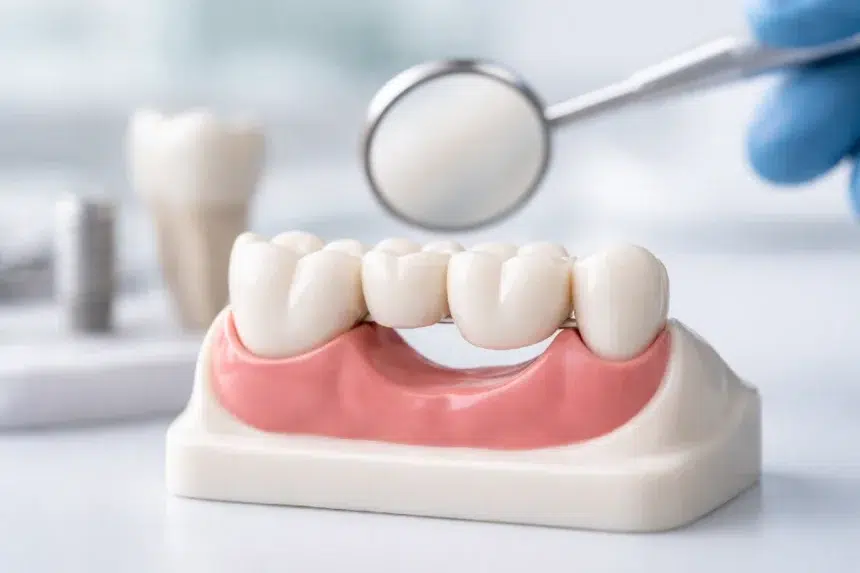
Losing a tooth changes more than your smile. It can affect how you chew, how clearly you speak, and how confident you feel in everyday conversations. That is why many people start looking at fixed replacement options as soon as a gap appears. One option your dentist may discuss is a Cantilever Bridge Dental restoration. It is not the right fit for every mouth, but in carefully selected cases, it can be a smart and practical solution.
- What Is a Cantilever Bridge Dental Restoration?
- How a Cantilever Bridge Dental Differs From Other Tooth Replacement Options
- Cantilever Bridge Dental Cost: What You Can Expect
- Benefits of Cantilever Bridge Dental Treatment
- Risks and Downsides You Should Understand
- Who a Cantilever Bridge Dental Works Best For
- Who Should Probably Look at Other Options
- What the Procedure Is Like
- How Long Does a Cantilever Bridge Dental Last?
- Caring for a Cantilever Bridge Dental Restoration
- Real World Decision Making: Is It Worth It?
- Conclusion
A Cantilever Bridge Dental treatment is a type of fixed bridge that uses support from a tooth on only one side of the gap. That design is what makes it different from a traditional bridge, which usually relies on support from teeth on both sides. Because the load is shared differently, case selection matters a lot. The success of a Cantilever Bridge Dental plan depends on bite forces, tooth position, gum health, and the strength of the supporting tooth.
For some patients, a Cantilever Bridge Dental option can restore appearance and function without the time, surgery, or cost that often comes with implants. For others, it may place too much pressure on one tooth and create future problems. The real value is in knowing where this treatment works well and where it does not.
What Is a Cantilever Bridge Dental Restoration?
A Cantilever Bridge Dental restoration is a fixed prosthetic tooth replacement that is anchored to one abutment tooth rather than two. In simple terms, the false tooth extends from a single supporting tooth, which is why dentists often describe it as “hanging over” the space. This is different from a standard bridge, where the replacement tooth is supported on both sides.
This design can be useful when there is a healthy tooth on one side of the gap but not on the other. That situation can happen in the front of the mouth more often than in the back, where biting pressure is usually stronger. Since a Cantilever Bridge Dental setup is not as strong as a traditional bridge, most dentists are cautious about where they place it.
How a Cantilever Bridge Dental Differs From Other Tooth Replacement Options
When people compare a Cantilever Bridge Dental restoration with other choices, they are usually deciding between three common treatments: a traditional bridge, a Maryland bridge, or a dental implant.
A traditional bridge is typically stronger because it is supported by teeth on both sides. A Maryland bridge is more conservative because it often uses bonded wings instead of full crowns, especially for front teeth. An implant usually lasts longer and helps preserve bone, but it involves surgery, healing time, and a higher upfront cost.
That means a Cantilever Bridge Dental treatment often sits in the middle. It is fixed in place, faster than an implant in many cases, and useful when anatomy or budget rules out other options. At the same time, it is more technique sensitive than many patients realize.
Cantilever Bridge Dental Cost: What You Can Expect
Cost is usually the first practical question, and it is a fair one. A Cantilever Bridge Dental restoration can vary widely in price because the final fee depends on several moving parts, not just the bridge itself.
According to Delta Dental, the average out of network cost for a three unit dental bridge is about $3,965, though bridge type, material, location, and insurance all affect the final amount. Since a Cantilever Bridge Dental case is still a fixed bridge, the same cost drivers apply, even if the exact fee may differ from a standard three unit bridge.
In the UK, bridges are included under NHS Band 3 treatment, which the NHS lists at £332.10 on its patient information page, though private alternatives and upgraded materials can cost more. That makes it clear why the answer to “How much does a Cantilever Bridge Dental treatment cost?” is always “It depends.”
Main factors that affect Cantilever Bridge Dental cost
- The material used, such as porcelain fused to metal, all ceramic, or zirconia
- The location of the missing tooth
- The condition of the supporting tooth
- Whether you need x rays, scans, build ups, or gum treatment first
- Local lab fees and your dentist’s experience
- Insurance coverage and annual maximums
- Whether you choose public or private treatment where both are available
Here is a quick cost snapshot:
| Cost factor | What it means for price |
|---|---|
| Material | Stronger or more aesthetic materials usually cost more |
| Prep work | Fillings, crowns, or root canal treatment can raise the total |
| Insurance | Bridges are often treated as major restorative care, so benefits may be limited |
| Location | Urban private clinics often charge more than smaller local practices |
| Complexity | Bite issues and cosmetic demands can increase lab and chair time |
Insurance can help, but patients should still read the fine print. Cigna notes that major restorative care often includes bridges, and plan maximums matter because once the annual cap is reached, the rest becomes out of pocket.
Benefits of Cantilever Bridge Dental Treatment
The biggest strength of a Cantilever Bridge Dental restoration is that it can solve a very specific problem in a simple way. If you have one healthy support tooth next to a small gap, this treatment may allow you to replace a missing tooth without surgery.
Another benefit is speed. A Cantilever Bridge Dental procedure is often completed in two appointments unless your dentist offers same day CAD/CAM fabrication. Compared with implant treatment, which may take several months because implants need time to integrate with bone, the turnaround is usually much faster.
It also improves daily function. Dental bridges can restore chewing, support clearer speech, and help stop nearby teeth from drifting into the empty space. Those practical gains matter just as much as appearance.
Why some patients like this option
- It is fixed and does not come out like a removable partial denture
- It can be completed faster than implant therapy
- It may cost less upfront than an implant based solution
- It can look natural when designed well
- It may work when there is support on only one side of the gap
Risks and Downsides You Should Understand
A Cantilever Bridge Dental restoration works by asking one tooth to carry forces that would ideally be shared more evenly. That is the central limitation. Because of that, dentists usually avoid using it in areas with very heavy chewing loads unless the case is especially favorable.
Technical and biologic complications are possible with tooth supported bridges. Reviews in the dental literature report issues such as loss of retention, decay around abutment teeth, bridge fracture, and stress on supporting tissues. With cantilevered designs, debonding and overload are important concerns, especially when case selection is poor.
There is also the irreversible part many patients overlook. To place a conventional Cantilever Bridge Dental restoration, the supporting tooth often needs to be reshaped so a crown can fit over it. Once enamel is removed, it does not grow back.
Possible drawbacks of a Cantilever Bridge Dental plan
- Extra force on one support tooth
- Risk of loosening or fracture over time
- Harder cleaning under the pontic area
- Possible decay or gum inflammation if hygiene slips
- Enamel removal from the abutment tooth in many cases
Who a Cantilever Bridge Dental Works Best For
This treatment is best for patients with a small gap, a healthy neighboring tooth on one side, stable gums, and a bite that does not overload the bridge. A Cantilever Bridge Dental restoration is often more suitable in selected front tooth situations than in back molar areas, where chewing pressure is higher.
It can also make sense for someone who wants a fixed option but is not ready for implant surgery, either because of budget, health history, bone limitations, or personal preference. In younger patients, especially where growth or future treatment planning matters, conservative cantilever resin bonded designs may also be considered in selected anterior cases.
A good candidate often has
- One missing tooth
- One strong adjacent support tooth
- Healthy gums and manageable bite forces
- Good brushing and flossing habits
- Realistic expectations about longevity and maintenance
Who Should Probably Look at Other Options
A Cantilever Bridge Dental restoration is usually a weaker choice when the missing tooth is in a high force chewing area, when the supporting tooth is already heavily restored, or when the patient has untreated gum disease, active decay, or strong grinding habits.
If two healthy teeth are available on both sides of the space, a traditional bridge may distribute force better. If preserving adjacent teeth is the priority and bone conditions allow, an implant may be the more durable long term option. Cleveland Clinic notes that implants generally last longer than bridges and also help preserve bone.
What the Procedure Is Like
The process for a Cantilever Bridge Dental restoration is usually straightforward. At the first visit, the dentist numbs the area, reshapes the support tooth if needed, takes impressions or scans, and places a temporary bridge. The final bridge is often fitted at a second visit after the lab completes the restoration.
Some clinics use digital systems to design and mill restorations in house, which can shorten the timeline. Still, fit, bite balance, and polish matter more than speed. A beautiful bridge that is even slightly high in the bite can fail early.
How Long Does a Cantilever Bridge Dental Last?
A dental bridge often lasts 5 to 15 years, and sometimes longer with good care. That range comes from patient factors as much as the bridge itself. Daily hygiene, diet, grinding habits, gum health, and regular dental reviews all affect longevity.
A Cantilever Bridge Dental restoration can last well when placed in the right case, but it is not something to treat casually. Long term success depends on keeping the supporting tooth healthy and controlling the forces placed on it.
Caring for a Cantilever Bridge Dental Restoration
If you want your Cantilever Bridge Dental work to last, home care has to be part of the plan. You need to clean not only the visible crown area but also under the false tooth where plaque can build up.
Helpful habits include:
- Brush twice a day with fluoride toothpaste
- Clean under the bridge daily with floss threaders or interdental brushes
- Avoid chewing ice and very hard foods
- Wear a night guard if you grind your teeth
- Keep regular checkups and hygiene visits
Real World Decision Making: Is It Worth It?
A Cantilever Bridge Dental option is worth considering when the case is small, the support tooth is strong, and you want a fixed restoration without surgery. It is often a smarter treatment for the right person than a more expensive option chosen for the wrong reasons.
But “worth it” should never be based on price alone. The best decision balances cost, bite forces, appearance, future maintenance, and how much tooth structure needs to be altered. A lower upfront fee is not always the better deal if the abutment tooth is overloaded and fails early.
In the end, the best conversations happen chairside. Your dentist can test the bite, examine the support tooth, review x rays, and tell you whether a Cantilever Bridge Dental restoration is a smart fit or just a tempting shortcut. If you want more background on fixed tooth replacement, a brief overview of fixed prosthodontics can also help you understand where this treatment sits among other restorative options.
Conclusion
A Cantilever Bridge Dental restoration can be a very good solution when there is support on only one side of a missing tooth and the bite is favorable. It offers a fixed, natural looking replacement that is usually faster than implant treatment and may cost less upfront. At the same time, it is not the most forgiving design, and that is why careful case selection matters so much.
If your goals are simple, the support tooth is healthy, and your dentist confirms that the area is suitable, a Cantilever Bridge Dental treatment can restore function and appearance very effectively. If the case is high stress or the support tooth is questionable, another option may protect your mouth better in the long run. The right answer is not the same for everyone, and that is exactly why personalized planning matters.