
If your schedule is packed and your wash day already feels like a part-time job, you’re not alone. 4B Hair can be stunningly versatile, but it also tends to thrive when you stop “doing the most” every single morning. That’s where low-manipulation styling comes in.
- What “low-manipulation” really means for 4B Hair
- The “busy-week” prep that makes any style easier
- 21 low-manipulation styles for busy weeks
- Twist-based styles (easy, protective, and super flexible)
- Bun and updo styles (sleek without the struggle)
- Puff and pony styles (fast, but watch the tension)
- Braided looks (neat and long-lasting, keep them gentle)
- Wash-day set styles (do once, refresh lightly)
- Accessories that count as styles (because life is busy)
- How to keep styles neat all week (without redoing everything)
- Common questions people ask about 4B Hair styling
- Real-world styling scenarios (because this is real life)
- Conclusion
Low manipulation basically means fewer daily touch-ups, less tugging, and less friction. You still get cute, polished looks, just without constantly re-brushing, re-parting, re-gelling, and re-stressing your strands. And because tight styles and repeated tension can contribute to issues like traction alopecia, choosing gentler options matters for long-term scalp health.
In this guide, I’m giving you 21 low-manipulation styles that work beautifully for busy weeks, plus practical tips to make them last, keep them neat, and protect your edges.
What “low-manipulation” really means for 4B Hair
With 4B Hair, the goal isn’t perfection. It’s consistency. A low-manipulation style usually checks most of these boxes:
- Minimal daily combing or brushing
- Low tension on hairline and crown
- Hair is stretched, tucked, or contained (to reduce tangles)
- Works for 2 to 7 days with small refreshes
- Doesn’t require heat every time you restyle
If a style makes your scalp feel sore or gives you bumps along the hairline, that’s your body telling you the tension is too high. Dermatology literature flags tight, prolonged styles as risk factors for traction alopecia, especially when repeated over time.
The “busy-week” prep that makes any style easier
Before we jump into the looks, here’s what makes styles last longer on 4B Hair without extra work.
Quick prep checklist
- Detangle gently in sections (fingers first, then wide-tooth comb if needed)
- Use a slip product (conditioner or detangler) so you’re not ripping through knots
- Add moisture, then seal lightly (cream plus a little oil if your hair likes it)
- Let hair dry or stretch before heavy styling to reduce shrinkage tangles
Afro-textured hair has structural features that can make it more prone to dryness and breakage, so moisture plus gentle handling makes a real difference.
The two product categories that matter most
You don’t need a 12-step routine. For most people, these two do the heavy lifting:
- Hydration + slip: leave-in, moisturizing conditioner, detangler
- Hold + protection: mousse, foam, light gel, edge control (used sparingly)
21 low-manipulation styles for busy weeks
Below are options you can rotate through, depending on your length, density, and comfort level.
At-a-glance style guide
| Style | Time to do | How long it lasts | Tension risk | Best for |
|---|---|---|---|---|
| Mini twists | 1 to 2 hrs | 5 to 10 days | Low | Moisture retention + versatility |
| Flat twists | 20 to 40 min | 3 to 7 days | Low | Quick, neat, edge-friendly |
| Low puff | 5 to 10 min | 1 to 3 days | Medium | Fast styling with minimal product |
| Claw-clip updo | 2 to 5 min | 1 to 2 days | Low | Zero-gel days |
| Headwrap style | 2 to 6 min | 1 day | Low | Protective, chic, instant |
| Pineapple with scarf | 3 to 6 min | Overnight to 2 days | Low | Preserves curls and reduces friction |
Now let’s get into the full list.
Twist-based styles (easy, protective, and super flexible)
1) Mini twists
Mini twists are one of the best “set it and forget it” styles for 4B Hair. They reduce tangling, keep ends tucked, and can be worn as-is or styled into updos.
Make it last:
- Twist on damp, moisturized hair
- Don’t make parts razor-sharp (clean, yes; stressful, no)
- Refresh the perimeter only if needed
2) Medium two-strand twists
Same benefits as mini twists, just faster to install and easier to take down.
3) Flat twists straight back
Perfect for work weeks because they look neat with minimal effort.
Tip: Keep them slightly looser around the hairline to protect edges.
4) Flat twist crown
A halo-style flat twist keeps hair off your face and looks intentional even when you’re tired.
5) Twist-out “banded” at night
Do a twist-out once, then protect it nightly with a few loose bands or chunky twists to keep definition longer.
Bun and updo styles (sleek without the struggle)
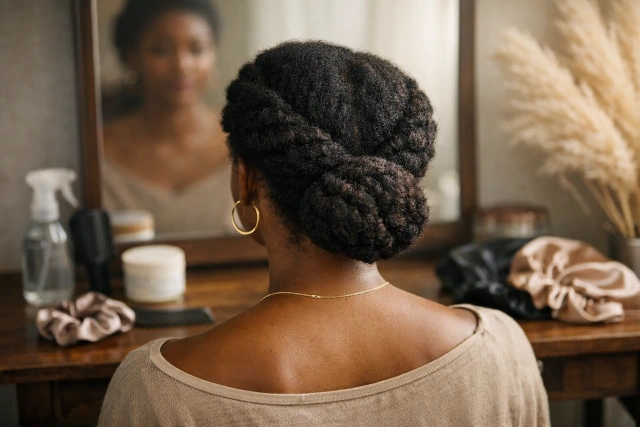
6) Low tucked bun
This is a classic: smooth the sides gently, gather hair at the nape, tuck ends in.
Low-manipulation upgrades:
- Use a soft scrunchie, not a tight elastic
- Avoid slicking with heavy gel daily; re-smooth with water and a little conditioner
7) High bun with puff base
If your hair is medium to long, a high bun can be quick and cute.
Keep it low tension:
- Use a stretchy band and stop when it feels snug, not tight
- If you feel pulling, redo it immediately
8) Double buns
Two buns look playful but still polished. Great for keeping ends tucked without a ton of product.
9) Claw-clip twist updo
Twist your hair upward, clamp with a large claw clip, and let ends fan out or tuck.
Why it works for 4B Hair: minimal pulling, minimal gel, minimal drama.
10) French pin or hair stick bun
If you want something elegant for office days, this gives “put together” in under five minutes once you learn it.
Puff and pony styles (fast, but watch the tension)
11) Low puff
The low puff is a busy-week hero, especially if you’re stretching your wash day.
Tension check:
- You should be able to slide a finger under the band easily
- Alternate placement so the same area isn’t stressed repeatedly
12) High puff with scarf base
Use a scarf tied around the perimeter to guide hair upward without yanking.
13) Side puff
A side puff is an instant style change with the same base. Great for midweek variety.
14) Bubble pony (low or mid)
Create one ponytail, then add soft bands down the length for a “bubble” effect. It’s cute and keeps hair contained.
Braided looks (neat and long-lasting, keep them gentle)
15) Chunky plaits
Braid hair in 6 to 10 big sections. Wear them down or pin them into a bun.
16) Crown braid using chunky sections
You don’t need tiny feed-ins for a crown braid look. Big sections keep it quick and reduce tension.
17) Loose, knotless-inspired perimeter braids
If you braid often, consider looser installs and avoid making the hairline too tight. Dermatologists often recommend reducing tension and taking breaks when hairline stress is frequent.
Wash-day set styles (do once, refresh lightly)
18) Wash-and-go with controlled sections
Yes, 4B Hair can do a wash-and-go, but the trick is controlled sections and realistic expectations.
To make it low manipulation:
- Style in sections
- Sleep with a bonnet or scarf
- Refresh by misting and smoothing, not re-raking daily
19) Flexi-rod or perm-rod set (no daily heat)
If you want stretched curls without daily heat styling, rod sets can last several days with light maintenance.
20) Braid-out with chunky braids
Braid hair in medium-to-large sections, let it dry, and unravel. The key is not over-fluffing. Fluff once, then protect at night.
Accessories that count as styles (because life is busy)
21) Headwrap, scarf, or turban style
This is not “giving up.” It’s smart. Headwraps protect hair from friction, wind, and constant touching, and they look amazing.
Bonus: A wrap can hide a style that’s past its prime while still protecting your ends.
How to keep styles neat all week (without redoing everything)
Sleep protection matters more than people admit
Night friction and repeated rubbing can weaken strands over time. Many dermatologists and hair-care educators emphasize protecting hair during sleep to reduce damage and preserve styles.
Try one:
- Satin or silk bonnet
- Satin scarf
- Satin pillowcase (backup option if bonnets slip)
The 5-minute morning refresh
Keep a spray bottle mix:
- Water
- A little leave-in or conditioner
Then:
- Mist lightly (do not soak)
- Smooth with palms
- Re-tie scarf for 5 minutes while you get dressed
- Fluff gently only where needed
Edge care that actually protects edges
Edges don’t need daily slicking. If you style edges, do it lightly and give them rest days.
Edge-safe habits:
- Use minimal product
- Avoid hard brushing
- Skip tight bands
- Rotate styles and parting
Repeated tension is one of the big avoidable causes of traction-related thinning.
Common questions people ask about 4B Hair styling
How long should I keep a low-manipulation style in?
Most styles can stay 3 to 7 days comfortably if they’re clean and not too tight. Mini twists and similar protective sets can often go longer, but listen to your scalp. If it itches, feels sore, or gets heavily matted, it’s time to reset.
Are protective styles always “protective”?
Only if the tension is low and your hair is moisturized underneath. Tight installs, heavy extensions, and long wear without cleansing can backfire for scalp health.
What’s the easiest style for a truly chaotic week?
For many people with 4B Hair, the easiest rotation is:
- Day 1 to 3: low puff or claw-clip updo
- Day 4 to 7: flat twists or chunky plaits
That combo keeps manipulation low and saves time.
Real-world styling scenarios (because this is real life)
Scenario 1: You have 10 minutes before work
Go with:
- Low puff or side puff
- Claw-clip updo
- Headwrap style
Scenario 2: Your hair is dry but you can’t wash today
Choose a style that needs minimal product:
- Chunky twists
- Chunky plaits
- Low tucked bun with a light mist and cream
Scenario 3: You want a style that lasts through workouts
Try:
- Flat twists
- Mini twists
- Low bun
- Headwrap post-gym
And remember: scalp health is part of hair growth. If you’re dealing with ongoing shedding or thinning, it can also be worth checking basic health factors with a clinician, since nutrition and deficiencies sometimes play a role in certain hair-loss patterns.
Conclusion
The best low-manipulation routine is the one you can repeat without burnout. When you choose styles that reduce daily pulling and keep your ends protected, 4B Hair often rewards you with better retention, fewer tangles, and way less morning stress. Rotate a few go-to looks, keep tension low, protect your hair at night, and treat your scalp like it matters, because it does. Over time, those small choices add up, and your hair starts feeling easier to manage because it’s not constantly being asked to “perform.”
If you ever feel stuck, go back to basics: moisture, gentle handling, and simple styles that work with your natural hair texture instead of fighting it.